
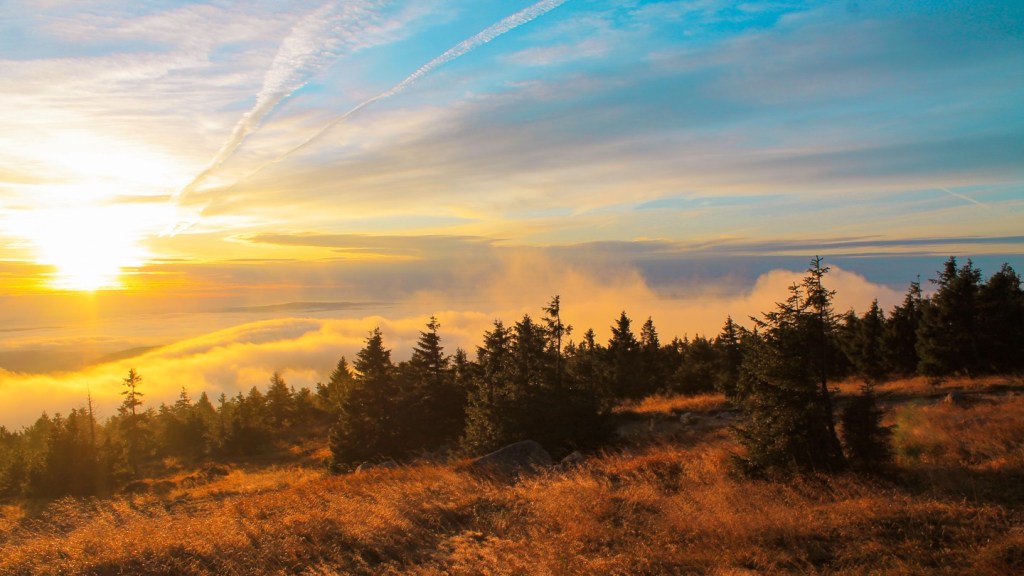
On a sunny autumn day I set out from Göttingen with my rucksack and a copy of Heinrich Heine’s Harzreise in my hand. The aim was to follow his walk through the Harz mountains, almost exactly two hundred years later, to see what had changed and what remained the same…
24th September
On Weender Straße, in the centre of Göttingen, the past and the present jostle for attention. The pedestrianised street is bathed in afternoon sunshine, the cafe terraces crowded for as long as the soft light falls on them. My walk begins tomorrow, but for now I am in search of ghosts. Not only Heine, but all the other writers and thinkers who passed through this university town. Plaques on the facades of houses show where they lived. Heine at Weender Straße 50, in 1825. A few doors down I spy Samuel Taylor Coleridge. He called the street home in 1799. The English Romantics liked their long walks in German forests too.
In a small bar the three regulars discuss football and politics while I flick through my book and nurse a beer. The landlord asks me what I am reading and I show it to him. He smiles at the illustration of a student party from 1820. One figure is perched on a table while another hands his head out of a window to vomit.
‘Cool party,’ the landlord says, and then laughs when I read him aloud Heine’s assessment of Göttingen.
The number of philistines in Göttingen must be very great, like the sands, or rather the mud, of the sea; truly, when I used to see them in the mornings, planted outside the gates of the academic court, with their dirty faces and clean accounts, I wondered how God could have created such a pack of scoundrels…
25th September
Light drizzle falls as I leave Göttingen via the Platz der Synagogue, where the synagogue stood until Kristallnacht in 1938. In Corrado Cagli’s sunken memorial, 282 names are carved into bronze plaques, each belonging to a Jewish person from Göttingen murdered by the Nazis. I stop long enough to read them all, thinking of Daša Drndić’s novel Trieste and its 42 pages listing 9,000 names. Each collection of letters represents a life, and Drndić makes you read them all.
In Weende I follow a footpath between back gardens and a stream that marks the edge of town. On the other side of the water lies a sloping field offering views across the Leine valley. Heine writes of boys on horseback and donkey drivers, but I am walking above what is now the main road, trying to avoid the traffic fumes.
At Burg Plesse I meet a woman doing her daily exercise, walking poles click-clicking against stones laid in the track. The castle has been a ruin longer than it was ever complete, abandoned as it was already in 1660. In Heine’s day it was already a popular daytrip for students and others connected to the university. They came for the aesthetic beauty of abandonment and the legends and ghost stories that hung about castle walls that had, the story goes, been strengthened through the sacrifice of a child who spoke through his coffin to declare his mother’s heart harder than a stone.

Unlike Heine, I’m not walking a marathon on my first day, and it ends in Northeim where Heine stopped for lunch. Through Northeim’s streets, lined with half-timbered houses and empty shop fronts, it is not hard to feel that this is a place that history has passed by. At the hotel bar the owner shows me a book of photographs, images chronicling the changing face of Northeim over more than a century.
One building appears twice across facing pages: the Englischer Hof in 1902, renamed Hotel Deutsches Haus by 1933. In the later photograph, swastika flags dress the street as marchers hold a banner: Adolf Hitler, we will not abandon you.The image was taken during the March 1933 elections, the last free vote for thirteen years. A single photograph has the power to reframe everything around it.
The landlord handles the book tenderly when I hand it back. Unfortunately, he tells me, the book is missing the last twenty-five years but the photographer has passed away, and he’s not sure anyone would be interested in taking new photographs now.
26th September
On the edge of die Harten, at the fringe of the Harz, I walk on. From Elvershausen to Dorste. From Dorste to Ührde. A few times I find my way blocked with red tape across the path. Forestry workers are felling trees and loading logs onto huge trailers, so I have to make detours, using my maps and the phone to find alternate routes. Even then I can hear the sound of the chainsaws and the rumble of the engines, the distinctive creak and crash of the trees as they fall.
Into the woods I walk. Germany is the forest, and the forest is Germany. It connects the people of these lands all the way back into prehistory. Pagan rituals explain why tree tops are today lashed to new houses as offerings to tree spirits. Tacitus tells of heroic German tribes led by Hermann defeating the Romans before melting back into protective forests. Centuries later, poets and scholars looked to the forest to create a unified German history and imagine a community. Out of the forest, a nation was being made.
Ironically, just as Goethe, the Brothers Grimm, Caspar David Friedrich, Heinrich von Kleist and the rest were finding poetry and a sense of identity in the forest, the land that was to become Germany had reached an unprecedented level of deforestation. Using today’s borders, forests covered about a third of the land in 1 AD. By the 19th century it was just three per cent.
And so, at the very moment the forest became that source of longing and belonging, as scholars and artists began to imagine a nation into existence with its deep roots beneath the canopy, there was barely any forest left. That they all went to the Harz was not really a coincidence. There were not many other places they could go.
I arrive in Osterode to a rain storm, the water puddling on the floor of the hotel reception. Heine made it to the town long after dark. Dog tired, he slept like a god.
27th September
Clausthal-Zellerfeld is two towns joined together, built atop the mines that once made its fortune. It is here that I find a memorial to a much darker journey through the Harz mountains, the forced death march of 1945. On the 5th April, 450 concentration camp prisoners arrived at this spot, forcibly moved through the mountains by the SS guards.
These 450 souls, of whom 21 were murdered during the three day march to Wernigerode, were part of a total of over 40,000 prisoners from the Mittelbau-Dora concentration camp, who were marched across the mountains in the early days of April 1945. Four weeks later, at the end of the Second World War, a quarter of them would be dead. They died of starvation and thirst, from being beaten and shot, from disease or by being burned alive.
In Zellerfeld, the children chatter on their way home from school. A flock of starlings raises havoc in a bush at the edge of the churchyard. On the main road to Goslar, a lorry rumbles past.
There is a plaque on the front door of the hotel that tells me that Heine also stayed here during his walk. At the front desk, I ask if I can stay in the same room. The receptionist shrugs. Nobody knows for sure which room it was, so it could be mine. Why not? Sometimes the possibility of something being true is enough.
28th September
The path out of Clausthal leads through landscape increasingly scarred by bark beetle damage. What should be a thick forest appears as a battlefield after the fight. Ghostly pale trees stand among clear-cut sections where machines have torn the damaged timber from the earth. A forestry worker whose car is stuck in the mud explains they have to clear whole sections because the trees are dying.
‘You’ll see more of it if you keep walking,’ he says. ‘All over the Upper Harz. It’s a plague.’
These are the plantations that replaced the ancient mixed forests, spruce trees planted for the mines because they grew quickly and could be used to support the mine shafts. But warming temperatures have created perfect conditions for the bark beetles to thrive. The trees are dying because when there’s a drought there is less sap flow, less resin to trap the beetles when they try to feed, and less chance for the trees to protect themselves.

Waldsterben. Forest death. Anyone who lived in Germany through the 1970s and 1980s knows the term. Anyone who lived in Germany through the 1970s and 1980s knows the term. It means ‘forest death’ or ‘forest dieback’, and it was identified as a phenomenon across Central Europe and parts of North America in the final decades of the 20th century. That the phrase was coined first in German is perhaps no surprise. After all, no country or culture seems to identify more with the forest as a symbol, and it became the dominant ecological theme of the decade, on both sides of the German-German divide.
Blame for the forest dieback was placed on acid rain and the air pollution caused by heavy industry and ever-increasing car usage. Over time there would be debates about both the causes and the extent of the problem, and by the 1990s it seemed accepted that the panic might have even been excessive. By this time, excessive or not, it had already captured the imagination of the wider public.
The fear was so great it caused major political shifts. In the West, the Green Party was founded in 1980 and built its first electoral successes out of fear of nuclear energy and environmental destruction. In the GDR, heavy industry and brown coal had created terrible air quality. Acid rain was killing not only forests but lakes, while chemicals leaked into groundwater. The response was a grassroots environmental movement, often aligned with the church, that would grow throughout the decade. These environmental groups would eventually play a leading role in the protests that led to the fall of the Berlin Wall.
Three decades on from reunification, the spectre of Waldsterben has returned. In 2021, Deutsche Welle reported that the German forest was doing worse than at any point in recorded history. Once again, the environment is at the centre of political debate.
And every person who goes for a walk in these woods can see the impact with their own eyes. As I pass through another clearing where beetle-killed trees have been uprooted and piled in neat pyramids waiting to be taken away, it’s hard to deny something when it’s right there in front of you. A forest that once symbolised German rootedness and continuity now speaks to fragility and loss.
29th September
At the Rammelsberg mine in Goslar, I descend into tunnels that provided silver, copper and lead for over a thousand years. Our guide is the son of a miner who worked here for 33 years before the mine closed in 1988. He shows us the warning systems, the clock that told time deep in the mountain’s heart, the wooden supports that would creak before breaking. It was one of the reasons all those trees were planted.
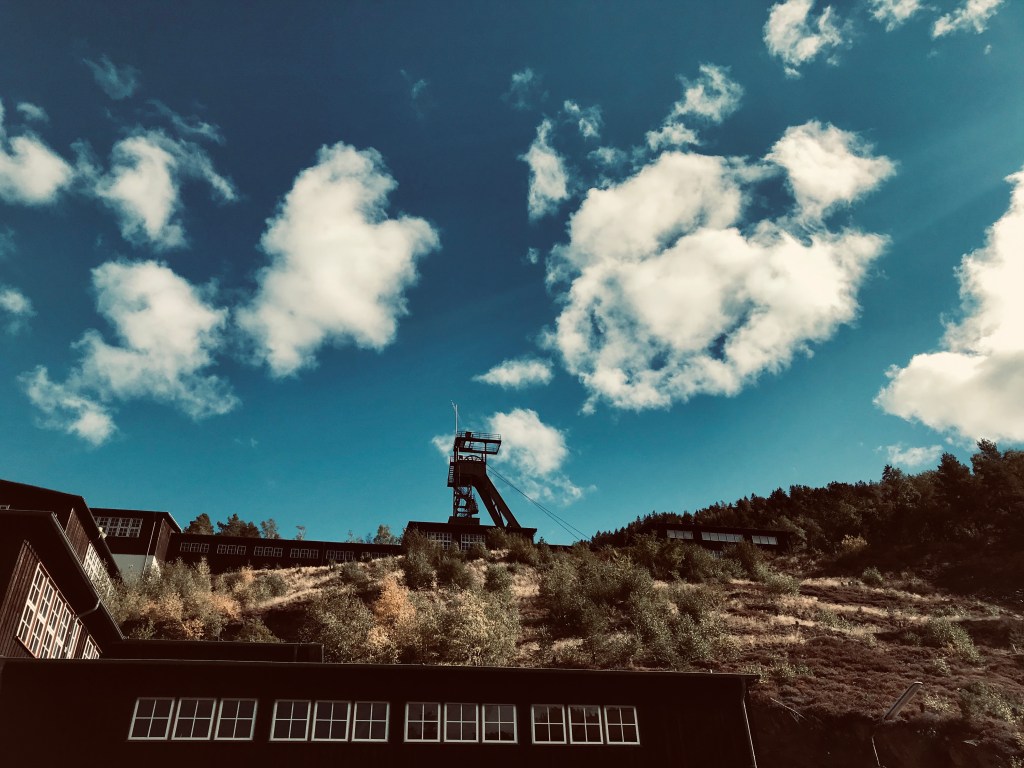
‘The spruce speaks before it breaks,’ he says, patting the tunnel wall.
Many miners’ lives were saved by those warning sounds from inside the wood.
When I ask about the closure, his face drops momentarily. Men were in tears, he tells me. It was generations of families, a community. He asks me where I am from.
‘Then you understand,’ he says. ‘In Wales. Yorkshire. The same thing. What do you do if this is all you have known for thirty years?’
30th September
In Bad Harzburg, with its timber-framed houses that look like something from America’s Deep South, I find a bookshop. I emerge with a copy of Heine’s Buch der Lieder. Most of the town is in shade by now, the buildings casting long shadows in the low sun, but I find a spot outside an Imbiss where the plastic chairs and tables were light enough to keep moving them as the shadows crept ever deeper across the base of the valley.
I order some food and flicked through the book. Most of the poems collected in Buch der Lieder were written in the years before Heine’s Harzreise of 1824, although my edition also features some poems from his later books, including his long walk through the Harz. It also contained a forward, written by Heine in Paris in 1839, almost a decade into his exile. He begins it with some lines of verse that feel as if he is taking himself back in memory, not only into the poems themselves but also to those places that inspired him to write them, and which he had long since left behind.
This is the old enchanted wood!
Sweet lime trees scent the wind!
The glamor of the moon has cast
A spell upon my mind…
From where I sit I can look up the hillside to where the trees are still clinging on. There’s less evidence of the bark beetle devastation here, but nevertheless, it is hard to think of the Harz as an enchanted forest having walked through it over the past few days.
1st October
The path from Bad Harzburg to the summit takes me across the Ecker river, which once marked the border between two Germanys. From 1952 to 1990, this was part of the Iron Curtain. Locals on both sides lost access to the Brocken mountain. For those in the West, it was on the other side of the border. For those in the East, it would become a restricted zone following the building of the Berlin Wall. It might as well have been in the Urals.
At the Ecker Dam, I cross where a fence once ran across the walkway, topped with barbed wire. A border post still stands in the middle, where the reservoir was split between East and West. Old photographs show the absurdity of it: a two-meter version of the Berlin Wall blocking what is now part of my waymarked route to the Brocken summit.
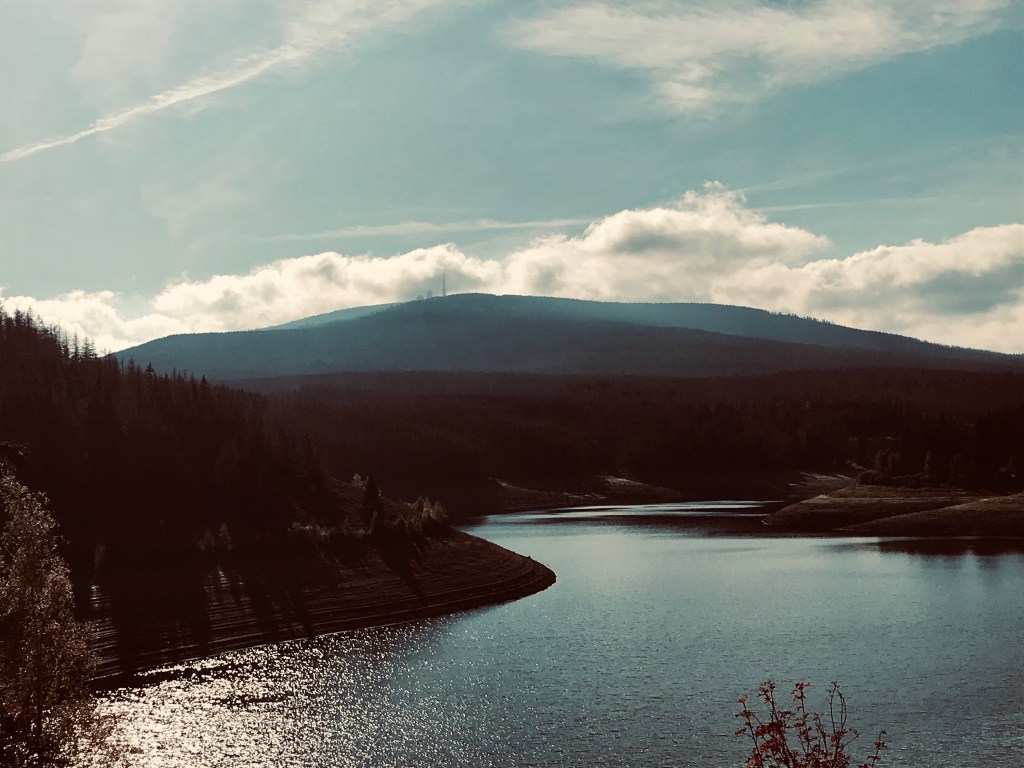
As I climb, the forest gradually changes. The spruce trees become shorter and more stunted, until only bilberry bushes and mountain plants remain. The path is steep, but increasingly I’m not alone. Dozens of hikers are making their way up, forming an unspoken summit team.
The top is crowded with tourists, many arriving by steam train. There’s a hotel, restaurant, beer garden and visitor centre housed in a former Stasi listening station nicknamed the “Stasi Mosque” for its square shape topped with a dome. It is clear that this is no pristine wilderness, but it still attracted the visitors.
The Brocken has captured the imagination for centuries. When Goethe first climbed it in December 1777, there was only a small shelter at the summit. By 1800, the first Brocken Inn was open. The botanical garden was laid out in 1890 and by 1899 the Brocken Railway was bringing daytrippers to the top. The Nazis erected the first television tower in 1936, in time for the Berlin Olympics.
During the Cold War the Brocken was forbidden to ordinary citizens on both sides of the border. A mountain that had inspired Goethe’s Faust and Heine’s Harzreise, the peak where witches supposedly danced with the devil each Walpurgis Night, became the domain of soldiers and spies.
That changed on December 3, 1989. Less than a month after the Berlin Wall fell, approximately 2,000 hikers gathered in towns around the mountain’s base and met at the top. They carried homemade placards and were surprised when the border guards that met them on the way offered them tea and sausages. Outside the high fences that closed off the summit plateau, they pressed at the gate until they were finally let in. The Peaceful Revolution had come to the GDR’s highest point.
I check in to the hotel that is housed in the same building where the border guards once slept. As the afternoon progresses, the weather changes dramatically. Clear views give way to a mist that engulfs everything. It is in such conditions that people report seeing a Brocken Spectre, that magnified shadow of oneself cast upon clouds with a glowing helo. I stand with my back to the low sun hoping to glimpse my own ghost, but it doesn’t appear.
Katrin arrives on one of the last trains, and we circle the summit together as the beer garden closes and the final hikers prepare to descend. She’s brought news from Berlin and we share the evening together, watching the mist roll across the plateau, occasionally glimpsing the rocky outcrops known as the ‘Devil’s Pulpit’ and ‘Witches’ Altar’ in the swirling clouds.
2nd October
Light is dawning in the east
As the sun begins to glimmer,
Far and wide the mountain peaks
In the misty ocean shimmer.
Early morning on the Brocken. Sunrise. The scene Heine described nearly 200 years ago appears before me almost exactly as he wrote it: we seem to be floating, a wind-scoured island in a white sea of clouds. Other islands are visible, populated by tall trees through which mist drifts, but otherwise we appear alone, cut off from the world below.
We have slept with the curtains open and wake at first light. With bleary eyes we climb out of bed and head onto the plateau. Our luck has held. The sky is clear, a brilliant blue. But nearly everything below us, from the hills and valleys of the Lower Harz to the towns where the mountains meet the plains, the windfarms and the fields in the distance, are all obscured by low clouds. The rest of the world is out of sight, and it is easy to imagine that this was what the witches saw, in the early morning after a long night of revelry.

Moments later, everything changes. The clouds seem to rise up from the valleys to engulf the summit and its buildings. For a time, visibility is less than ten metres and the voices of other early risers or those who had risen in darkness to reach the summit before the crowds seem to belong to ghostly apparitions. The clouds retreat once more. More people begin to arrive on the summit, beating the first train by a good couple of hours. They have hiked through mist from Schierke below, but the mountain has decided to oblige them, as the sky clears as they move beyond the last of the spruce trees.
The afternoon brings more people by train and on foot. Every seat in the beer garden is taken. The sunny day has drawn hundreds to northern Germany’s highest everything: train station, restaurant, hotel and beer garden. Flags wave in preparation for tomorrow’s German Unity Day celebrations.
Later, in the hotel dining room, I eat with my reflection in the window against the darkness outside. Stepping out onto the plateau one more time it is possible to pick out the shivering lights of towns beyond the hills. Heine wrote that it’s never really dark on top of the Brocken, and tonight it proves true. A Harvest Moon and stars shine above. The darkness, if it’s anywhere, is below, in the forest that surrounds us and all it contains.
3rd October
October 3rd dawns clear but blustery. Flags are being raised, sound systems tested, deliveries made for what promises to be the Brocken’s biggest day of the year. We leave early to Helene Fischer’s siren song calling everyone to the summit party, following the Heinrich-Heine-Weg down toward Ilsenburg.
As we descend, hundreds pass us heading up. The atmosphere is celebratory for this German Unity Day in brilliant sunshine. But the descent also takes us through more devastated forest, bark beetle damage creating scenes like an Anselm Kiefer painting brought to life. Sawn stumps and jagged survivors, their insides spilling out in browns and reds, mist drifting through as if we’re exploring a battlefield. An information board promises renewal: re-wilding, new mixed forest. There is hope.
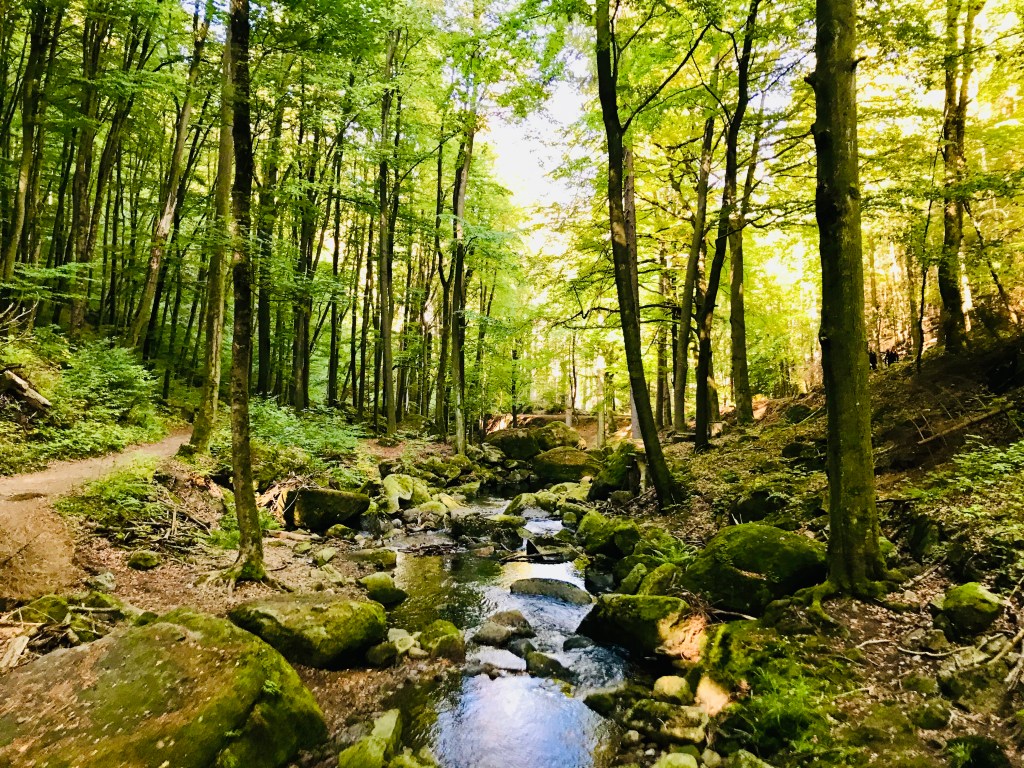
Halfway down, we reach the Ilse river and follow it the rest of the way. This mixed forest of beech, oak and birch alongside the spruce creates the most beautiful section of the entire walk. The river runs beside us on a path carpeted with autumn leaves. Is this a vision of the Harz’s future, once re-naturing takes hold?
Heine was equally enchanted:
This is the Ilse, the sweet charming Ilse. It flows through the blessed Ilsetal, at either side of which the mountains gradually rise higher, and they are mostly covered, right down to the valley floor, with beeches, oaks and ordinary shrubs, instead of firs and other conifers…
For an hour or so we walk between the trees, not really talking, just moving through the woods. Walking with Heine through these mountains I’ve glimpsed the layers this landscape contains. I’ve seen terrain shaped by mining and planted with spruce, now dying from climate change. I’ve traced borders both visible and invisible, between past and present, myth and reality. And I’ve thought constantly about belonging, how the forest has been claimed as a symbol while simultaneously being altered, exploited and reimagined.
The forest contains it all. Romance and horror. Myth and industry. Ancient and modern. Desperate and hopeful. It holds witches and miners, poets and prisoners. A last night in the Harz is spent in a hotel at the forest’s edge, the trees reaching out towards our open bedroom window. Tomorrow the train will carry us back to Berlin, but tonight the Harz forest rustles outside, holding all its secrets in the darkness between the trees.
Up there on the hillside, the bark beetles continue their work, and somewhere in the devastation, new forests are waiting to be born.

The book of this walk was published as Harzwanderungen by Matthes & Seitz in Germany (translated by Ulrike Kretschmer). Unfortunately, at the time of writing, the English original remains unpublished.
Words by Paul Scraton
Photographs by Katrin Schönig & Paul Scraton
