
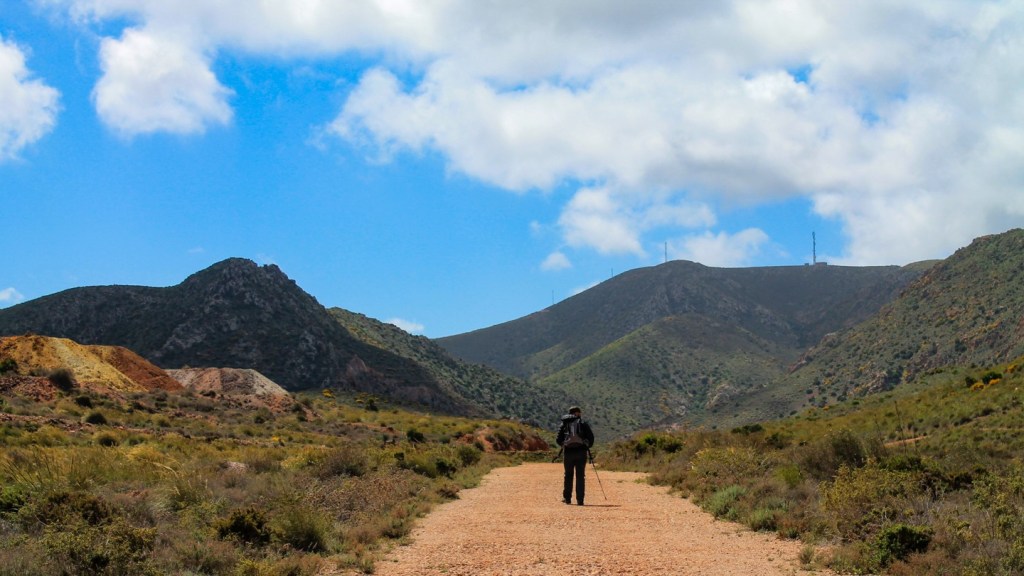
The township of Rodalquilar, in the Cabo de Gata Natural Park, was born of a gold rush. When the mines were opened there was the belief that the volcanic landscape was about to give up great riches. Linked to the town by wide, dusty roads cut through the low mountains, the Rodalquilar mines employed more than a thousand miners at their peak, while they and their families called this collection of low slung houses surrounded by a barren, rocky landscape their home.
For a while, wealth was indeed extracted from the hills, but the dream would only last until the 1960s when the mines were abandoned. The population of the township fell to a couple of hundred, and today it is possible to walk through whole neighbourhoods of empty and crumbling cottages, social halls, schools and other buildings that have been abandoned to the elements.
By the time we arrive, more than half a century after the mining heyday, the town appears to be home to a mix of hippies and artists, second homes and holiday rentals, close to the sea but not on the beach. That the town exists in the first place is because of the mines, but since the miners have left it became a place in search of a purpose. But despite the harshness of the environment here, Rodalquilar has had a second life. It offers space for those who are looking for something different, whether in their choice of home or holiday destination. It has found its niche and survives, thrives even, not despite its location but because of it, and the mix of creativity and slow, sun-baked decay is unquestionably appealing.
The story of the town begins in 1864, deep inside an extinct volcano. Gold was discovered at three sites, all in the vicinity of a farmhouse on the site where Rodalquilar now stands. It was not that easy to get much gold out of the rock here, but still they tried. Working by hand or using explosives, the next hundred years saw miners and the companies they worked for come and go, but it was only by the 1930s that the mines started to make real profit.
During the Spanish Civil War the mines were seized by the workers and then, after the end of the war and victory for Franco’s forces, by the state. By the 1950s this was the largest mine in Western Europe and with improved extraction methods was yielding almost a quarter of a million tonnes of ore a year. It wasn’t to last. By the mid 1960s the mine was exhausted, although there was a final attempt at extraction that lasted for about a year from 1989, the history of mining in the town was pretty much over.
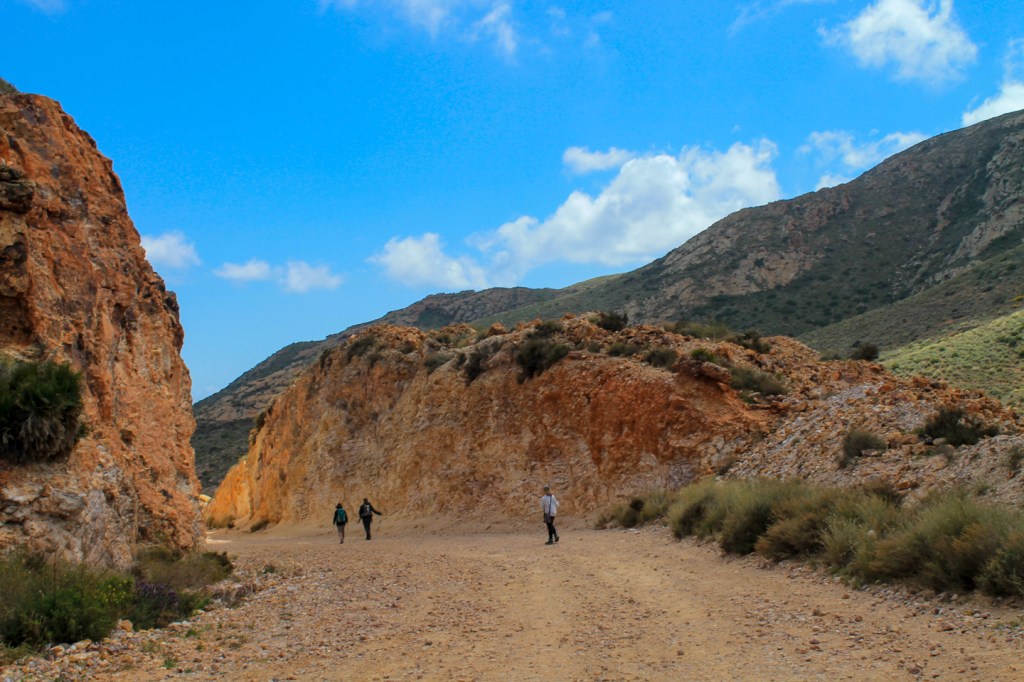
As we walk out of Rodalquilar, our route takes us up the winding track that leads past the remnants of the gold mine. It is Easter, but the sun is high in the sky and in this part of the world, where what plant life there is remains squat and low to the ground, any shade we can find comes from abandoned buildings or the cuttings made into the hillside. The huge trucks and heavy vehicles that once used these roads are long gone, and now they are the preserve of hikers, mountain bikers and the occasional cars, as families on day trips from less inhospitable places head for the hills in search of legends and stories.

Up where the mountain road reaches a high valley, we discover more abandoned mine buildings. These have been closed since 1936 and the outbreak of the Spanish Civil War, when these hills became a place of hideaways and secret communication trails along the narrow valleys and over the passes. The track is deep red by now, flanked by aloe vera plants and the first of the cabbage fields that stretch out across the plateau. It feels like the Wild West of a child’s imagination, a feeling that becomes more concrete as the dusty red roads lead us between prickly plants to yet another abandoned building.
This is the Cortijo de Fraile, the farmhouse of Federico Garcia Lorca’s ‘Blood Wedding’ and the destination for those family saloons that had overtaken us on the old mine road. In 1928, the playwright Lorca was reading the newspaper and the story of a young woman who attempted to elope with her cousin ahead of a marriage to someone else. In the course of events, the cousin was shot and killed by a relative of the groom-to-be. The young woman was called Francisca Montes Canada, and she never would marry, continuing to live in a nearby village until the 1990s.
Lorca was fascinated by this story and spent four years or so preparing to write about the tale. He claimed that the writing itself only took about two weeks, and the play would become a literary sensation when it was first performed in Madrid in 1933, about five years after the events upon which it was based. Perhaps because of this tragic tale the farmhouse is abandoned, slowly collapsing in on itself over the decades. But the story was not over with the death of a young lover and Lorca’s success on the Madrid stage. There was another twist in the tale.
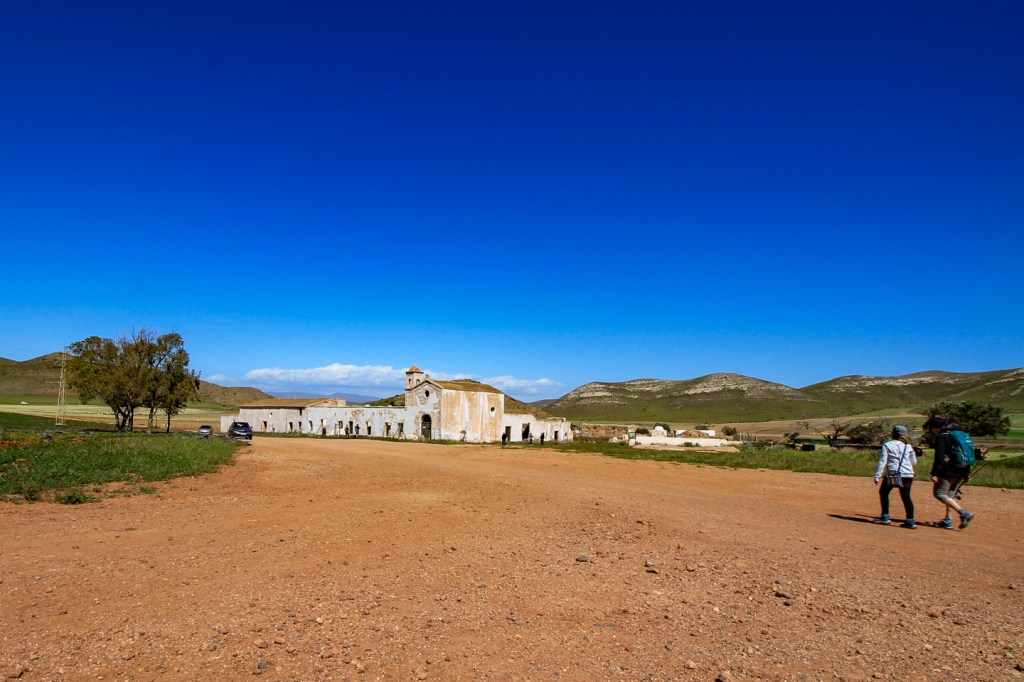
In the 1960s, as the mines were closing, the Cortijo de Fraile was used as an atmospheric backdrop for films such as ‘A Few Dollars More’ and ‘The Good, The Bad and The Ugly.’ Clint Eastwood filmed here twice with Sergio Leone and his crew, as Andalucia and its desert landscape offered up an authentic sense of desolation that the filmmaker required for his understanding of the American West. Today, despite the cabbage fields and the tourists wandering around the buildings, it still feels a long way from anywhere as we find shade in the only place that offers respite from the midday sun: the farmhouse’s old water tank.
We make our way back to Rodalquilar by dropping off the main mining road to follow what look like animal trails through the hills dotted with prickly bushes and along the rocky beds of dry rivers that will nevertheless, should we keep going, lead us all the way to the sea. Simple wooden signposts signal the presence of other farmhouses, tucked away in the folds of the earth and, unlike the Cortijo de Fraile, seemingly still inhabited. It is hard to imagine a life here, surrounded by rocks and lizards and the ghosts of tough lives lived in this unforgiving place.
And yet. Across the tops of the lumpy hills before us we can see the sea shimmering in the springtime heat. Keep walking and we will pick up another dusty track that will lead us to a dark beach where we can cool off between the gentle waves, our heads filled with the stories of the hills that we have walked through, and the people who once called this toughest of landscapes home.

Words by Paul Scraton
Photographs by Katrin Schönig
