
What brings us to a place? What is it that feeds our wanderlust and has us reaching for the map or the app? What is it that we are looking for when we travel? In our kitchen in Berlin, there is a faded poster featuring Preikestolen, the square slab, the Pulpit Rock, that hangs out over the Lysefjord in southern Norway. It is arguably the country’s most famous natural landmark. If you have ever shown any interest in Norway then you have almost certainly seen it. It features on the cover of guidebooks and in the thumbnails for Youtube videos. It takes centre stage on Instagram feeds and travel websites. It was part of the reason we had travelled to Norway in the first place. To experience the Pulpit Rock for ourselves. And now we were in a campsite only about an hour away.
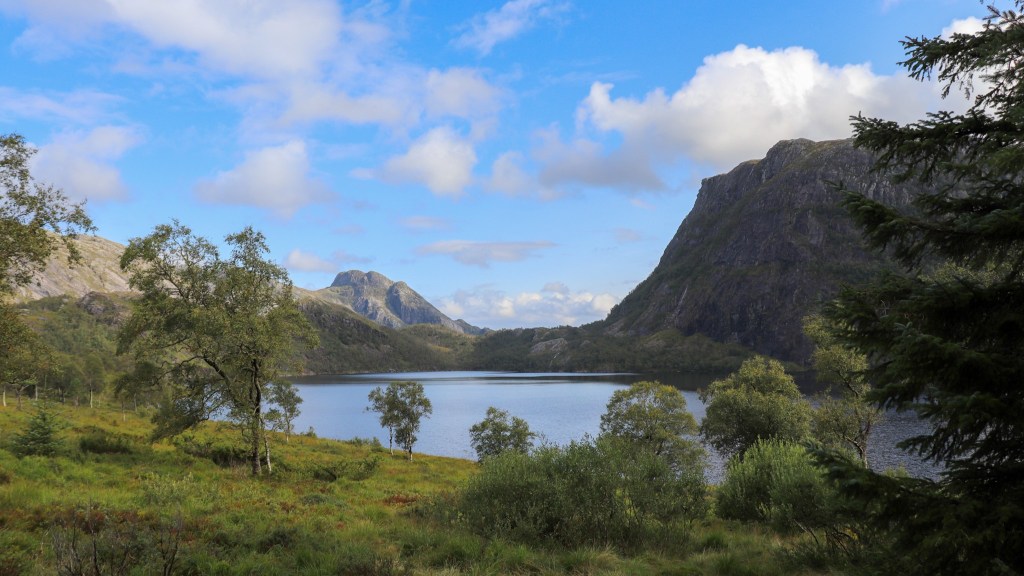
‘Yeah, it’s easy enough to get there,’ the owner said as he checked us in on a break from feeding his goats. The campground was perched on a low ridge overlooking Ytra Vinjavatnet lake, about twenty minutes drive from the town of Vikeså.
He came around from the reception desk to look at a map pinned to the wall. He traced the route from the campsite to Preikestolen with his finger, but then returned it to home.
‘The thing is, and I always tell my guests… unless you get up really, really early it will be absolutely full up there. Everyone wants to go to these famous places. Almost everyone is like you. When they check in, they ask for Preikestolen. But I tell them, we have beautiful hikes right here. You won’t even need to drive. And you’ll be mostly alone.’
On the map he pointed out a series of places, all very close to the finger-smudged spot that represented where we were standing.
‘This valley. Or this valley. I would say it is just as beautiful…’ I mean, I am a bit biased but…’
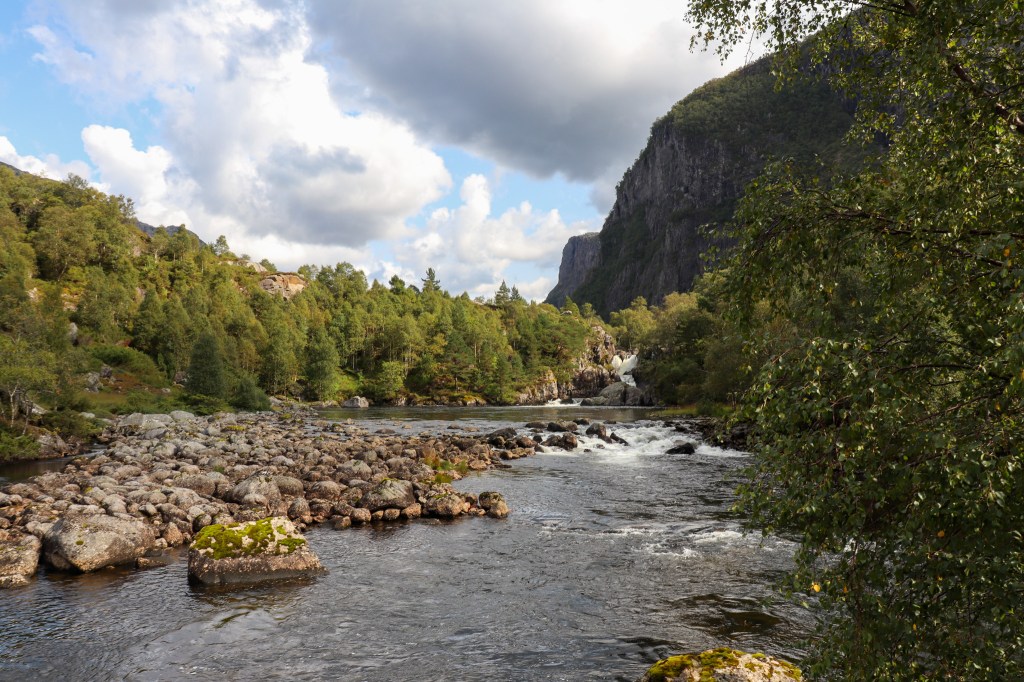
On the steps of the little wooden cabin between the pine trees, we sat with a map and tried to make a plan. We wondered how many of his guests, with their hearts set on the Preikestolen, took his advice and searched out the unheralded spots closer to home. As the sun fell behind the mountains to the west and the quiet of evening only disturbed by the sound of the waterfalls cascading down the hills all around, we decided we would listen to our host. We would stay local. Climb the nearby hills. Explore the nearby valleys.
***
A place like Preikestolen takes us to the heart of the biggest issue when it comes to contemporary travel: the sheer numbers of visitors and the impact they have, from the local and global ecology to the communities that both live from tourism but also are on the brink of collapse under the weight of it. As responsible travellers we want to weigh up the costs of our trip in all the different ways, from the carbon footprint of travelling at all to decisions around where we will spend our time once we have decided to go. The answers are not easy.
We live in Berlin, a place that has struggled with the increase in tourism numbers over the last twenty years. In cities across southern Europe, such as Lisbon and Barcelona, where entire districts have been given over to holiday lets and where the very things that made these places magical in the first place are hollowed out, the local communities that remain are demanding something is done.
And it’s not only the cities. It is possible to observe something similar in the outdoor space. The summit of Yr Wydffa on a sunny summer day, when it feels like half the country are climbing Wales’ highest mountain. The shoreline path of the Königsee, where people wait patiently in queues to take a people-less photograph of the lake and the Alps behind, as if the crowds out of frame don’t exist. Or the narrow path to the Preikestolen, which grows ever wider under the volume of feet heading to and from the most famous name on the map.
What is the answer? Some would say we should limit our travel, or indeed not travel at all. This is a justifiable position. But travel in general, and experience in the outdoors in particular, can be life-changing to those lucky enough to be able to do it. Exploring someplace new, whether city streets or a mountain path, shows us that there are different ways of living, a change of perspective, and that the world is complex and the answers to the challenges in front of us are not always simple ones. At the same time, if we are curious enough it can teach us many things, not least that we can never know it all, and that there will always be another way of doing things that we just haven’t thought about.
***
For our campsite owner, a man for whom at least some of his income relies on tourism, the answer was to disperse the pressure. To encourage, in his own small way, his guests to ignore the scenic routes marked in every guidebook and the top 10 lists of websites and social media, and to understand that in a country like Norway there was plenty to discover that was full of awe-inspiring beauty that, even in the height of summer, you might have pretty much all to yourselves. And for every one of his guests who decided to walk out from the campground instead of driving to the Preikestolen trailhead, there would be a little less traffic to and from the famous outcrop on that particular day.
And so we followed the tracks he’d traced with his finger, up to the hidden valleys tucked away among the hills and mountains all around. Hiking up through the forest towards Ramsvatn lake and a view that would grace every outdoor magazine in the UK if it was in Scotland, the only person we met was a farmer who was checking his sheep, grazing the land through which we walked. He chatted to us in broken German, letting us know that we were both on the right track and that the view would be worth it when we got there.
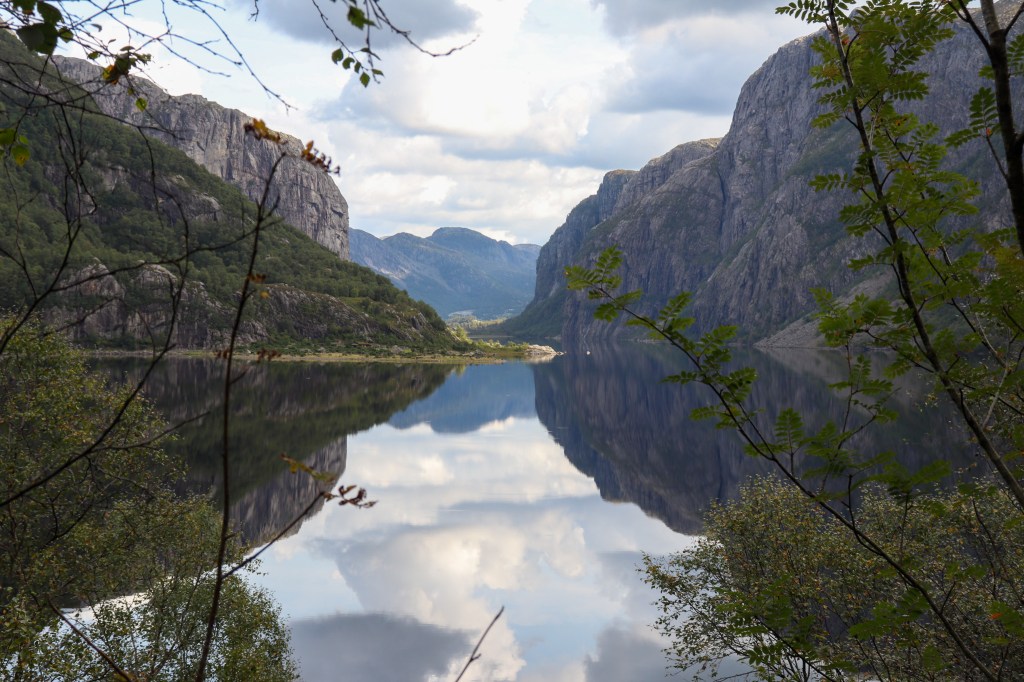
The next day we followed the river towards the ever-increasing sound of the rapids, where the water rushed out of Maudalsvatnet lake on its journey to the sea. Once we got there, we discovered steep cliffs that towered over a single farmhouse on a grassy promontory, where goats grazed and birds pecked at the upturned kayak, but otherwise no soul stirred. We ate our lunch having the whole place to ourselves, lost in thought as we looked out over the lake.
In the quiet and the solitude we tried as best we could to take it all in. How it looked. Sounded. Smelled. Felt. Trying to record it all so that we can return to it time and again, even after we’d left.
***
From solitude to a sense of community. A few kilometres downstream from the campsite we climbed out from the small town of Vikeså to the upper slopes of the Storafjellet. At 500 metres, this is a modest mountain by Norwegian standards, and it was difficult to find much information about it. But as we would discover during the walk, it was a ‘home mountain’ in the truest sense of the phrase, a place close to the hearts of the people who lived in its shadow and on its lower slopes.
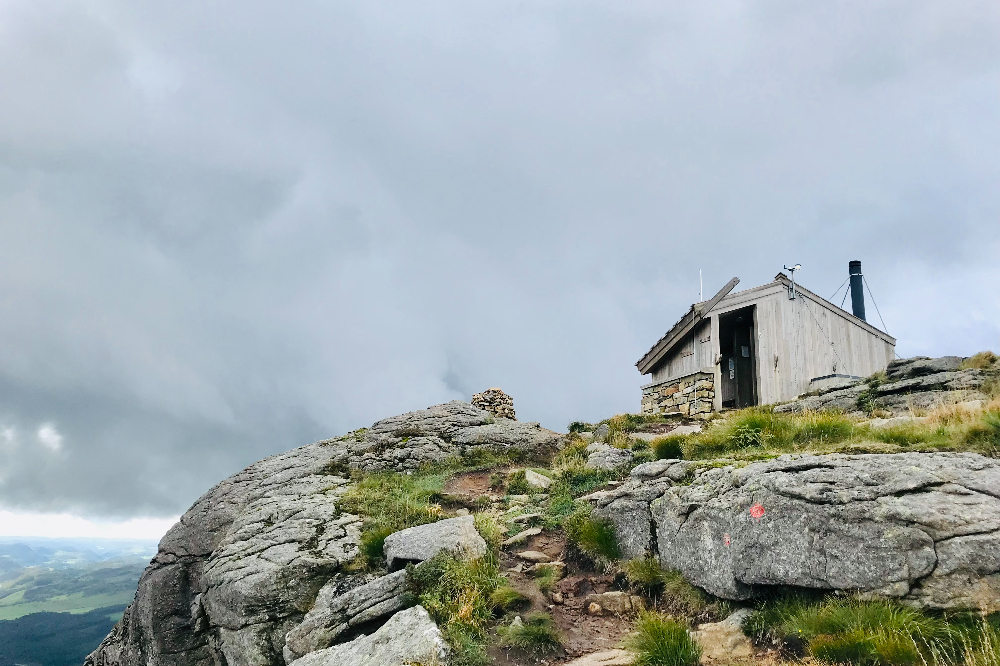
The route from the valley floor took us beyond the last of the houses with their neat gardens and a small bathing lake before the path began to climb. It was steep and rocky, with some sections secured with cables. The path was well worn. Stone slabs worn smooth by decades of boots and trainers. Muddy stretches of footpath that are forever in the shade had been crossed with neat planks of wood. This was clearly a popular trail, leading from the town up to the Gapahuk Storafjellet, the mountain hut that was our goal for the day.
As we made slow but steady progress, we met others coming the other way. Trail runners in their short shorts, bounding down the hill without seeming to touch the ground, who cheerfully shouted their greeting as they passed us by. But others stopped to talk, telling us about the path to come and that the views would be worth it. About how often they made the climb. About how the views were always different, because the weather changed, and the seasons. About how to climb the same mountain time and again was never boring. These were people for whom the ascent to the Gapahuk Storafjellet was their Sunday stroll, a quick climb of their home mountain before lunch.
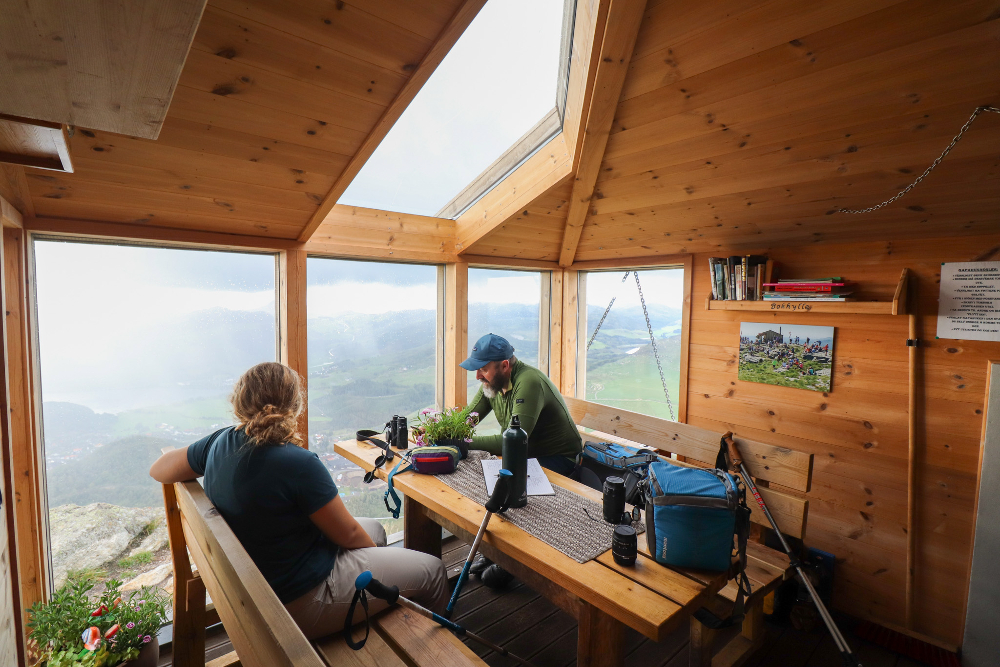
The hut, it turned out, was pretty new. It had benches and a table, a collection of books and binoculars, a wood stove and a kettle for making tea. Pictures in the hut showed the volunteers who had built it, and the big party that was held when it opened, with hundreds of people up on the mountain top to celebrate.
Along with our chats on the trail, looking over the photographs and reading the notes in the hut’s book, we had begun to understand what role the mountain and its little hut built by local volunteers played in the everyday lives of those who lived nearby. It was built by the community for no other reason than to give people a place to shelter, a place to walk to and to take a rest, and a place to protect them if they were unlucky and protection were needed.
We lingered in the hut for a while. It was a wonderful place to be. We marvelled at our luck as a rain shower passed overhead, hammering against the roof, before the door opened and a bedraggled French family stumbled inside. But even getting caught in the rain hadn’t dampened their spirits, and I think the appearance of the hut along the path certainly had something to do with it. As the sun re-emerged from behind the clouds we left them to it, and started to make our way back down the mountain.

It was about an hour beyond lunchtime, and soon the path was full of people coming up the mountain on this Sunday afternoon after the rain. Groups of friends. Solitary hikers. More trail runners. Families. The speedy would be up and down in about ninety minutes. Others would take their time, stopping for photographs or to catch their breath at the different lookout points along the way. All would spend a moment or two at the hut. Their hut. One which they had built, and which they seemed very happy to share.
***
Why we fall for a place is an individual thing. Were the hidden valleys with only a friendly farmer for company or the slopes of Storafjellet, where people took an interest in us and stopped to chat, as spectacular as Preiskolen? Perhaps not. But they were not inferior to their more famous landmark an hour or so to the north. They were just different. And from our days exploring the valleys around our campground, both in the solitude of the landscape but also in sharing it with people for whom this was their home, we developed a small but lasting connection to a place far from home.
On the last morning we sat by the lake as thin clouds hung low above the water, cutting the hills beyond the opposite shore in two. We had spent almost a week in these valleys and never made it the Pulpit Rock. Would our trip have been better if we’d seen it? We’ll never know the answer to that question. But what we were sure of, was that our time spent and our experience was richer because we had got to know this place in some small way. We had spent unrushed time in the landscape. We had met people who told us about their relationship to it. How they loved it, but also their fears for the future and the impact of the worsening climate crisis.
In all these discussions, the question of climate and travel never goes away.
No one will protect what they don’t care about, David Attenborough once said, And no one will care about what they haven’t experienced.
We can experience the world in many ways. We can read books or journals on websites. We can watch films made by David Attenborough or on our favourite Youtube channels. We can listen to podcasts or a talk at our local outdoor store or town hall. And we can also travel, experiencing the wonder of this planet of ours with all our senses. Hopefully, if we use those senses well, we will not only care about the places we pass through but also want to protect them. Travel can have a role in all of this, but how we choose to do it and where we choose to go matters as well.
Words by Paul Scraton
Photographs by Katrin Schönig
