
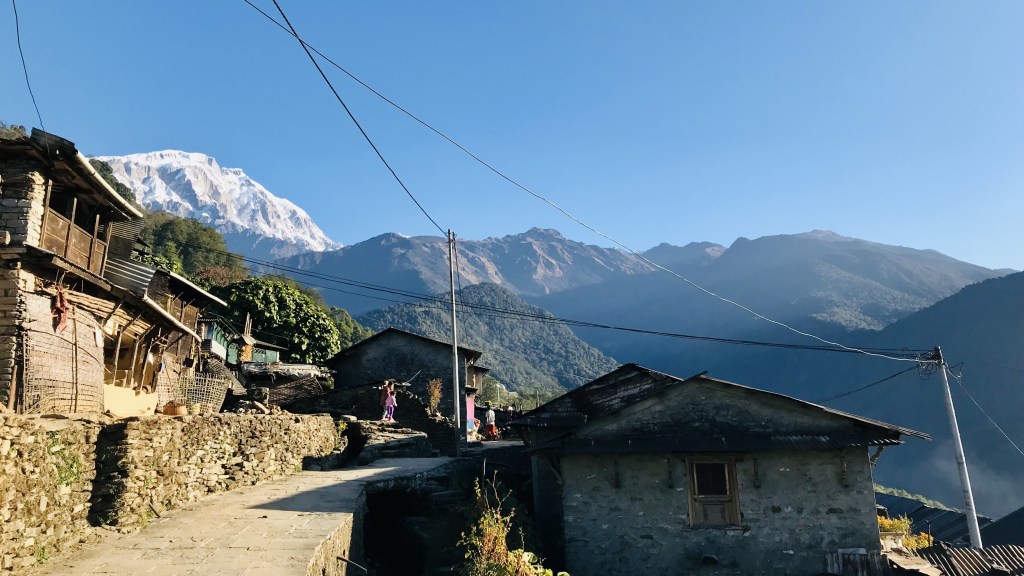
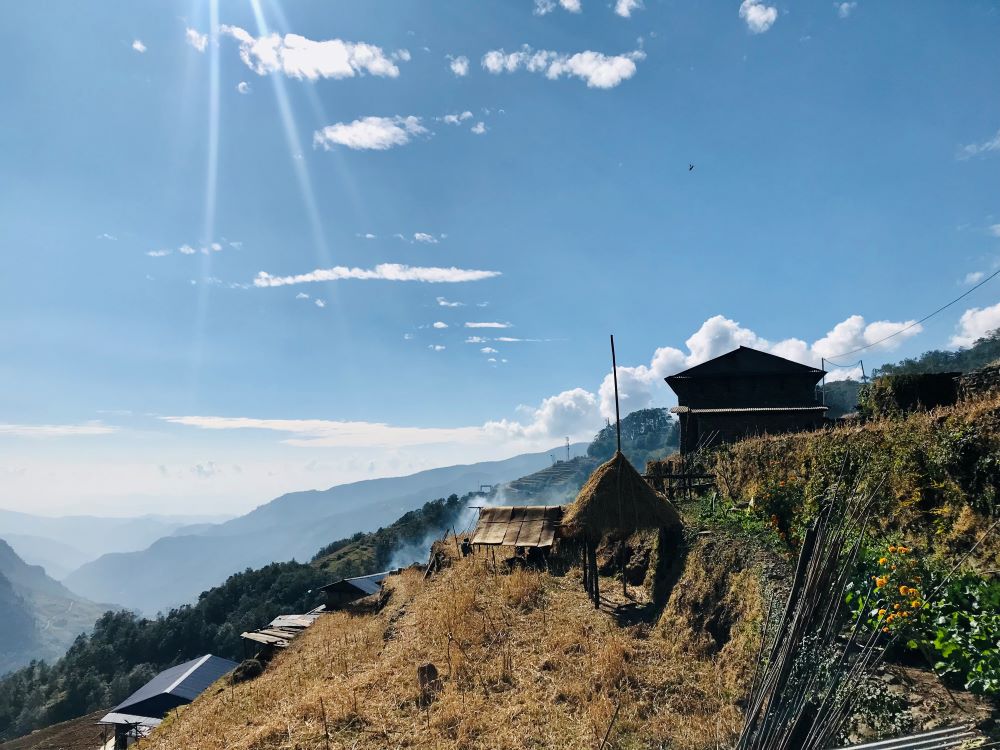
Prakash stops the jeep about halfway up the track. A little break in the journey. We climb out onto the rocky, uneven road and take in the view. The steep-sided valley with the Madi river somewhere down below, where the morning sun is yet to reach. A chain of villages strung out above terraces on the slopes opposite. Snow-capped mountains rising up to just shy of 8000 metres at the head of the valley. We are about twenty kilometres from Pokhara and it has taken the best part of two hours to get here. We still have another thirty minutes to go.
‘The last time I came there was no road,’ Chris says, with a shrug. ‘We had to walk.’
I kick a stone across what counts for a road in the mid-western foothills of the Himalaya.
‘There’s a bus coming,’ Prakash says, matter-of-factly. It seems unlikely, but he is telling the truth.
With a tuneful sound of the horn, the public bus turns the corner above us and makes its way past in a dusty cloud. Later, in Tangting village, we will hear of the importance of the infrastructure that has been developed in the fifteen years since Chris last came here. A water supply for every house. Homestays and guesthouses. Internet. The road. At a time when communities are losing people to the cities and jobs abroad, as fields fall fallow and better healthcare leads to a lower birth rate, all those things that link Tangting to the outside world offer new possibilities.

The trip began by the lakeshore in Pokhara, a place of hotels and restaurants, trekking companies and countless shops selling rack after rack of outdoor gear that, if perhaps not genuine North Face, Patagonia or Columbia, then probably made in the adjacent factory. As we approach Tangting village, the road climbing from where we have crossed the Madi river and passing through small settlements and hydroelectric projects with the peaks of the Annapurna range appearing ever closer through the dusty windscreen, it feels a long way from the tourist bubble of Lakeside. And yet it is already possible to see that there is something up here that many down there would be interested in. As if on cue, a group of French trekkers appears by the roadside.
And then, as Prakash turns one more corner, with the words Welcome to Tangting painted on a rocky outcrop, we reach the smooth, white concrete of the village road. There, not far from the bus stop, a group of young people and their teachers are there to welcome us. Two and a half hours up the bumpy track, the mobile reception is better than in Berlin, and Prakash has called ahead to warn of our arrival.
***
We are here with Pahar Trust Nepal, an organisation of which Chris is an Ambassador. Founded by two ex-servicemen of the Queen’s Gurkha Engineers – one British and one Nepali – this UK-based charity works with a sister NGO in Pokhara to improve standards of education, health and sanitation in hard-to-reach communities in Nepal, including in Tangting.
The village sits at 1685 metres above sea level, with about two thousand residents who are predominantly Gurung, an ethnic group who make up approximately 3% of the Nepali population. In what has traditionally been an agricultural community, countless young Tangting men, like so many others from the hill villages of the region, have long followed the trails out of the valley to join the British and Indian armies as part of Gurkha (or Gorkha) units.

This link between the rural communities of the foothills of the world’s highest mountains and the damp streets of England, rooted in colonialism and British India, has created ties that bind.
‘A lot of my family are Gurkhas,’ a man told us yesterday. He is from a hill village but now drives a taxi in Pokhara. ‘My brother… but not me. I wanted to, but I was too small. And not fast enough. Or strong enough.’
As he darted his taxi in and out of the traffic between the city centre and Lakeside, he laughed with the ease of a man who has long embraced his fate.
***
With garlands around our necks we are shown around by Om Prakash Gurung. Headteacher, homestay owner and writer, Om Prakash is a passionate advocate for his village; a storyteller of the past and visionary for the future. As we go from house to house, we hear time and again about the importance of the developments in infrastructure for the future of Tangting, alongside the deep desire to maintain the distinctive culture and traditions despite the changes that the internet and the road are starting to bring.
Landscape, hospitality and Gurung culture, Om Prakash tells us, are what makes Tangting attractive for visitors. And as people leave the village in search of work and fields go unfarmed, tourism is a great hope.
“Everything has its pros and cons,” Om Prakash writes in his book Tangting: My Village, “We shall develop Tangting as a model destination mitigating the negative aspects of tourism. Then, tourism shall be the economic backbone of the village. Our own generation should lead the virtuous action. Therefore, I shall utilise my remaining life in the prosperity of tourism and education.”
At the school where he is the headteacher, we look on as workmen clear the rubble from an upper storey that suffered damage in the 2015 earthquake which, in turn, led to further problems due to the heavy rains of each monsoon season. Pahar Trust Nepal is funding and overseeing the redevelopment of the classrooms and a new teacher’s room. In the meantime, any available space, including outdoors, is being used for classes.
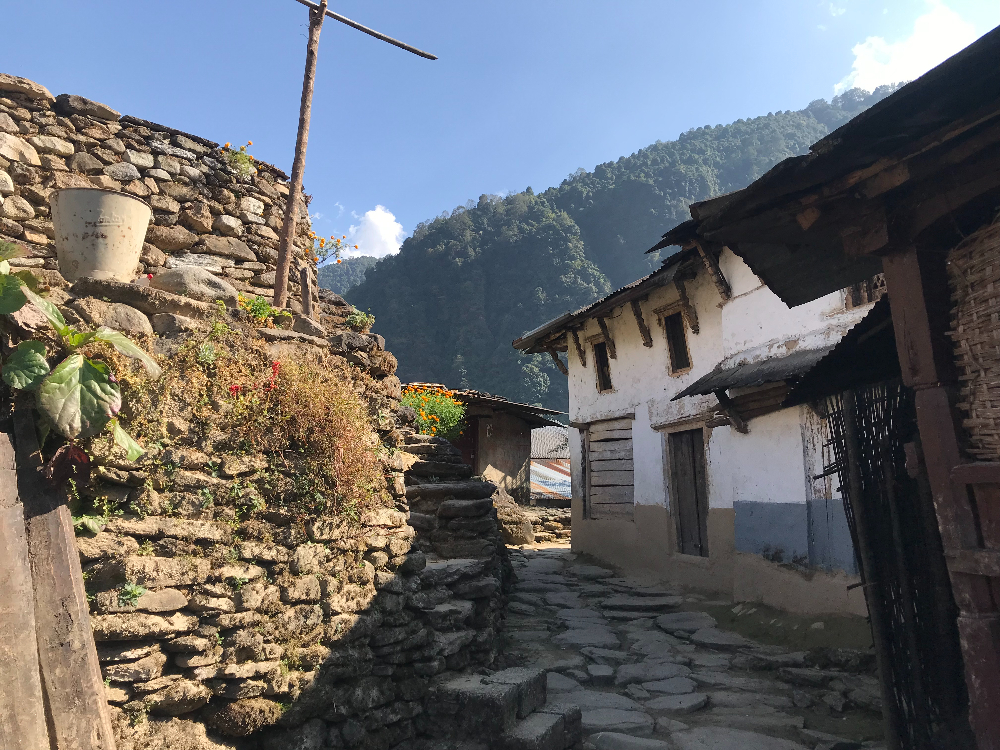
The road makes it easier of course. To bring equipment and supplies. As we walk the village the same topics come up in conversation. The abandoned fields. The people who have left. The possibilities of tourism. The importance of the road. About how it brings people in but also makes it easier to leave.
In the evening, we sit on Om Prakash’s terrace and watch the sun disappear, until it only shines on the highest of peaks. And then it is gone, and Annapurna II looms ominously against the dark sky. A fire is lit against the mountain cold, and the conversation that occurs between a medley of songs alternates between tales of the past and hopes for the future, for this little village at the end of the bumpy road.
***
Over the next week we travel out from Pokhara to one valley and then another, to villages among the rice fields and those perched on ridgelines above the forest or terraced slopes. We visit schools and new classrooms, learn about the devastation of the 2015 earthquake and how much work is still to be done. And we speak to children and their teachers, meet their parents and others from the villages, and try to grasp the realities of life in these communities.
Anyone who has lived in a hard-to-reach community will know that there are certain challenges that the rest of us don’t have to think about. How far is the nearest shop? Is there a reliable water supply? Who is collecting the rubbish and where does the rest of our waste go? Is there a school? Internet? And what happens when you get sick?
The turn off from the dirt track leads down onto a terrace carved from the hillside. The valleys of the central foothills of Nepal fold out in front of us until they reach the snow-covered peaks of the Himalaya in the distance. Our journey from Pokhara has taken about three hours and countless hairpin bends.

Welcome to the jungle, and welcome to Gumlek.
Until the health post was built in the village of Gumlek in 2019, it took an hour by jeep or three hours on foot to be able to access any medical care at all. Longer, if you lived beyond the village and further into the forest. Gumlek’s health post, located beside the dirt road at the entrance to the village, was built by Pahar Trust Nepal and funded by one its founders and current Ambassador, Dick Crowther. Costing £41,000 and constructed between September 2018 and March 2019, the facility is staffed by three nurses and is arranged in an elongated U-shape that includes nursing and patient rooms, delivery room, pharmacy, kitchen, toilets and a waiting area.
Welcomed by the nurses, one of the first things we ask is about doctors and how often they visit.
‘Very rarely,’ one of the nurses replies, her answer clear in her wry smile, even before her words are translated for us to understand.
We are there as part of our PTN trip to Nepal, but specifically to join members of Pahar Trust Foundation, an Australian charity that helps fund the PTN’s work. One of their team, Kym Eden, is a former paramedic and now Managing Director of a leading registered first aid training organisation in Victoria, who has travelled to Gumlek to deliver medical supplies, including a new defibrillator, and to host a first aid workshop for the people of the village.
It seems like most of the village turns out for Kym’s workshop. There are toddlers, old folks and everyone in between. As the sun shines down on the terrace and the mountains sparkle in the distance, Kym runs through topics such as the recovery position, choking, bleeding and wounds, snake bites and CPR. Ably assisted by Kanta from the PTN Head Office in Pokhara who is translating, there is a lot of laughter and fun despite the seriousness of the topic.
***
Afterwards we walk up into the village itself, where dogs doze in the shade of banana trees and chickens cross the road between the houses and the rice mill. These hills are known for their goats, Kanta tells us, one of the many local and regional differences we discover as we move between the villages during our trip.
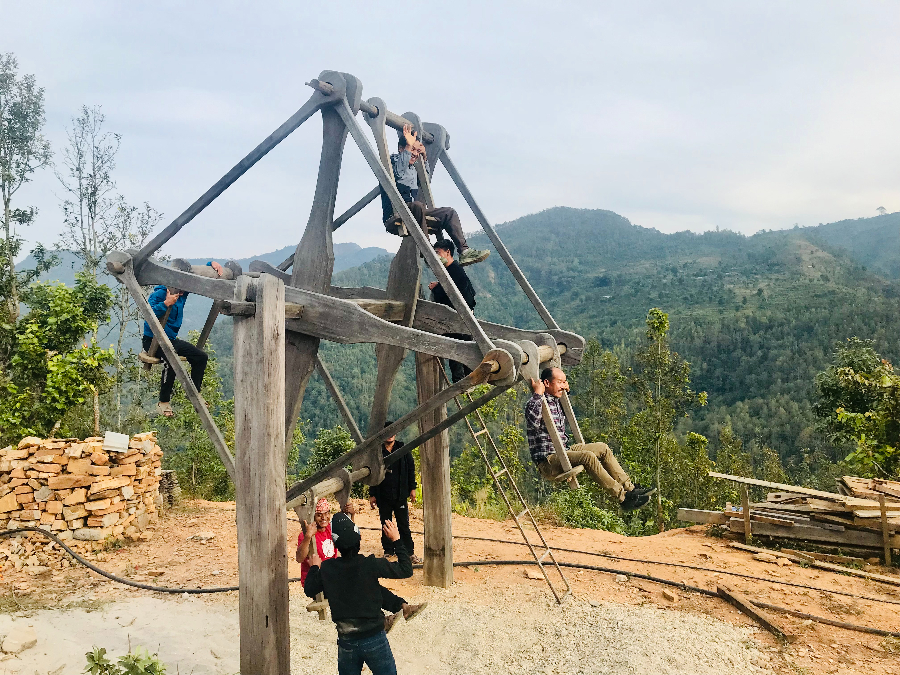
At the highest point, above the village and beside the temple, a bamboo swing and a rotating whirly machine have been built as part of a recent festival. The sun is beginning to set as we look out across the hills to the mountains, where the Annapurna and Manaslu ranges seem to be floating on clouds, as if ready to drift off, released from any connection to the world below.
One of the guys from the village tells me about his dream of a paved road.
‘Although I worry also,’ he adds. ‘The paradox in other places has been, if the road is built it makes it easier for people to leave. Some say that in fifty years, all these villages will be empty.’
He looks around. The beautiful houses. The jungle. The mountains in the distance.
‘I really hope not. It’s why the schools and the health centres are so important. It helps people stay.’
On the whirly machine, three of his mates persuade Kym to join them, and their shouts and laughter echo across the valley and their smiles light up the late afternoon on the hilltop.
As we drive back to Pokhara that evening, the different villages at dusk are hives of activity. It is hard to imagine these places devoid of people. Kids walking home from school. Men and women carrying heavy loads. Goat herders creating traffic jams. In one village a bus blocks the road while all the supplies for a wedding are unloaded from the roof. As so often in the mountains, darkness comes quickly. No-one seems to mind. As with the kids in the workshop and the men on their whirly swing, the good mood of the happy couple is contagious.
***
A week later, and we are following the Madi river once more, only this time along the opposite side of the valley. I am travelling with Alan from Pahar Trust Nepal and we are supposed to go trekking, but my knee is playing up. When we left Tangting we spotted the hanging bridge from the other side. It has been built to cut a corner, to shorten the journey for those travelling between the villages on foot, although the odd motorbike rider has been known to also use it. For those walking it is a boon, a genuine shortcut hundreds of metres above the valley floor. It is, we are told proudly, one of the highest in the country. But we are travelling by jeep. There is no reason for us to cross it.
‘Come on,’ Alan says. ‘You’ll regret it if you don’t’.
I am someone who turned back on a bridge like this in Austria after only about twenty steps, while my daughter skipped ahead and my partner leaned over the edge to get a better view. A week earlier and I’d have declined. But somehow, Alan is persuasive. The jeep will meet us on the other side. It is like some kind of rite of passage. You can only go to Sikles if you cross the bridge.
How bad can it be?
A third of the way across I stop. Not to turn back, but because a young guy and his father are posing for selfies and want to have a chat. He is a Gurkha soldier in the British Army, back in Nepal on leave. They are on their way to Sikles for the night, just like us. I like small talk with anyone who will chat. It’s part of the joy of travel. But as we compare notes on which corners of England we have lived in, what we think of Nepal and what our plans are for the rest of our stay, I can’t help but think about how we are basically floating in an empty space between two steep slopes.
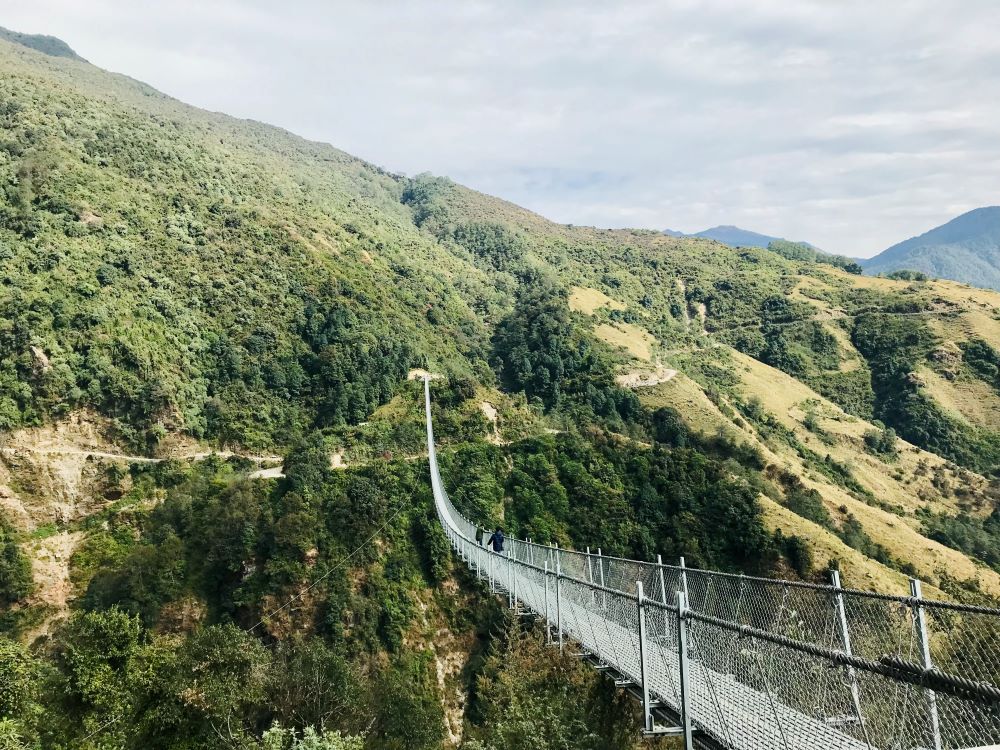
But the cables are strong. The cables hold. Alan is right. I would have regretted it, if I hadn’t. Despite my sore knee, I arrive in Sikles with a feeling of elation, as if I’ve just climbed one of the snowy peaks of the Annapurna range that are just beyond the ridge, every so often making themselves known as the road turns a corner right out on the edge of the slope.
We are welcomed by Gehendra Gurung, headteacher at the school in Sikles and proud representative of his village. Pahar Trust Nepal has raised funds for one of the buildings at the school and it is there we head to first, leaving behind the surprising hustle and bustle of the car park at the edge of the village, where the motorable road runs out.
‘Domestic tourists,’ Gehendra says, as we follow a narrow path through the trees towards the school. ‘Here for the weekend. Mostly just for the night.’
He will later explain that on a Friday evening at this time of the year there are roughly a thousand domestic tourists in the village, increasing the population by about 50%. Some come to be in the places where the family came from. To connect with their Gurung culture. Others come simply to escape the city for a few hours, to drink and be merry at 2000 metres above sea level, in the shadow of the Himalaya.
We are greeted at the school with garlands, but unlike most of our school visits during the trip it is not connected to an opening or stone-laying ceremony, and classes are all in session. So we move from classroom to classroom, meeting the children and young people, saying hello to the teachers, learning about what they are up to and telling them some things about our experiences in Nepal.
***
After classes end and the children head home along the narrow streets, Gehendra shows us around the village. The Gurung museum, with its collection of artefacts and other symbols and signifiers of Gurung culture. The places of worship and the community hall. The terraced “stadium” where the annual shot put competition is held. In a village built on such a steep slope, no-one is going to be throwing a javelin or a hammer. The guesthouses and hotels that have been built to meet the demand of increasing tourism, both domestic and international.
From the lookout tower at the heart of the village we can see across the valley at dusk. The lights of Tangting have begun to twinkle. Far down below, we know the river is flowing out of the mountains. Alan will descend the next morning, step after step, to cross the river only to climb up the other side. I am sad to not be going, but with the pain of each step up or down as we follow Gehendra through the village, I can admit to being a little relieved.

Tangting twinkles, but Sikles is going dark. There is a power cut and it will not be fixed for a number of days. It is a reminder that although the infrastructure has reached these mountain villages – the road, the internet, electricity – connectivity is precarious. As we have driven up, workmen are fixing a landslide that has taken out half the road. Each monsoon season something similar happens.
No matter. We have a firepit and some homemade Raksi to give us light and keep us warm, sitting outside Gehendra’s guesthouse as darkness swallows the valley. We talk and drink, listen to the challenges of running the school, of the impact of tourism on the village. Of what the future might hold. The plan is to be up with the birds, so after a couple more cups of Raksi it is to be an early night. For us.
***
Throughout the night we can hear the strains of the tourist parties across the village. Music plays through (presumably) battery-powered speakers. Guitars and other instruments. Drums. Lots of singing. A night to remember, if you haven’t drunk too much to forget. As we eat breakfast in the fresh morning air they are still going, the dawn chorus a mix of Nepali folk songs, off-tune singing, dogs and cockerels.
Across the valley, my friends in Tangting will be watching the sun sparkle against the snows of the Annapurna range. We’ve got the morning sun. They’ve got the view. Over the two nights I have spent in this valley, one in each of the villages that face each other, I have got a sense not only of their good-natured rivalry, but also what they share. The balances between developments that make life easier and also make it easier to leave. The desire to bring in new business while maintaining tradition.
In Gumlek they worry about better roads emptying the community even while they bring better services. In Sikles, they attempt to manage the weekly influx of revellers while preserving what makes the village special. Across the way in Tangting, Om Prakash attempts to make plans for what comes next.
What connects them, is what links them to communities in countries far away and very different to Nepal. The people who live above the Madi river could share similar stories with those on Scottish islands or villages on the edge of eastern Germany. The tension between tradition and modernity. Of the need for tourism to survive but to protect what makes a place special. The question for young people of whether to stay or to leave. The tales around the firepit of a past that is fading from view, and plans for an uncertain future.
Since this trip, Paul has become an Ambassador for Pahar Trust Nepal, a UK-based charity that works with their sister NGO in Pokhara to improve the standards of education, health and sanitation for hard-to-reach communities in Nepal.
Words & Photographs by Paul Scraton
