

Slowly but surely we leave the city behind. At Tokyo station we catch the Shinkansen south. It is sixty years to the day that the bullet train was launched, and we get ceremonial stamps for our notebooks before we climb the stairs to the platform and our allotted spot for boarding. It whisks us south towards Nagoya, where we switch to a Limited Express train that takes us towards the mountainous interior of the country, following the river ever deeper into the hills.
In Nakatsugawa, we get a feel for small-town Japan for the first time. Ringed with hills, and in the soft, late afternoon light, it is an appealing place. The local tourist association has a shop and a sake stand by the station. The brewery is not far away, in the tiny cluster of wooden buildings that are surrounded by the modern town but link it to its past as one of the stations on the historic Nakasendō, the main highway between Kyoto and Edo (present-day Tokyo) during the Tokugawa shogunate (1603-1868), when it linked the old capital with the new.
But that is for another day. For now we try the chestnut sweets and sip the sake as darkness falls on the town. By 8pm the place feels like it has already gone to bed. Only the 7-Eleven shows any real sign of life. A row of kei cars parked out front. Schoolkids still in their uniform, stopping on their way home. A local drunk swaying outside the automatic door. The brilliant bright lights of the convenience store, vivid against the black sky.
***
The next morning we cross the Kiso river, having walked out of town through a neighbourhood of detached family homes, a cemetery and some small shops and workshops among the houses on the narrow streets. Tomorrow we will be on the Nakasendō but today our destination is the Naegi Castle Ruins, high on the hill above the riverbank.
As we follow the road along the river towards the start of the climb, we pass the entrance to a construction site. A man in a hard hat sits on a stool by the entrance, sticks in hand, to direct any vehicles that might be entering or leaving the site. Otherwise the scene is distinctly rural. Small houses and cultivated fields. Patches of bamboo forest. But the man’s presence, finding shade where he can in the autumn soon, is a sign of what is soon to come.
At this point on the river, a tunnel emerges from the mountains that will eventually carry the new Chūō Shinkansen. This inland maglev train will slash travel times between Tokyo and Nagoya to about forty minutes. There will also be a stop at Nakatsugawa. It took us about three hours to get here yesterday. When the new line opens, the travel time to the capital will be about thirty minutes. This pleasant town in the hills will suddenly be within commuting distance of Tokyo. What it will do to Nakatsugawa remains to be seen. But what is sure, is that it won’t be the same.
But perhaps we should see the new train more like a kind of return to the past, when Nakatsugawa was an important staging post on the old road between Kyoto and Edo. When the train runs, travellers will be carried beneath the old road and through the mountains, a modern-day Nakasendō moving at speeds of 505 kilometres-per-hour.
For now, the scene remains peaceful, even as construction continues beneath us as we climb the bluff beside the river to the castle ruins. There is a winding approach road up the other side of the hill, passing by cemeteries and other symbolic sights as part of the main route to the castle when it was still standing. But we are climbing the Shijuhachi-magari, the ‘48 curves’ that wind their way up the hillside through a forest of cypress, bamboo, chestnut, oak and maple, a secret path that the daimyō (feudal lords) would once use if they wanted their visit to Naegi to be kept quiet and their arrival hidden from prying eyes.
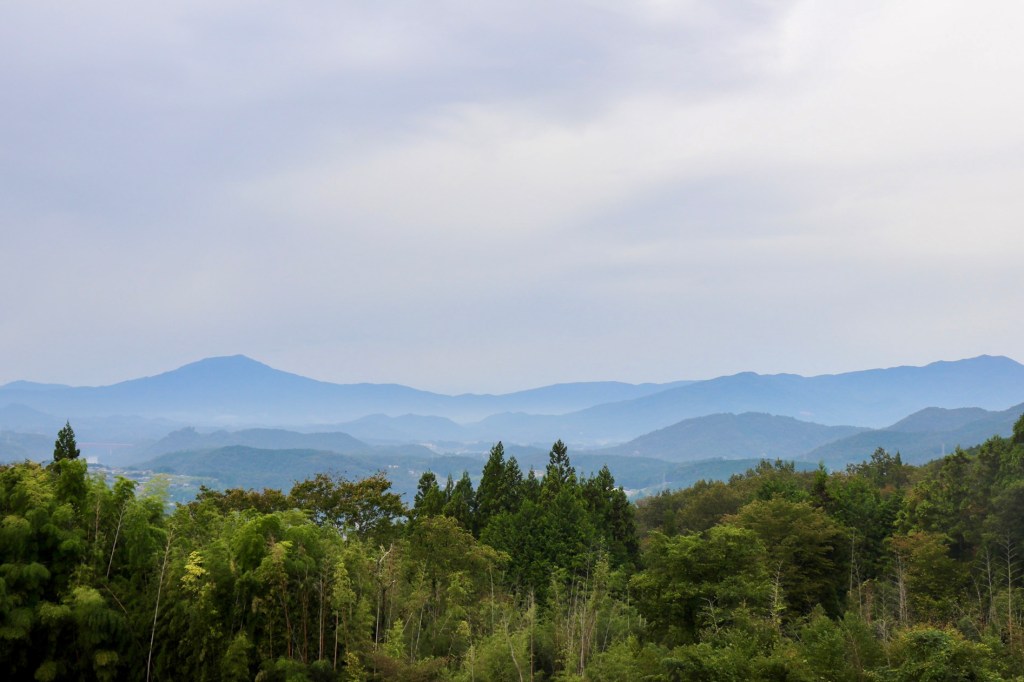
From the ruins we look down upon the river and across the hills towards Mount Ena, source of the water for the local sake that is named for the mountain. The blessing to use the name Enasan came from the head priest of the Ena shrine, who clearly approved of what the water was being used for.
May Sake brewed with the waters of Mount Ena bring joy to all those who drink it…
Our descent from the ruins takes us back into town and the sake brewery, to try it for ourselves.
***
Outside Nakatsugawa station, the hikers are beginning to gather in the early morning light. Some have arrived on a train from the south, from Nagoya or even further away. Others have walked from their hotel or guesthouse, their hiking poles click-clacking on the pavement as they go. We are meeting Nick, our guide through the Kiso Valley for the next couple of days. He’s arriving on a train from a few stops to the north. We wait in the car park by the bus that will eventually deliver us to the trail, as the driver smokes a cigarette with the unhurried experience of someone who knows he has plenty of time.
We could have started our walk along the Nakasendō from our hotel, as it passes right by the front door, but Nick had recommended we take the bus to skip the trudge through the outskirts of a town that has, as we had already seen, long outgrown the confines of the historic post station.
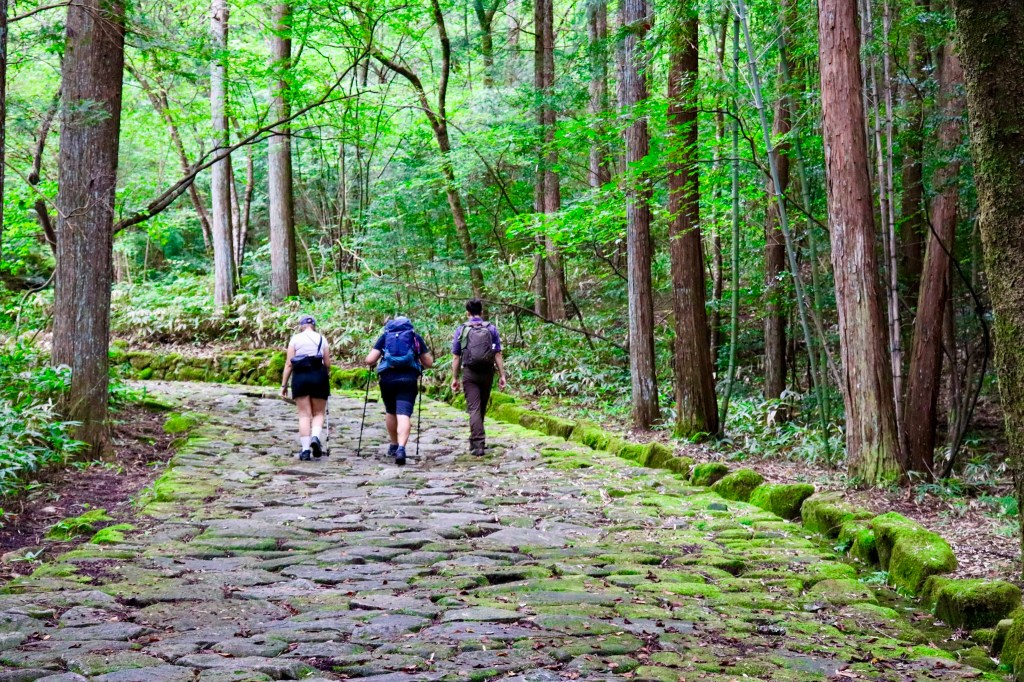
The Nakasendō, Nick tells us, as we start our walk from Ochiai-juku, the forty-fourth of the the sixty-nine stations along the trail, was not so much a transportation link between Kyoto and Edo as it was part of a sophisticated system of control. The shogun, fearful of what the daimyō might get up to if left to their own devices in the provinces, decree that they were supposed to spend every second year in the capital, while their family remained in Edo permanently. This meant that once a year the lords and their retinues travelled either to or from Edo, along one of five routes lined with staging-posts to ease their passage. These journeys cost time and they cost money, leaving the daimyō with little of either that they might use to plot or conspire against the shogun’s authority.
Altogether, the Nakasendō runs for 534 kilometres, of which we are going to walk about sixteen. From Ochiai-juku to Magome-juku, and then across the Magome Pass to Tsumago-juku. This is the most popular of the stages on the trail, and Magome and Tsumago are two of the best preserved of the historic post times. Most of the others are like Nakatsugawa, long engulfed by modern towns and cities, even if they usually maintain a handful of Edo-era buildings to be spotted among more modern constructions.
In Ochiai we stop to explore a crumbling Buddhist temple before following a steep road into the mountains. It is this topography, we begin to learn, as much as anything else, that has kept – at least in part – modernity away from this stretch of the trail.
***
We pass through a forest along one of the few remaining stretches of old cobbled road as Nick tells us about how much of the old growth trees were removed as part of the national reconstruction that followed the devastation of World War II. Today, the forest in much of the Kiso Valley is fast-growing cedar. But there remain patches of the five sacred trees that are still revered in this part of the world: the sawara, the asuhi, the nezuko, the koya maki and the hinoki.
These trees were traditionally so important that they were protected, and could only be used for special buildings such as temples and shrines. For those who ignored their protected status, the price for unlawful felling was severe. One tree, one head. One branch, one limb.
As we walk we are afforded views across the hills of the valley to the mountains beyond. The forecast has been for rain and the cloud is low in the sky, but with the mist rising from the valley floor and clouds clinging to the mountain tops, it is somehow everything you could wish for from a walk in the Japanese countryside.
At Magome-juku we wander the old streets with their waterwheels and beautifully maintained wooden buildings, stopping for coffee and then lunch in a wooden mountain hut set back from the trail, where hikers rested in front of steamed bowls of noodles and soups and the walls are decorated with greetings from tired wanderers from around the world.
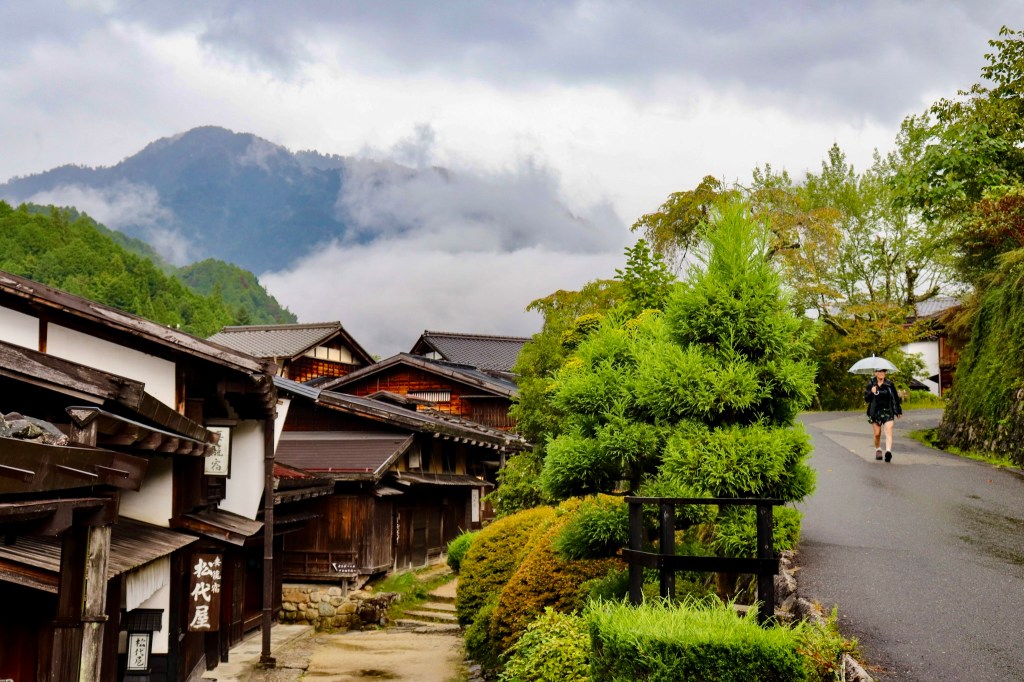
As we walk, Nick tells us stories of the trail and of his years living in Japan. Every so often we pause our conversation to take in the view, explore another shrine or temple, or to ring the bells that warn any neighbourhood bears that we are passing through. As we reach the high point of the walk at the Magome Pass the rain begins to fall, chasing us down the slippery trail through the forest until we reach Tsumago-juku.
***
‘Shall we step inside for a moment?’, Nick says.
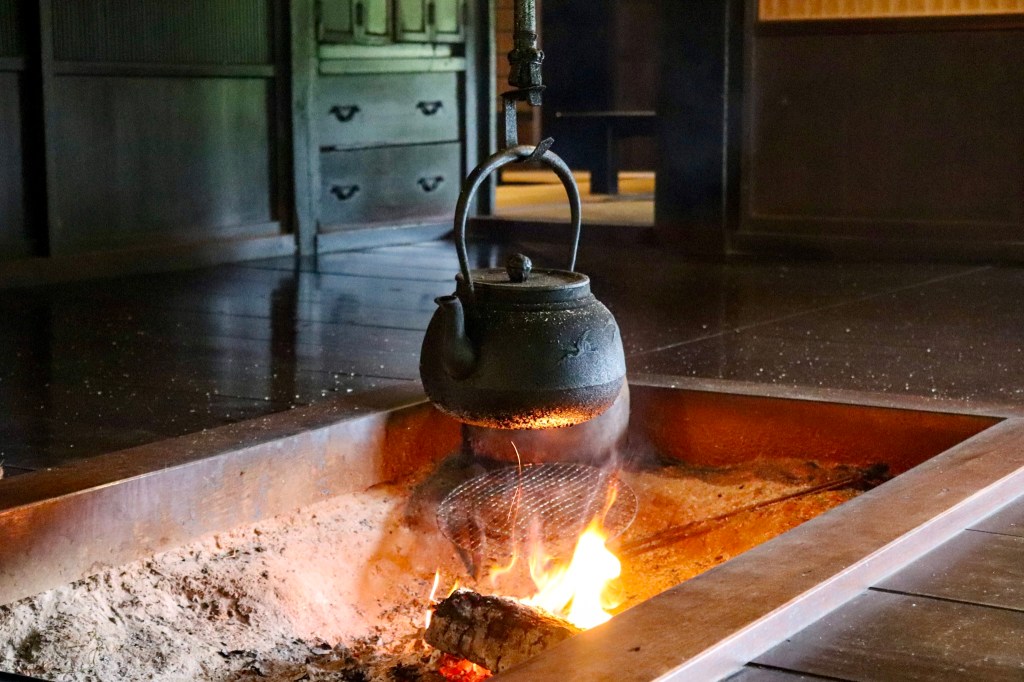
At one of the few remaining Tateba or tea houses along the trail, a group of volunteers maintain the space – including a traditional hearth with kettle – to provide free tea and a chat for those hiking the route. We add our nationalities to the list on the chalkboard outside and get out of the rain for a moment, while the friendly man shares the story of the building with us via Nick, who translates as the man talks.
The rain is falling heavier as we arrived in Tsumago, and we hurry along the main street to find a tiny bit of shelter beneath the awning of a house. We drink a beer to celebrate the end of the walk and look back towards the hill that we descended in the rain. Here, the town looks somehow older but also a little less cared for than Magome. Nick tells us about the preservation rules of the town, about how electricity cables are kept out of sight and how only those local to the town were allowed to own or rent buildings here. The problem is, if you want to sell, it is not always easy to find a buyer.
The staging posts of the Nakasendō are no more immune to rural depopulation than the rest of Japan, but even if outsiders want to come to restore some of the buildings that have fallen into disrepair, the rules do not allow them. Here is a town that owes its present-day success, as measured in the number of hikers both Japanese and foreign crossing the pass from Magome, to its obscurity and the fact that it somehow avoided the Japanese post-War economic boom and subsequent construction mania. As so often in a tale of preservation, heritage, tourism and modernity, there are no easy answers.
***
The next day we explore another corner of the Kiso Valley, exploring the Akasawa Natural Recreational Forest with Nick and Tanaka-san, a volunteer forest ranger who tells us the history of what is one of Japan’s three forests of outstanding beauty. Akasawa, where the forest grows on steep hillsides above a fast-flowing river, is a place of 300-year-old Kiso cypress trees and where shinrin-yoku or forest-bathing therapy was first developed in the 1980s.
As we walk along sodden trails, Tanaka-san rings the bells as we go, to give the bears fair warning that we are on our way.
‘Did you ever see a bear?’ we ask him, and he smiles.
‘Not this year…’
For centuries, Tanaka-san tells us via Nick, the Kiso area has been renowned for the quality of its wood. It was to do with the climate of the valley, and the fact that the cold means the trees grow slowly but extremely solidly, making the timber much more durable that from trees grown elsewhere in Japan. It was this reason that the forest was long protected, and why the punishments (One tree, one head) for illegal logging were so severe. During the Edo era, local villagers were forbidden from even walking the forest trails, and over time the five revered tree species recovered. And although elsewhere in the valley these trees have been replaced by faster-growing varieties, in Akasawa the long-running protections have been maintained to this day.

We come to the site of the felling of two trees, one of the few allowed instances of harvesting within this protected forest. Every twenty years, two trees are selected to be used for the Ise Shrine. It takes a long time for the trees to be selected, for they must be perfectly straight, not twisted at all, and close enough to the other that they can fall across each other. The consequences for a felling where the trees don’t cross presumably don’t bear thinking about.
The next ceremony will take place in a year from our visit, and if the trees have been selected, Tanaka-san is not telling.
***
At our hostel, a beautifully restored old building high in the hills above Nagiso, we watch the rain fall and the mist cling to and caress the mountains that surround us. We collect our stories of the trail, and the forest, the ones that Nick has told us or those shared by Tanaka-san, and the ones we have made ourselves, sharing space with the gentle piano and electronic sounds of Ryuichi Sakamoto, whose album swirls around the hostel dining room like the clouds on the hillside beyond the window.
As darkness falls, the rain finally stops, and the sky above the valley begins to clear for the first time in a couple of days. I am reading Matsuo Bashō, Japan’s great poet and someone who found inspiration in the forests and the landscapes of the country through which we have been walking.
Regardless of the weather, he writes, translated into English by Nobuyuki Yuasa,
The moon shrines the same;
It is the drifting clouds
That make it seem different
On different nights
We dry our boots by the fire, sip beer and sake, and look out into the darkness where the moon now shines down onto where the forest sleeps below. Soon it will be time to sleep and to dream, of our footsteps on the trail and between the trees, of the travellers we have followed, of sacred trees and shy bears, and the poetry of Japanese mountains in the mist.

Words by Paul Scraton
Photographs by Katrin Schönig
Note:
We spent two days in the Kiso Valley in the company of Nick from Uncharted Nakasendo, and we can recommend his guiding service wholeheartedly. He was not only a wealth of information about the trail, the surrounding region, its history and its culture, but also gave us an insight into contemporary life and society in Japan that would have otherwise been inaccessible to us. The Nakasendō hike is undoubtedly a great start to exploring the region, but Nick also offers a range of hikes and experiences that are well worth your time.
