
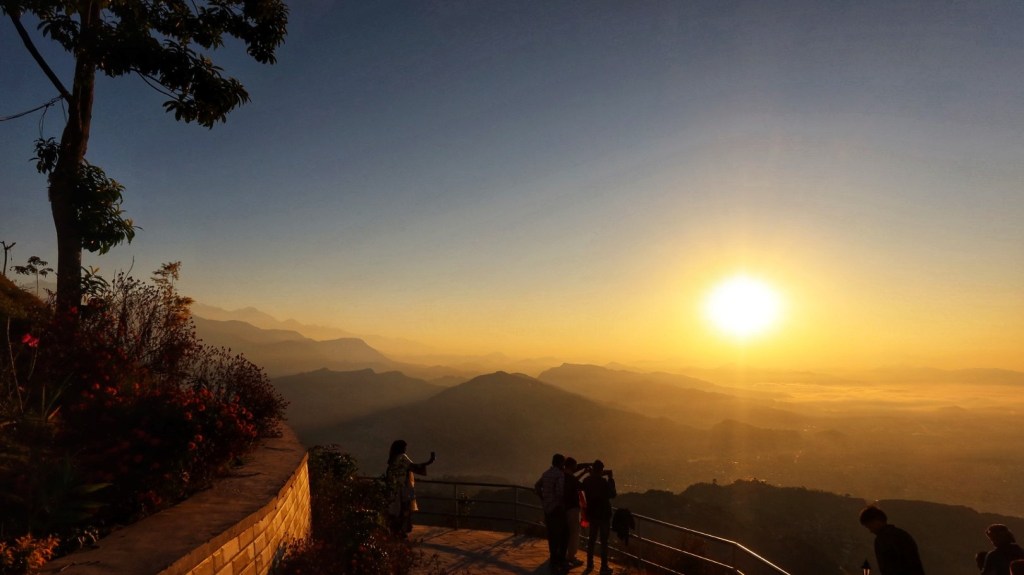
The sun is barely up as we step out of the hotel onto the pavement at Lakeside. All the stores that throughout the day and into the evening are selling outdoor clothes, singing bowls, cashmere jumpers and all the other things that are likely to appeal to travellers drawn to this part of the world are shuttered and closed. A few people are making their way to work. The local dogs, after a night of barking, are preparing for a day of snoozing in a comfortable patch of sunshine. Everything is calm.
Not so much the taxi driver, who appears either wired after a long night shift or is someone who wakes up each morning with a bang. Originally we had only hired him to take us to the cable car, but he persuades us that if we let him drive us up the mountain, it will be considerably cheaper, and he’ll wait to bring us back down again. As we weave in and out of imaginary traffic (the roads are empty) we find ourselves agreeing. In a second he’s done a U-turn and we are heading in the opposite direction. For before we can climb the mountain, we need to approach it from the right angle.

Depending on where you are in Pokhara, the mountains of the Annapurna range loom over the city. But at Lakeside, unless you are high up in a building or on the right roof terrace, the view of snowy Himalayan peaks is at least partly obscured by the wooded slopes of Sarangkot, a hill that stands about 800 metres above the city and Lake Phewa below. The hike up Sarangkot has long been a favourite of adventurous travellers, to catch the sunrise or the sunset on the mountains. For a few years now, a cable car has linked the lakeshore with a station just a short walk from the summit. Or you can take a taxi.
The road snakes up the hill, through patches of jungle and villages clinging to the hillside. We pass by women sweeping their front steps in the early morning light and men hosing down their mopeds. Kids already in school uniform play in the road. More dogs stroll and sniff and only move out of the way of the oncoming taxi at the very last minute. The closer we get to the summit, we come to hotels and lodging houses, their guests stringing out along the road as they walk up towards the temple and the viewing tower at the top.
As we drive we occasionally catch a glimpse of a big mountain through the trees, the morning sun hitting the upper slopes of snow and ice and rock. But it is only when we get to the car park and climb the steps, skirt the temple and pay the tiny admission fee, that the view really opens out. Dhaulaugiri. Annapurna. Manaslu. Three eight-thousand metre ranges rising up like a wall across the valley below. The sacred Machhapuchhare (Fishtail), a little lower than the giants but never climbed. And in the other direction, the soft hills falling away to the plains, Phewa Lake and the city stretching out along the highway.
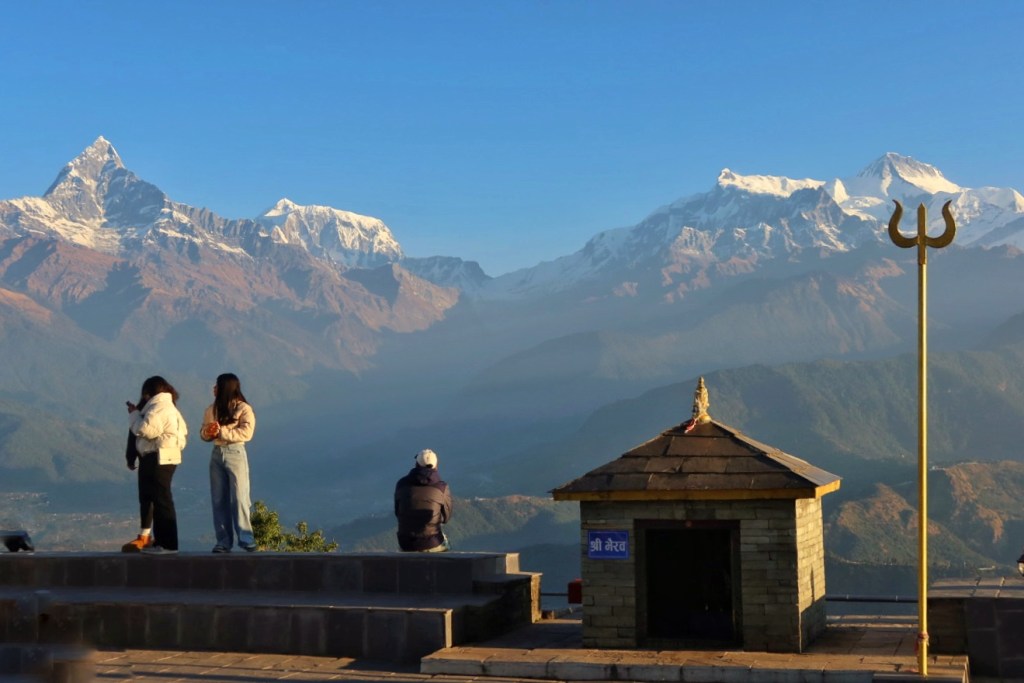
“Where are you from?” a young lad asks. I tell him. And him?
“Here,” he says, pointing at the ground and then lifts his hand towards the mountains in the early morning light. “Nepal. Beautiful, eh?”
He’s not wrong.
Why travel to Pokhara?
Most travellers to Nepal will, at some point during their trip, find themselves in Pokhara. Or more specifically, they will find themselves in Lakeside, the part of the city that meets Phewa Lake and arguably the outdoor capital of Nepal. A walk along the Lakeside Road will tell you why people are here, as every second store seems to offer treks or paragliding, white water rafting, ziplines or bungee jumps.
Pokhara tends to be the place people come before and after a trek in the Annapurna region, including famous routes such as Annapurna Base Camp (ABC), the Poon Hill Trek, the Mardi Himal Trek, or the iconic Annapurna Circuit. During our most recent visit, we completed the Poon Hill Trek over five days, a very leisurely and yet still strenuous introduction to trekking in the region.

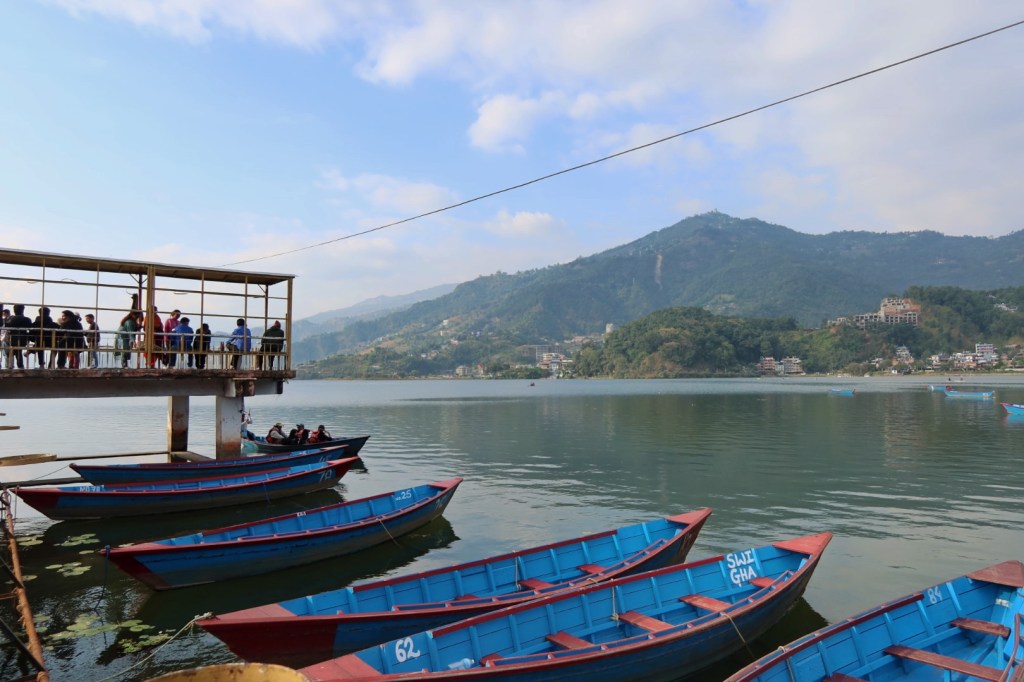
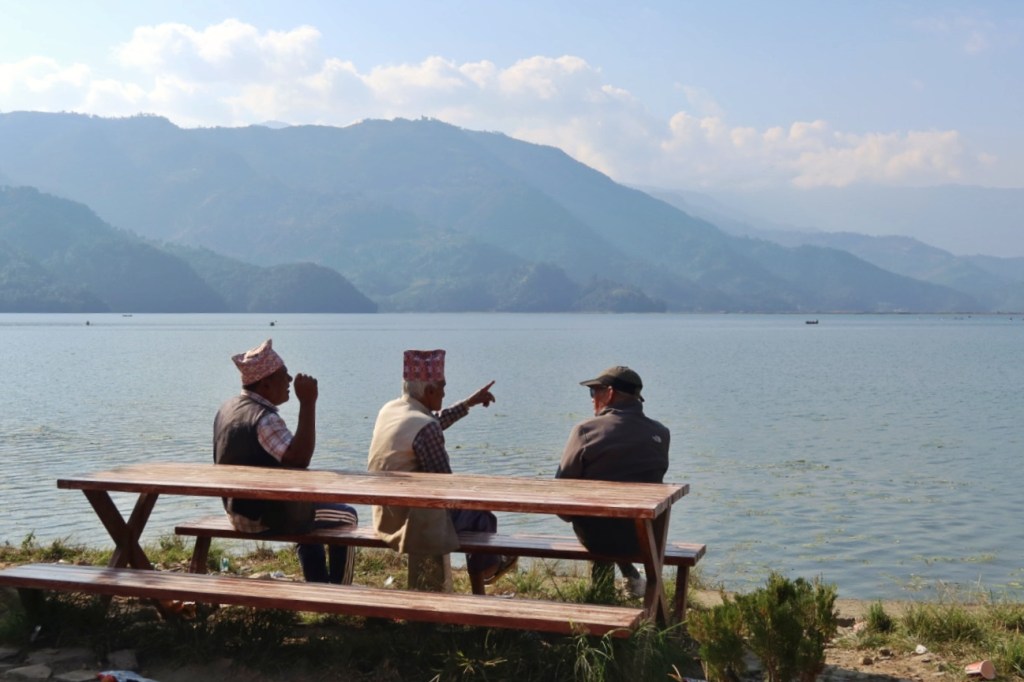
But the city itself has lots going for it. Lakeside, with its promenade along the water and countless boat, SUP and kayak rental opportunities, is a brilliant place to relax awhile between more energetic activities. There are nice restaurants and bars, comfortable hotels, and if you take some time to explore deeper into the city itself, you’ll also get a feel for urban life in Nepal quite different to what you’ll find along the main tourist strip.
Mountaineers, trekkers or anyone who simply loves looking at the high places, should head for the International Mountain Museum, with exhibits about the people, ecology, expeditions, climate and art of the Himalayas. There is also a moving memorial in the grounds to all those lost to the mountains. For anyone interested in the history of the Gurkhas – the Nepali soldiers who have fought bravely for the British and Indian Armies – the Gurkha Memorial Museum tells just some of their stories.
Favourite walk in Pokhara
One popular day hike (or energetic morning) from Lakeside is to the Shanti Stupa (Peace Pagoda), a Buddhist shrine that sits atop Anadu Hill at 1100 metres and about 330 metres above the lakeshore. Trekking companies in town offer day hikes with a guide, but it is relatively straightforward to make the hike yourself. The route uploaded to AllTrails suggests taking a boat to the dock at the bottom of Anadu Hill before the steep ascent, but if the day is clear then the view across the lake and beyond Sarangkot to the Himalayas is certainly worth the effort.
Our five-day trek from Pokhara to Poon Hill (there are variants of this trek for two, three and four days) was organised through 3 Sisters Adventure Trekking, a company founded by – yes, you’ve guessed it – three sisters in the 1990s to empower women through guiding. They not only offer tours with female guides, but also run a training programme to bring through the next generation of guides, breaking down barriers for Nepalese women and promoting sustainable adventure tourism.
Travel tips for Pokhara
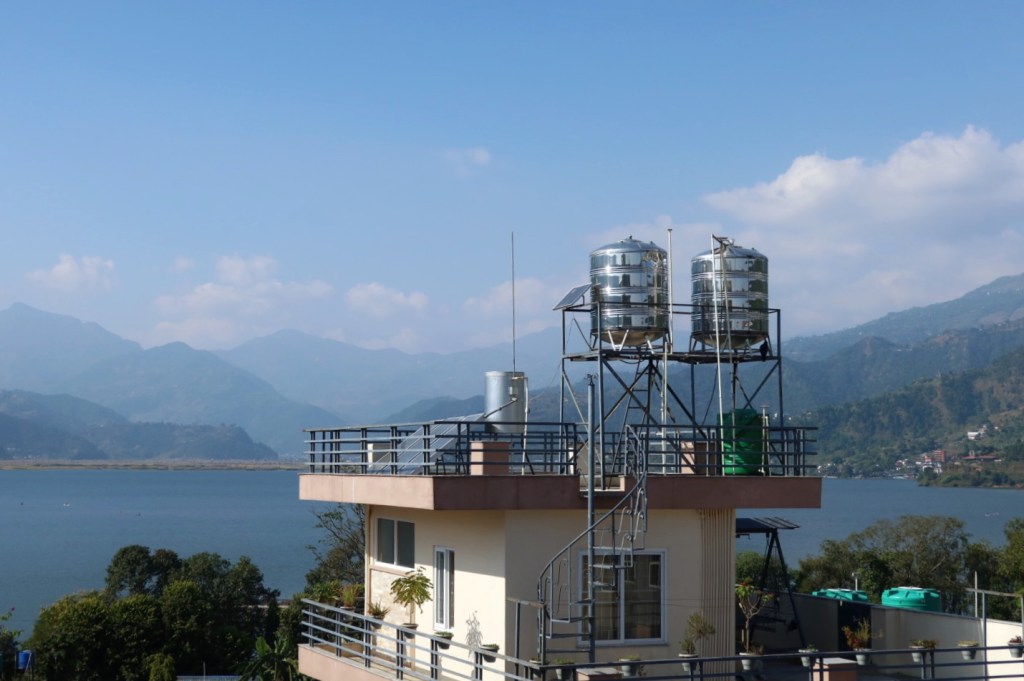
There are loads of accommodation options to choose from in Lakeside and elsewhere in the city. Our chosen homebase for visits to Pokhara and the surroundings has always been Hotel Adam, where the people are lovely and always treat us like family. The rooms in the new wing offer some fantastic lake views, as does the terrace where breakfast is served, and if you go up onto the roof you can even spy some Himalayan peaks. There is even a swimming pool, although with our visits usually landing in November and December, this can be a bracing experience.
There are plenty of great bars and restaurants in Lakeside. Silk Road is a cafe and bar not far from the 3 Sisters headquarters, with a garden overlooking the water and a great place for breakfast or lunch. For an early evening drink, people-watching by the lake, we tended to drift towards Bamboo bar where the fire kept us warm against the evening chill. Our favourite restaurant is probably Utopia Garden, tucked away between the lake and the main drag, with great food and a very friendly welcome. Always say you like it spicy, when they offer you a dip for the popcorn.
Our trips to Nepal are always linked to our support of Pahar Trust Nepal, a UK charity and Pokhara-based NGO that works to improve standards of education, health and sanitation in hard-to-reach communities. Since 2023 Paul has been an Ambassador, and for anyone who loves Nepal or would like to support this incredible work, then please take some time to explore the PTN website or read our essay from the hill villages outside Pokhara to find out more.
Words by Paul Scraton
Photographs by Katrin Schönig
