
On our last morning in Denmark we walk down to the beach beyond the copse of beech and pine that separates the campground from a ribbon of farmland, drained and managed by narrow channels that act as property lines along the coast. It is summer, but the sky is overcast and moody. The Kattegat, that body of water that sits between Denmark and Norway as well as the Baltic and North seas is grey-green and still, the surface populated by hundreds, if not thousands, of jellyfish. In the distance, it is hard to see where the sky begins and the sea stops.
Our goal is the opposite side of North Jutland, this island that sits like a cap atop the head of Denmark. It’s a pointy hat, and from where we are right now the drive will take a little more than an hour and a half to reach the other side. It is a drive across a landscape where we have been watching clouds race and skid across the sky while casting fast-moving shadows through the fields below. A place where houses are built, hunched and defensive between ripples in the heath and moorland. Where the further west you go the trees seem to shrink and curl, shaped by the wind.
This is a place where the horizon appears at all sides at once and yet the sky feels endless and ominous, a place where everything that stands beneath on this wind-worn land cannot help but seem small. A mountain landscape can make the traveller feel insignificant. But so too can a prairie, a marshland or, as we found as we drove from coast to coast along narrow roads, straight and true, the lonely interior of North Jutland.
***
Approaching the coast we can sense the North Sea before we set eyes upon it. The land has become more rugged the further west we drive, and the line of grassy dunes that seem to rise up ahead of us before the road runs out let’s us know we have reached what the Danish writer Dorthe Nors described as A Line In The World. Her book about the windswept coastline that stretches from the northern tip of Denmark down through Germany to the Netherlands has been our companion throughout our time in North Jutland. Now we are about to experience the places she so poetically describes all for ourselves.
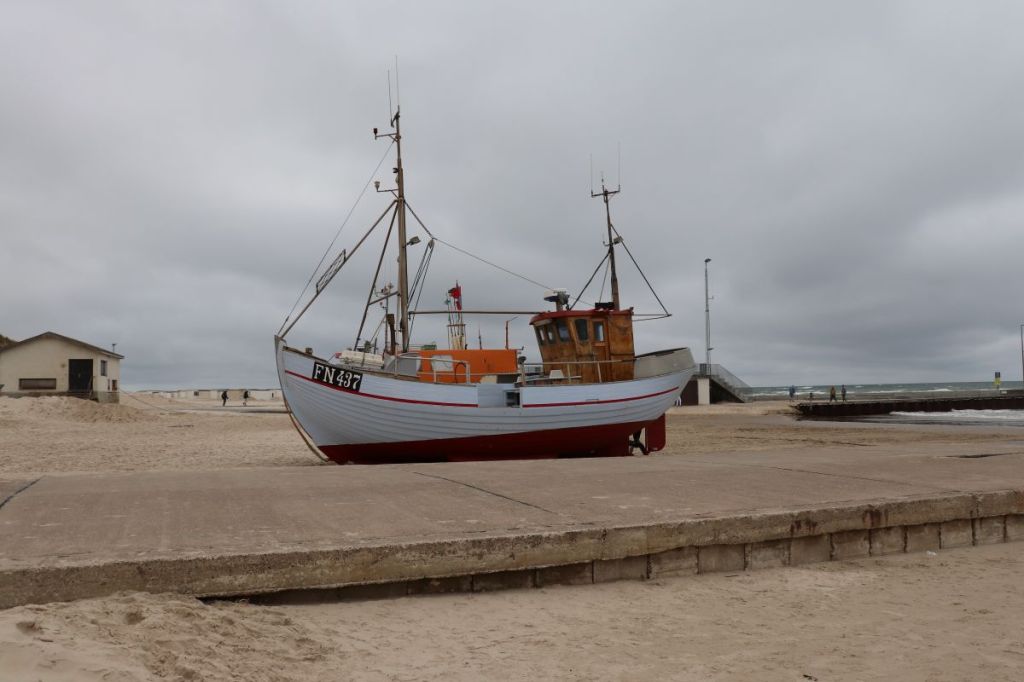
In Løkken, it feels easy to forget that we are in the middle of the summer holidays. The town itself is protected somewhat from the wind blowing in off the sea, but the strollers who make their way between outdoor shops and ice cream parlours, hot dog stands and souvenir stalls, are wrapped up as if anticipating the turning of the season. Leaving the last of the buildings behind, the road curls between two tall dunes and it is impossible to see the point at which the asphalt gives way to sand.
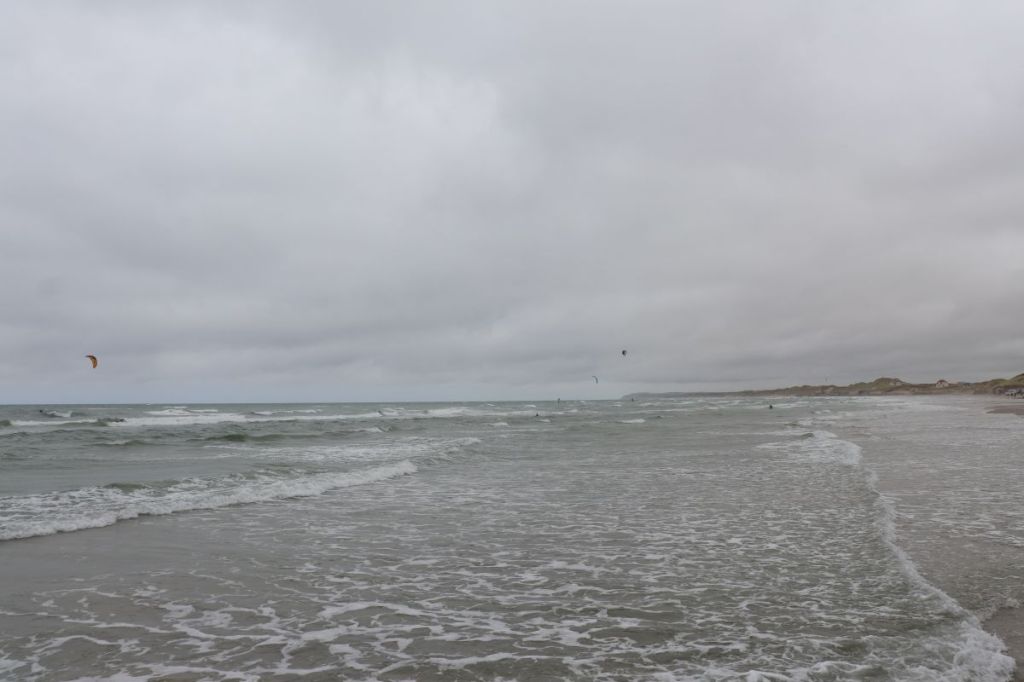
Compared to the composure of the Kattegat that we left behind a few hours before, the North Sea is vast, restless and unruly. Fishing boats have been pulled up high onto the sand, and the white summer houses are beginning to be closed up for the autumn, the sand drifting around them. Kite surfers have braved the waves, riding the white horses beyond their final breaking point. The wind whips, a stinging crack to the cheek. We escape back beyond the dunes to the white houses of the town, huddled in their shadow, in search of warming tea, coffee and hot chocolate.
***
How is it possible to love a landscape that feels like it is out to get you? How do you build a sense of belonging in a place that treats you so harshly? We travel on, north towards Lønstrup, a place where there is a scar in the town, like a furrow created by a stick dragged through sand, the result of a great storm that made landfall on a day not dissimilar to this in August 1877 and destroyed twelve houses as the sea reached far into the land.
Nors’ book is full of such stories. Of fishermen who ride the storm out to sea only to return and find their worldly belongings pulled out with the tide. Of moments when it became all too clear that the line between water and solid ground is never fixed. That maps can change and people’s lives with them. “When a landscape is in motion,” Nors writes, “people and buildings are compelled to follow…”
And yet she loves it. She is drawn back to these places of her past. Of her childhood and of a family who lived here for generations, long before she had even been imagined. A place that she once again calls home. What is it that is calling her?
“I want a storm surge” she thinks. “I want a north-west wind, fierce and hard. I want trees so battered and beaten they’re crawling over the ground. I want beach grass, lyme grass, crowberry stalks and heather that prick my calves until they bleed, and salt crystallizing on my skin. I want vast expanses, wasteland, wind-blasted stone, mountainous dunes and a body language I understand. I want to wake beneath a sky that is grey and miserable, but which creates a space of colossal dimensions in a second, when the light comes ashore. A horizon is what I want, and I want solitude.”
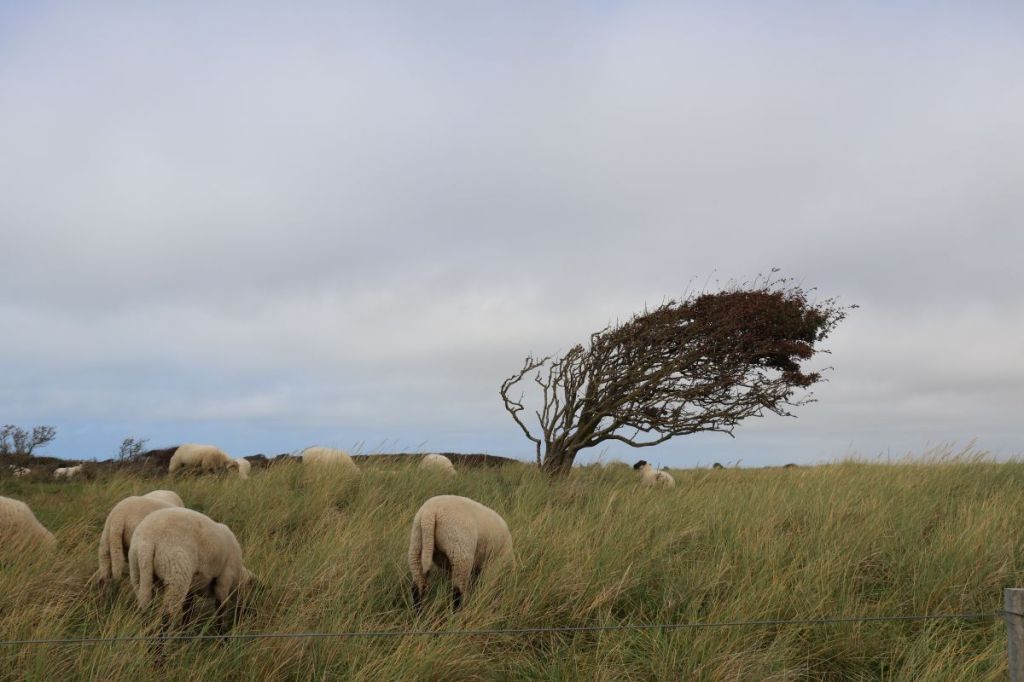
As we drive along Nors’ line in the world, experiencing it for the very first time, there is something that I recognise. We stop in a car park beside some tall dunes. The sand skitters across the ground between the vehicles. Beyond the fence, sheep graze on tough grass between gorse bushes. I have never been here. But I know this place. I can feel it on my cheeks and I can smell it. Salt and sand and seawind and wind. When senses link the world around you to your memories, you can find home wherever you happen to look.
***
I grew up half an hour from the coast at Birkdale, spending most weekends playing hockey in Formby, a place where we would also follow sandy tracks through the pines and the domain of the last of the red squirrels, heading towards the dunes, the beach and the Irish Sea, oftentimes far away across a seemingless endless expanse of sand, as we tried to spy Blackpool Tower to the north or the Welsh hills far away to the south.
Our holidays, more often than not, were spent in Rhoscolyn at the southern end of Ynys Gybi (Holy Island), having driven south through Liverpool and beneath the Mersey, following the North Wales coast and its line-up of caravan parks, sandwiched between the road, the railway line and the sea. Before the bypass was built we would get caught in traffic jams beneath Conwy Castle before eventually crossing the Britannia Bridge above the Menai Straits on our way onto Anglesey, waiting for the first glimpse of the tower at the aluminium plant that told us we were almost there.
No-one in our family lives in the small town in Lancashire where I grew up, so Rhoscolyn is now the place that I have been going to longer than any other. Late last year we celebrated fifty years since my Uncle and Aunty moved there, a few years before I was born. The path from their house across the headland to the Irish Sea, with its view back across Anglesey to the mountains beyond, and then along the coastal path that now circles the island, is my favourite walk in the world.
Half a lifetime ago I moved to Germany, to landlocked Berlin at least three hours from the sea. But through my partner Katrin I learned a new coastline. One of her childhood and youth. The Baltic shore is a strong part of her identity, and has become a key place for us as we built our family. Our daughter Lotte has spent much time in Ahrenshoop and Wustrow. On the islands of Usedom and Rügen. She has found her own connection to the Baltic, just as she has built her own relationship to Rhoscolyn. A family of shared memories among the dunes and atop the rocky cliffs.
***
The German Baltic is a very different landscape to the Irish Sea coastline of North Wales. But they share, along with Denmark’s North Sea shore, those places that trigger memories of anyone who spent significant periods of their youth by the seaside.
“Thousands of other people’s memories coexist here.” Nors writes, “Memories of a summer’s day, of a stinging jellyfish, of a storm. Memories of blind man’s bluff. Memories of violence. Of people who came and went, of houses that once stood but stand no longer. People on foot, people on horseback, and now the sky is high with summer.”
During more than two decades of Germany, we have also crossed from the Baltic to the North Sea, where we found reminders of other places beyond the horizon. On the island of Föhr we watched the tide rise and fall, just as we did on springtime weekends in Southport. In Sankt-Peter-Ording the seaweed smell took me back to Rhoscolyn beach on an autumn day. In Busum the call of the gulls as they followed the trawlers was the soundtrack of a summer morning in Wales.
***
In North Jutland, the sandy trail leads out from the car park between grassy fields where sheep graze. We can hear the waves crashing against the shore but the tallest dunes we have seen all day are blocking our view. We are not the only ones struggling with the wind and the sand whipping up into our faces. By the time we reach the point where the fields retreat and the dunes rise up on either side of us, we have joined a procession of sorts. It is a kind of secular pilgrimage, as we make hard work of each step through the sand.
‘You must see the lighthouse,’ our hosts on the opposite side of Jutland told us. ‘We thought we were going to lose it, to the sands and the sea. But then they moved it. Can you imagine?’
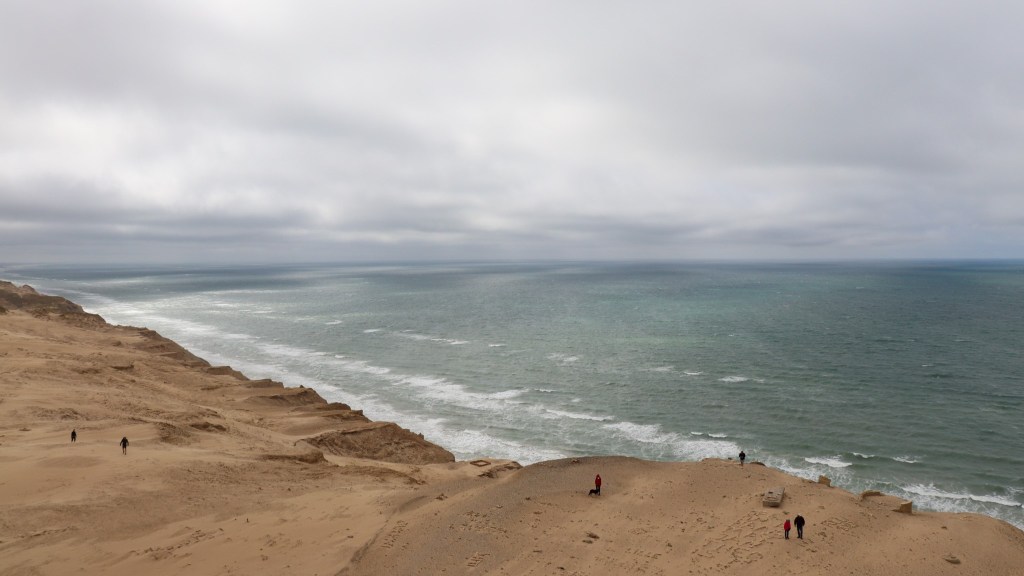
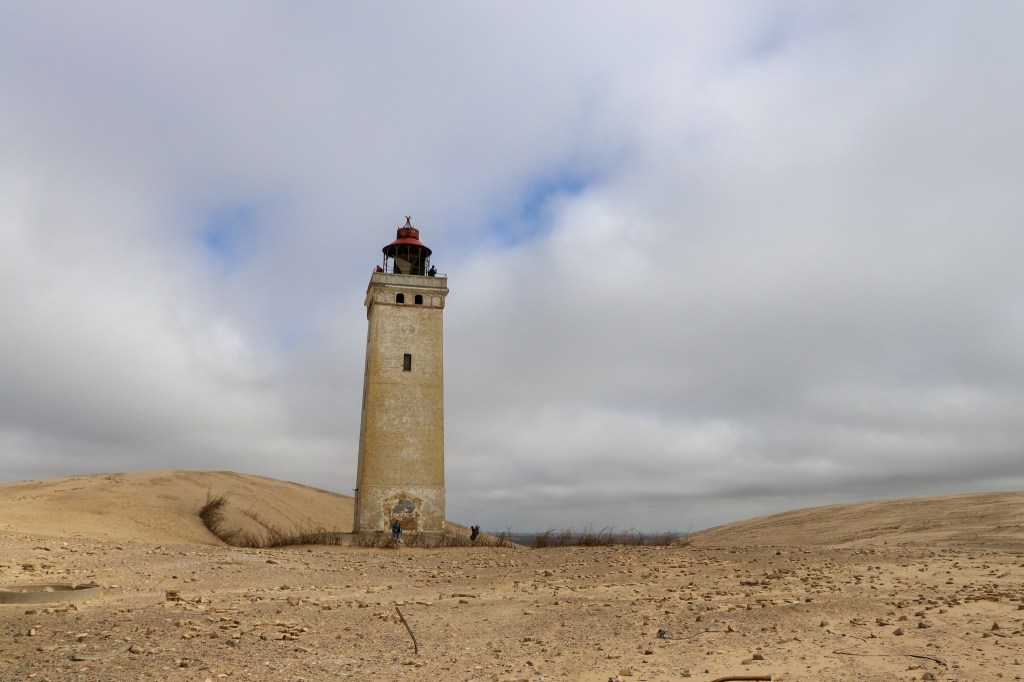
The Rubjerg Knude Lighthouse was built in 1900 on the high point of the cliffs looking down on the North Sea shore. At this moment in time, the high point was sixty metres above sea level and some two hundred metres inland from where the waves pummelled the sandy cliffs. Shifting sands and coastal erosion went to work, and despite various efforts to mitigate the effects, in the first fifty years of the lighthouse’s operation the coastline was eroded by an average of a metre and a half each year.

By 1968 the lighthouse had been shut down, and basic calculations made clear that it would not be that long before the structure would succumb to the forces of the wind and the sea and be claimed by the waves. By 2019, it was clear that there was not long to go. By now it was only six metres from the water’s edge. And at this point, it was decided to save it.
All 720 tonnes of the lighthouse were moved inland to safety. This was achieved by putting the lighthouse on rails and rolling it back seventy metres away from the shoreline. If the calculations are right, this should keep it safe and upright until 2060 at least.
Once at the lighthouse, a staircase offers us access to striking views of the coastline, where it is easily possible to imagine how the power of the wind and the waves can shift and push and move the land to the point where even buildings erected two hundred metres from the shore are not safe. It’s not altogether clear, as we stand in the shadow of a lighthouse that has been decommissioned almost as long as it was ever working, what the point of saving it was. But beneath those big Jutland skies, all of us who have made the trek across the sands seem to be in unspoken agreement that we were glad they had.
We think of Nors again, her landscape in motion, the people and the buildings forced to follow.
***
From the lighthouse we drive north, towards Hirtshals and the ferry to Norway. We have time, plenty of time, and we stop along the way. Another sand-strewn car park. Another path between the dunes. The smell of salt. The sting of the wind. The waves are rolling in here, uninterrupted lines beneath a clearing sky.
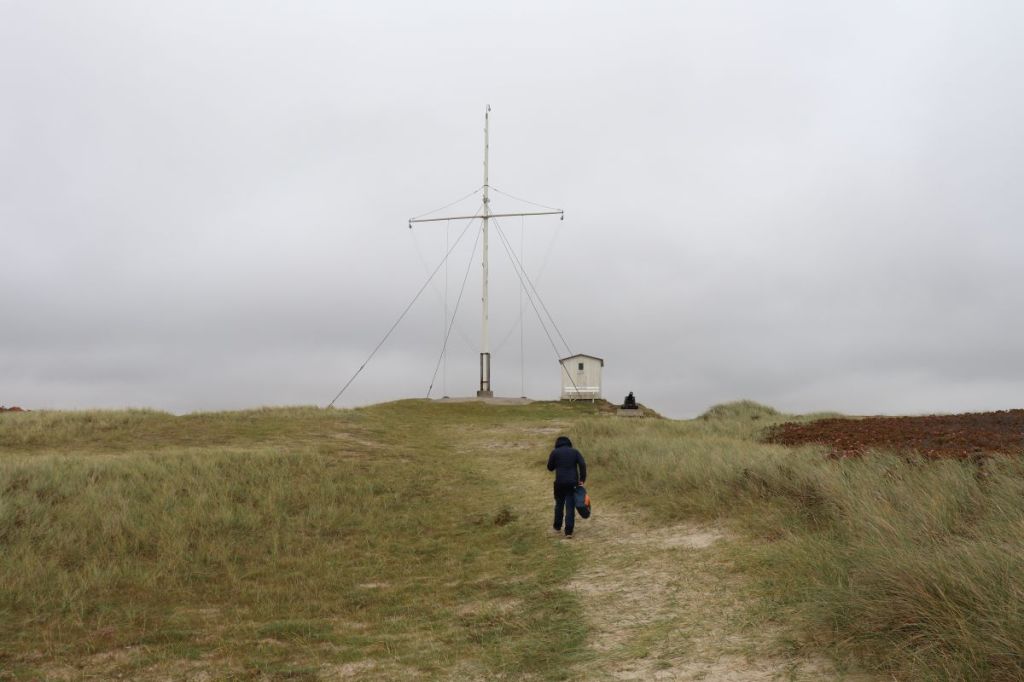
Look out, into the offing. Beyond it, I imagine the island of my youth. The geography is not quite right, but there is a truth to this somehow. Standing by the shore in Denmark, looking out to sea, I feel like I have found the connection between the two homes that I have ever known.
***
It is a strange thing, but it is only since moving to Germany that I have really discovered Britain’s North Sea coast. Wandering the streets of Scarborough in off season, marvelling at the faded grandeur of the largest hotel and the line-up of treats in a joke store window that feel like the memory of somebody else’s childhood.
In Northumberland we walked the track from Craster to Dunstanburgh. Made our way through the dunes at Bamburgh. Took a boat from Seahouses to the Farne Islands and crossed to Holy Island at low tide. We pointed to the horizon and told Lotte, who was much younger then, that home was over there. On the other side.
Years later, in Hamburg, I walked up from the old landing stage on the Elbe and into St Pauli with my father and brother. We hadn’t planned it, but we were following in the footsteps of my father’s father and uncle, our grandfather and great uncle. They had worked on the ships, out of Birkenhead and Liverpool. They had crossed the Atlantic but also the North Sea. Which of these pubs had already been here when they came ashore? At which bar would we find their ghosts, having just one more pint before it was time to leave?
The North Sea links Liverpool with Hamburg, like the Beatles and the fact that Scousers get their nickname from Labskaus, the sailors’ food for which communities along the North Sea and Baltic Sea shores all have their local variants and spellings. Some think of the sea as a gap. The space between here and there. That the line in the world, the coast and the shore, is the edge of something. The periphery.
But it also connects.
In 2016, in the weeks after the Brexit referendum, we drove from Berlin to Rotterdam to catch the ferry to Hull. The boat sailed overnight, and in the morning we walked up on deck to watch as the east coast of England came ever nearer, and we made our way up the estuary to dock in a country that I was not sure I recognised any more.
As we followed the dual carriageway towards the M62, we passed by a farmhouse flying a huge Union flag beside the track. Was that new? Did we wave flags so readily when I was younger? I couldn’t remember.
On that day, the North Sea seemed impossibly wide and impossibly deep. Fog in channel, Europe cut off. But time mellows feelings, and we are reminded that the things that link us, the ties that bind, are stronger than treaties, a referendum or the noise of social media.
***
In Hirtshals we sit at a cafe by the harbour. Beyond the wall, in the modern port, our ferry is docked waiting to carry us north. Port towns like this, bypassed by the majority of trade, the advent of roll-on, roll-off ferries lessening anyone’s need to stop and linger, feel quite similar, whether Holyhead or Hirtshals.
But still, despite the empty shop fronts and general feeling of neglect, there is something about harbour towns and port cities… indeed, anywhere that looks as much to the wide open sea as over its shoulder to the hinterland, that understands that the coast need not be a boundary. Especially for anyone who gazes out from one line in the world to the next, to where the sea meets the sky, and imagines what is beyond the horizon.
To look out to sea is to be both in the here and now but also to imagine and to remember. It’s a view that cannot help but take you someplace else if you spend enough time with it. This is Denmark but it could also be Wales. These dunes are the edge of North Jutland but they could be Mecklenburg or Merseyside. The portion of chips is here in Hirtshals but they were once in Leith, beneath Conway Castle or on Everton Brow.
It’s time for the ferry. For the next journey to begin. And in the morning, we will stand on deck, and make new memories to trigger the old and to be saved for a time when they are conjured on some other shore, in some other time that we cannot possibly yet know.
Words by Paul Scraton
Photographs by Katrin Schönig
