
Given enough time, you can get used to anything. On our first day in Kathmandu, we stepped out onto the street in the dreamlike state brought on by an overnight flight and a deliberately interrupted two-hour nap. It all felt like too much. The noise. The people. The traffic. Every second step was second-guessed. Every horn and gunned engine felt like it was aimed out our backs. The dust lingered in our nostrils. The smells caught our attention. Everything caught our attention. How was it possible to take everything in?
Today we stepped out into a film set. A crowd has gathered in front of the row of trekking stores, tour companies and textile shops on the opposite side of the street. The camera is set up in the middle. People throng around. Cars and mopeds push their way through.
‘She’s a famous film star,’ a man tells us. ‘Do you want to meet her? Come, I’ll take you.’
The man doesn’t work for the film crew. He sells carpets. But he is adamant he can make the introduction. That she will be glad to meet us. We politely decline as the director shouts action as the driver of a small truck loaded with blue water bottles beeps his horn in frustration. He has deliveries to make.
***
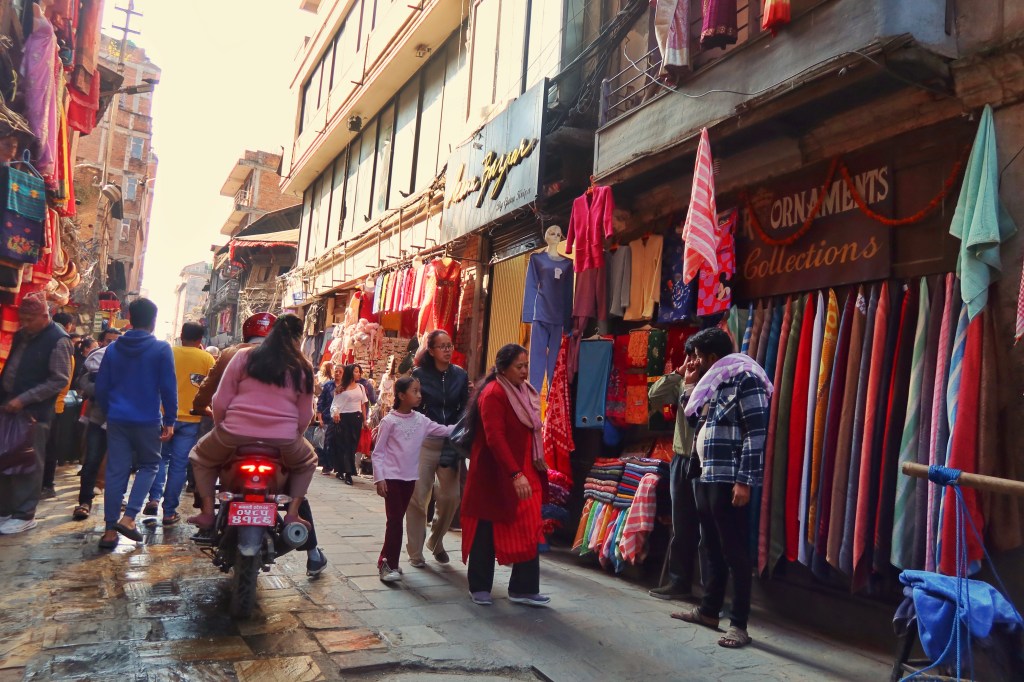
Day after day we set out from our hotel in Thamel, that neighbourhood of narrow streets and alleyways, to walk the city. Thamel itself is some kind of in-between space, lined with restaurants, bars and stores aimed at tourists like us. Hiking poles and puffer jackets. Books and maps. Bags of tea and spices. Singing bowls and prayer flags. As we move beyond the neighbourhood the target of the shopkeepers and streetside traders changes. Here the city is indifferent to our presence, going about its daily business with little care whether we are there or not.
We keep moving. In Wanderlust, Rebecca Solnit’s wonderful celebration of walking, the essayist writes that she likes walking, “because it is slow, and I suspect that the mind, like the feet, works at about three miles an hour. If this is so, then modern life is moving faster than the speed of thought or thoughtfulness…”
She is almost certainly correct. But in Kathmandu it feels like even three miles an hour might simply be too fast to absorb it all. There are moments when we simply need to stop. Step into a doorway to get out of the flow of traffic, pedestrian or otherwise, just for a second. Find a shop whose entraceway is a few steps back from the street, to pretend to browse for a cotton bag or a shawl, just to have a moment or two to catch a breath or to take a photograph and scribble down some notes.
***
We are meeting some friends at a different hotel, where the elevator lifts us from the chaos of the streets to a terrace that stands higher than most of the surrounding rooftops. Kathmandu spreads out around us, reaching out across the valley floor to where the green hills begin to rise on all sides. It is a matter of both myth and history that this place we have been walking through was once the bottom of a lake. The red clay bricks that are a feature of traditional Newar architecture across the Kathmandu Valley have been dug out of the ancient lakebed, fired in kilns that can still be spotted here and there, reaching for the hazy sky.
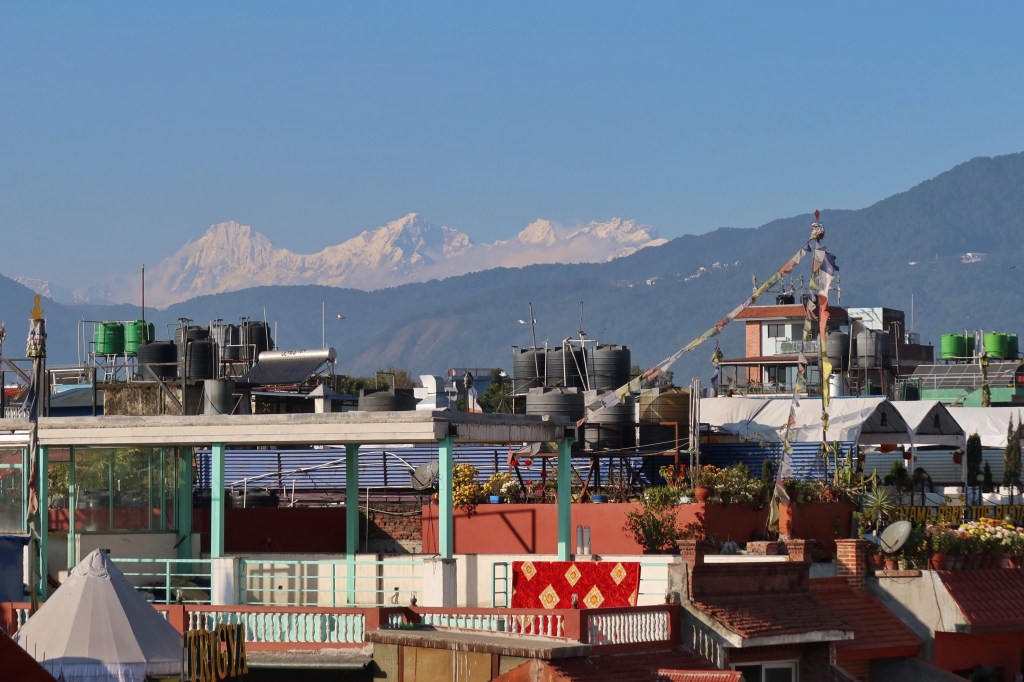
From the roof terrace you really can feel that the city is resting in the bottom of a basin. Those green hills surround Kathmandu on all sides and there are only a handful of roads in or out. When the air quality is bad, the pollution hangs in the basin, blocking the views to those hills, let alone the snowy peaks of the Himalaya beyond. And the city continues to grow, filling the valley. One in six of Nepal’s population live here. In 2010 it was about half that.
“It’s an ancient city,” Thomas Bell writes in Kathmandu, “in which most people were born in a village.”
Out in the countryside, the villages are emptying still. Moving to the capital or to Pokhara or abroad. Everywhere we walk we see signs of construction. Piles of bricks. New buildings. Jackhammers and concrete mixers. In the Kathmandu Valley, five million people now call this restless place home.
***
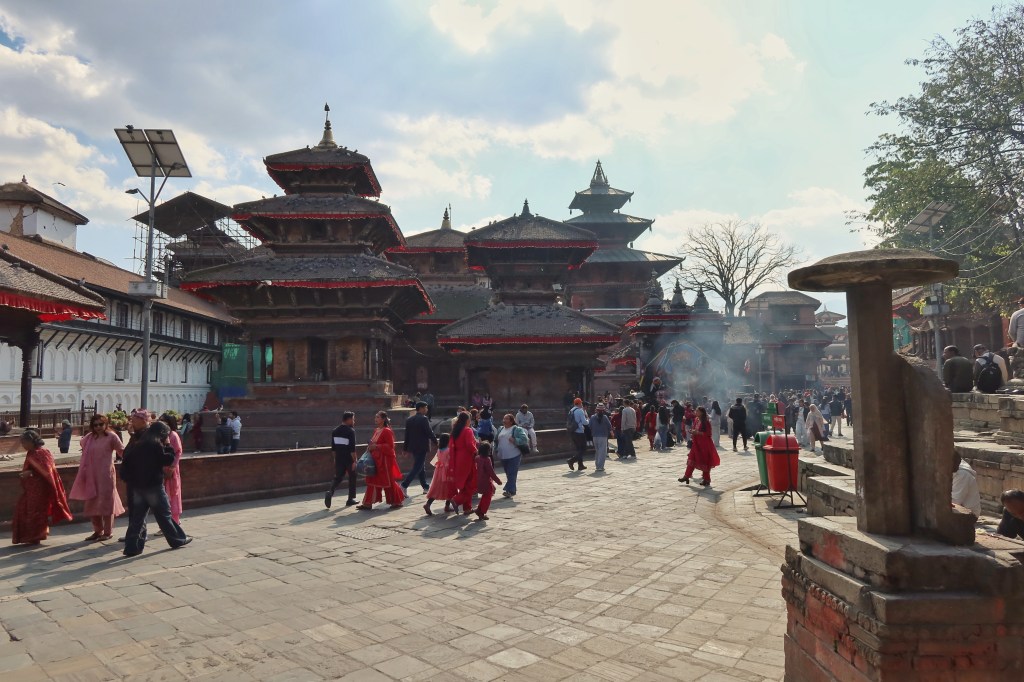
At Durbar Square we pay our entry and receive the orange scrap of paper that gives us admission to the public space. Us tourists appear to be in the minority. Groups of people mingle, enjoying the autumn sunshine. School groups in matching tracksuits are positioned for photographs before being led into the museum. Their teachers, trying to bring order to their class photographs, are not the only ones capturing the moment. A man with a huge telephoto lens picks out the details in the Newar facades. A group of young women set up their phone on a tripod to dance before the palace buildings. A mother and the female members of her family pose in front of a temple in their best clothes, while the toddler daughter takes unsteady steps in front of her amused father.
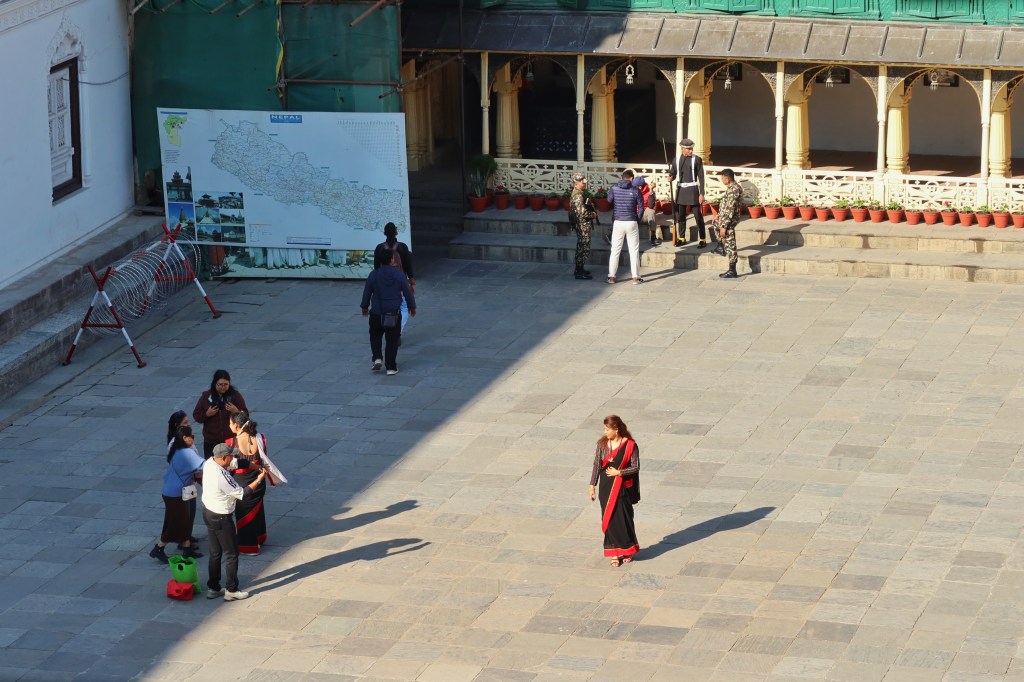
Old men loiter by the traders who have laid out their wares in the heart of a square. Holy men attempt to bless those of us with the orange scraps of paper around our necks in exchange for payment. A group of lads stroll through the scene, Adidas trainers against time-worn paving stones, Linkin Park hoodies and a confidence as thick as their baggy jeans. Hawkers hawk. Pilgrims pray. Tourists gawp.
***
These streets we are walking have been here for a long time, since before there were mopeds and water trucks, taxis and three-wheeled tempos. These are old ways. That one will take you out of the valley towards India. The one we are following now has been the trading route to Tibet for centuries. These merchant’s trails meet at the Asan crossing, site of one of Kathmandu’s oldest markets, where the temple facing the police post belongs to Annapurna, goddess of food and feeding.
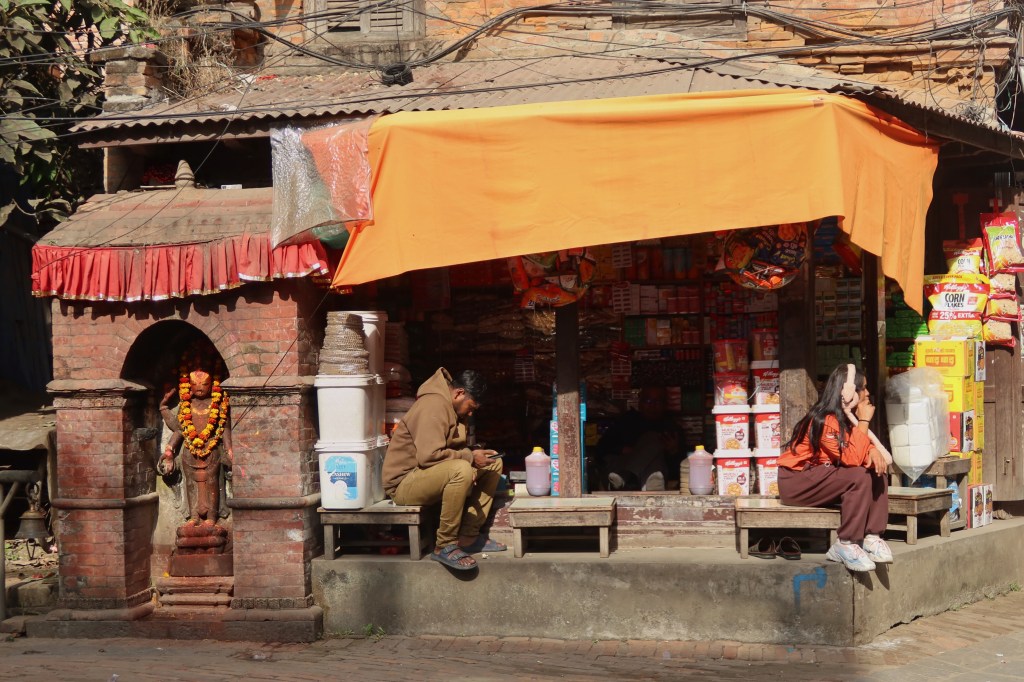
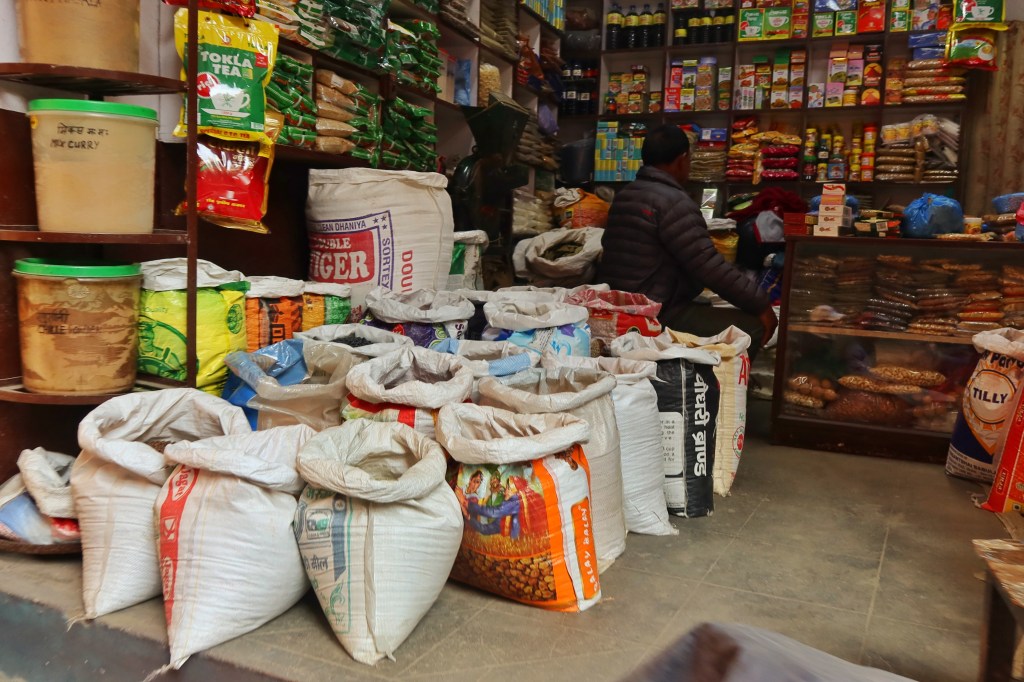
We move slowly through the crowd, the street narrowing one more. The road to Tibet might be old, but the buildings that line it speak to a multitude of eras. At street level, the shops sell herbs and spices, fruits and vegetables, mobile phones and plumbing supplies. A little further on is a row of bookshops, thousands of titles piled high from floor to ceiling. Above the street you can see the differences. Old red-brick buildings with wooden balconies leaning out over the crowds. New concrete buildings, taking the place of those lost to earthquake or fire. Others have been added to and adulterated, to meet the demands of growing families and fractured inheritances, as much of a mish-mash of times and styles as Kathmandu itself.
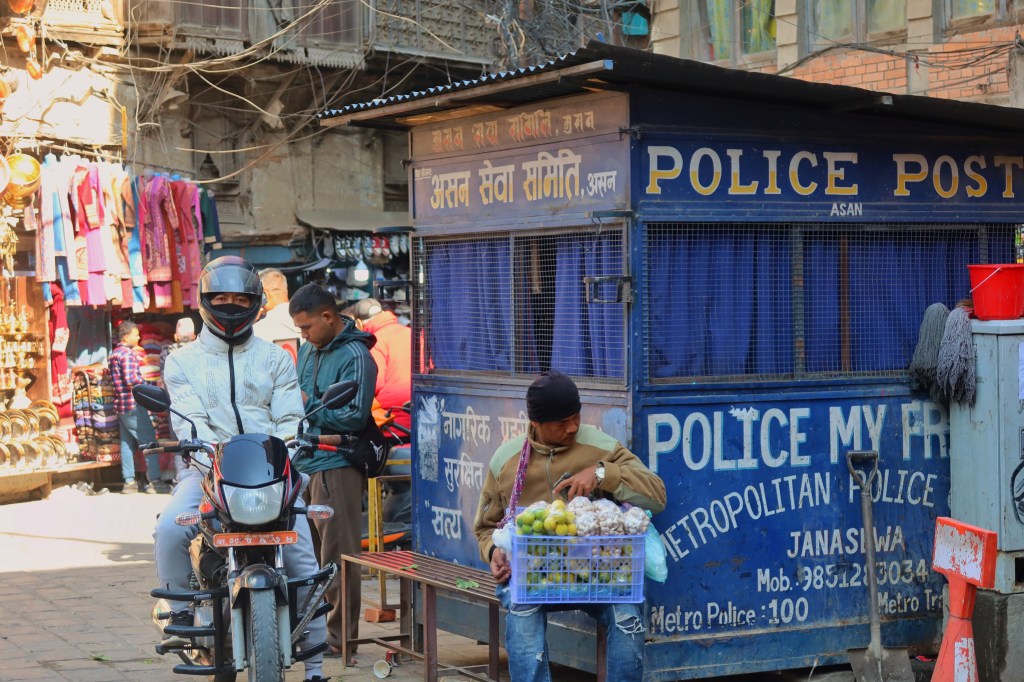
A young lad sits on his dirt bike at the heart of the intersection and watches it all go on around him. He is wearing a helmet but in his eyes you can see his smile.
‘Welcome to Kathmandu,’ he says, voice muffled, and then turns away to keep watching the comings and goings of the market.
***
After the last of the bookshops we are spat out of the narrow canyons of the older city and onto wider streets, where sometimes it is safer to walk a block or two to where a pedestrian bridge has been built above the traffic, than to attempt a crossing. It is from one of these that we spy the mountains in the distance. Snow-capped peaks, eighty kilometres to the north. A man killing time on top of the bridge tells us it is Langtang Himal. More than seven thousand metres. But it is hard to tell if he knows or he figures we’ll be happy enough with the information, whatever the truth.
But still, we can see beyond the valley, even if the air feels particularly heavy here. The boulevard is lined with boutiques and Apple dealers, travel agencies and language schools. The traffic streams across what is theoretically six lanes but feels like more. Mopeds and motorbikes. Electric cars and tempos crammed with people. The trucks are painted in bright colours and the buses make grandiose promises. One is offering a ‘King VIP Sofa’ and surely the most comfortable ride in all of Nepal.
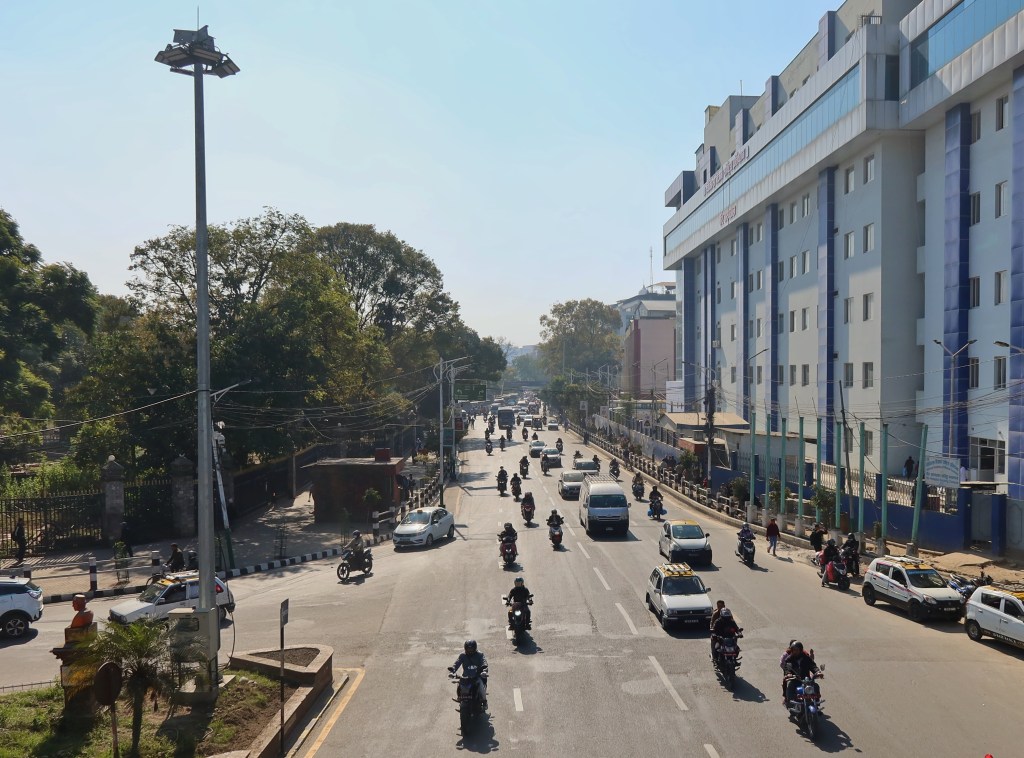
On the corner, a white wall is filled with anti-corruption graffiti. We are only a few months beyond the unrest that led to 76 deaths and the downfall of a government. Riot police occupy the corners of large junctions. The city is waiting for what will come next.
***
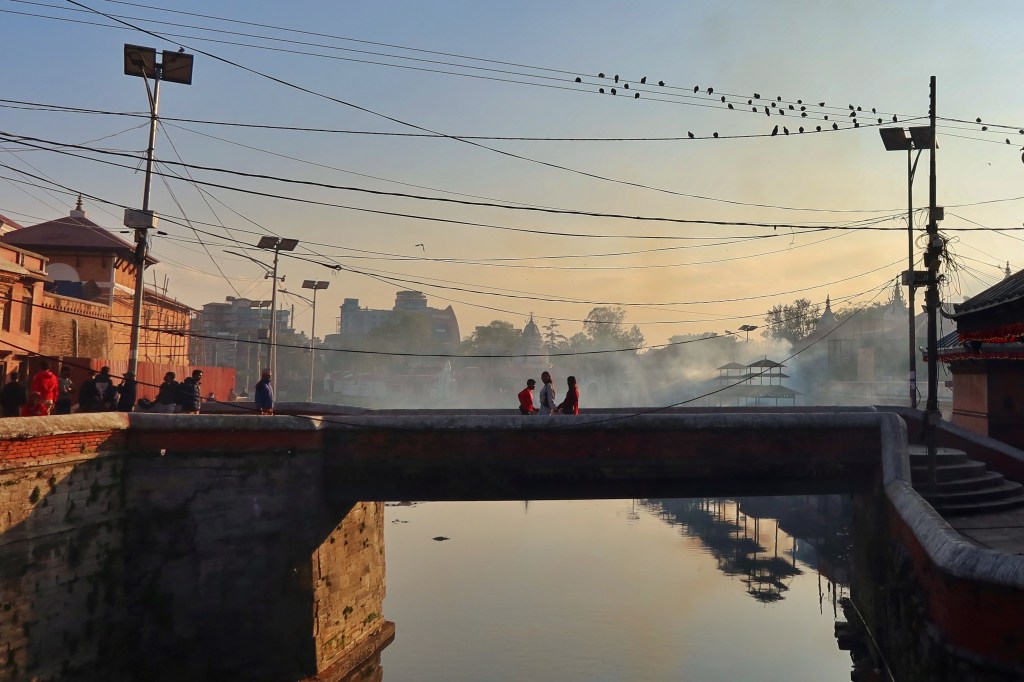
Yesterday we met with A., who took us to Patan and Boudhanath and then to Pashupatinah, on the banks of the Bagmati river, where bodies were being cremated in the soft, late-afternoon light. A. was happy to share stories of the valley, of the city and the religious traditions, both Buddhist and Hindu, that have shaped it. He was less happy to talk about politics.
‘This is the most corrupt country in South Asia,’ he said, after a lot of considered thought. ‘Maybe Pakistan or Afghanistan are worse. But not by much. This is why Gen Z is protesting. But I cannot help but be worried for the future.’
He speaks Hindi, English and Japanese and works as a tour guide. Each language has its season.
‘My children are ten and twelve. I imagine they will not live in Nepal. Perhaps they will go away to earn money and return when they are old. But maybe I will be gone then…’
***
The signs are everywhere in Kathmandu, however much the city continues to grow. More than three and half million Nepalese work abroad. More than two thousand young people leave the country every day. The money they send back accounts for a quarter of the nation’s GDP. There are six-storey buildings that seem to be almost completely devoted to getting people out.
WORK AND STUDY! EDUCATION AND MIGRATION SERVICES. WORK IN JAPAN AND KOREA. DARE TO DREAM! LANGUAGE SCHOOL. VISA. UK. AUSTRALIA. CANADA.
We want to cross the street and do so at a point where a policeman is standing in the centre of the stream, stopping and moving the collection of vehicles that face him down with flicks of the wrist and a stern look when needed. A couple of young people make their way between two buses on a moped. He is riding, his helmet visor down. She is sitting pillion, side-saddle and bare-headed, nonchalantly flicking through her phone as they go.
***
Beyond the Narayanhiti Palace, where nine members of the royal family including the King and Queen were massacred in 2001 by the Crown Prince, we find ourselves in a neighbourhood of houses behind high walls beyond which trees grow, their branches reaching out over the street. With a few steps from the main street the traffic sounds retreat and we can hear the birds.
We are meeting R. and her daughter in a peaceful beer garden. R.’s daughter wants to study in Germany. R. works for a travel agency that helps Nepalis with visa applications.
‘Many want to go to the Gulf states but… we try and encourage them to go to Japan. It’s better for them.’
We had met R. in her husband’s village, not far from Bandipur at the end of a dirt track off the Kathmandu-Pokhara highway. A brief meeting in a school playground led to invitation to lunch in this neighbourhood, not far from where R. works. The two places feel like a world apart. R.’s daughter is excited about the prospect of Germany. She has a cousin who is already there. From the village to the city to a university in Leipzig or Hamburg or Berlin. A journey in two generations.
***
We make it back to Thamel, back to our hotel where we climb the stairs to the top floor and the terrace outside our hotel room. The moment the sun fell beyond the hills that encircle the valley then the temperature dropped too. Music drifts from a bar beyond gates. Downstairs a group of trekkers swap stories from the trail over big bottles of beer. A volley of fireworks crackles above the sound of traffic pushing and easing and edging its way through the narrow streets below us. The explosions set off the local dogs, who continue to bark long after the smoke has cleared. The ancient city remains restless. Still moving forward. Tomorrow, it will be made anew once more.
Words by Paul Scraton
Photographs by Katrin Schönig
