
You need three cable cars to reach the summit of the Valluga, which marks the border between Tyrol and Vorarlberg in Austria at a height of just over 2,800 metres. As we are carried up from the valley floor we look down upon ski runs reverted to summer grazing grounds, high meadows and then the rocky moonscape of the mountain above the vegetation line.
Our home for next week or so is a small village just down the valley from St Anton am Arlberg, the cradle of alpine skiing from where the cable cars lift visitors up and onto the slopes of the Galzig and the Valluga beyond. Everywhere we go there are reminders of the history and present of skiing in the region. Old posters in restaurants and historic ski equipment decorating the walls of shops and cafes. An entire infrastructure dedicated to days on the slopes and evenings in the bars and clubs. When the St Anton Ski School was opened in 1922, there were about 400 beds for visitors in the town. Now there are ten thousand.
But this is summer, and the town is relaxed. From the cable car it is possible to see the odd patch of snow in the shaded corners of the mountain that the sun never reaches, and although there will be no skiing today it is obvious how much of the landscape around us has been altered and shaped for winter sport.
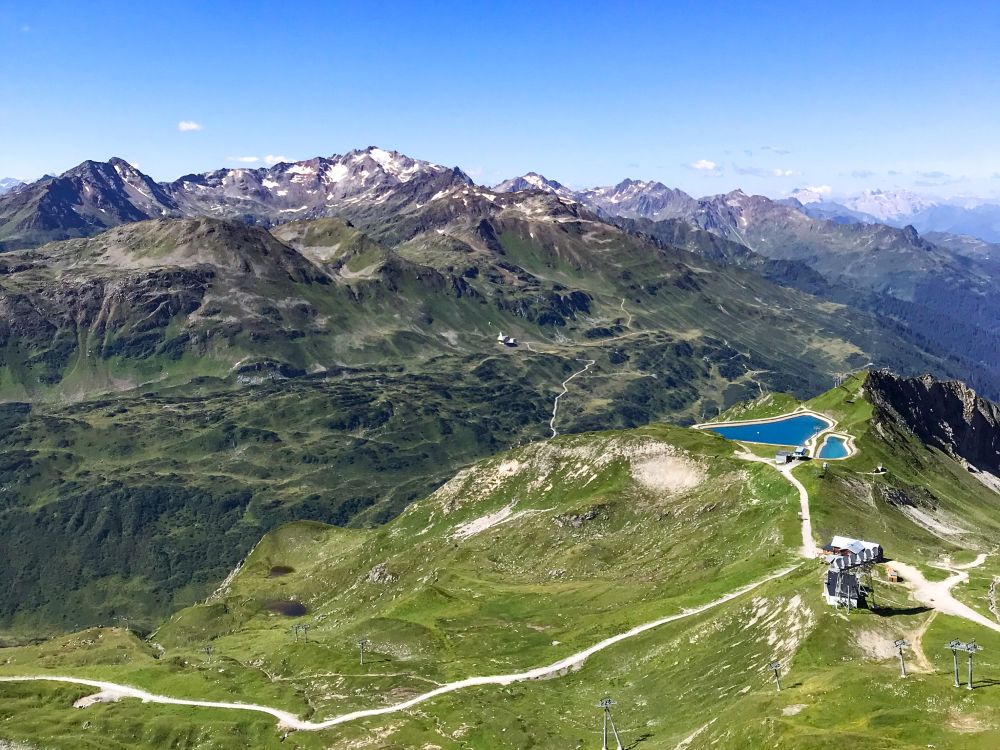
The cable cars string out above the reservoirs that feed the snowmaking machines. Access roads and electricity pylons. Avalanche nets and wooden huts for ski-up breaks of hot chocolate and schnapps. Summer sports have left their mark too. Hiking trails and the mountain huts from which climbers strike out on their latest challenge. But beyond the immediate scene below us, the view opens up and out as the cable car climbs. Peak after peak. Layer after layer of summits and the valleys between them.
At the very top we step out onto a viewing platform where countless visitors have stepped before us and left stickers from their favourite climbing wall and football club. We take photographs and make a video call to family in England, wanting to share the view that takes in Germany to the North, Italy to the South, Switzerland to the West and Austria all around. A pair of hikers join us, smiling a greeting despite the disdain they must feel for those who took a ride to the summit while they got here on their own two feet. But we are all sharing the same view, under a warm summer sun and brilliant blue skies, and all of us are simply happy to be here in this moment, however we reached the top.
***
Growing up in a small town in West Lancashire, surrounded by potato and cabbage fields, the mountains always felt a long way away. They weren’t really. The Welsh hills of Eryri (Snowdonia) were a couple of hours in one direction, visible on a clear day from the sands at Formby beach. The Lake District was a similar distance in the other.
But when you are young and the time between weekends, let alone school holidays, feels vast and unbridgeable, the mountains symbolised the adventures beyond the everyday. Trips to high places were adventures outside of the routine, often involving tents in soggy camping fields and traffic jams where the A55 tunnels and by-passes hadn’t been quite finished yet.
Let’s get this right: we didn’t always go willingly. For every walk that took place in fine weather, when the view would unfold like a scene in a play of elaborate natural theatre, there would be a long trudge to a mist covered summit, sheltering from drizzle behind an oversized cairn to eat a soggy sandwich while trying to imagine what the world would look like if visibility was something more than about six feet.
But even these moments became worth it after the fact. Parts of family folklore, added to the stories written before we were born, of winter ridge climbs and long summer days on one horseshoe or other. Outside our front door, the closest thing we had to a hill were the bridges over the railway and the Leeds and Liverpool Canal, but inside the mountains were everywhere. Books by Jim Perrin. Paintings by Rob Piercy. A collection of maps in a drawer. Crampons and an ice axe under the stairs.
The mountains were present but they were far away. And so they have remained. A childhood and youth spent on the West Lancashire plain has turned into an adulthood almost entirely located in Berlin and the flat, forested landscape of Brandenburg beyond the city limits. The mountains continue to be reserved for the moments outside of the routine. Yet here in Germany too there is a Rob Piercy painting of Llyn Idwal on the wall, books by Paolo Cognetti and Nan Shephard on the shelf. A drawer of maps. A YouTube playlist featuring Reinhold Messner, Alex Honnold and Laura Dahlmeier. No ice axes, but some trail running shoes and a pair of Leki poles…
***
In Cognetti’s book The Eight Mountains, a character who the narrator meets on a less-than popular peak in northern Italy says, ‘Well anyway, there’s nothing like the mountains for making you remember.’
***
In early Spring we drove across Ynys Môn (Anglesey) as the peaks of Eryri rose ever closer through the front window of the car. How many times had we made this trip? Sometimes at this time of year there is snow on the highest of the mountains, but on this day the sun was shining, there is barely a breath of wind, and in the car park at Nant Gwynant our fellow hikers were already tying their fleeces around their waists in the unseasonal warmth.
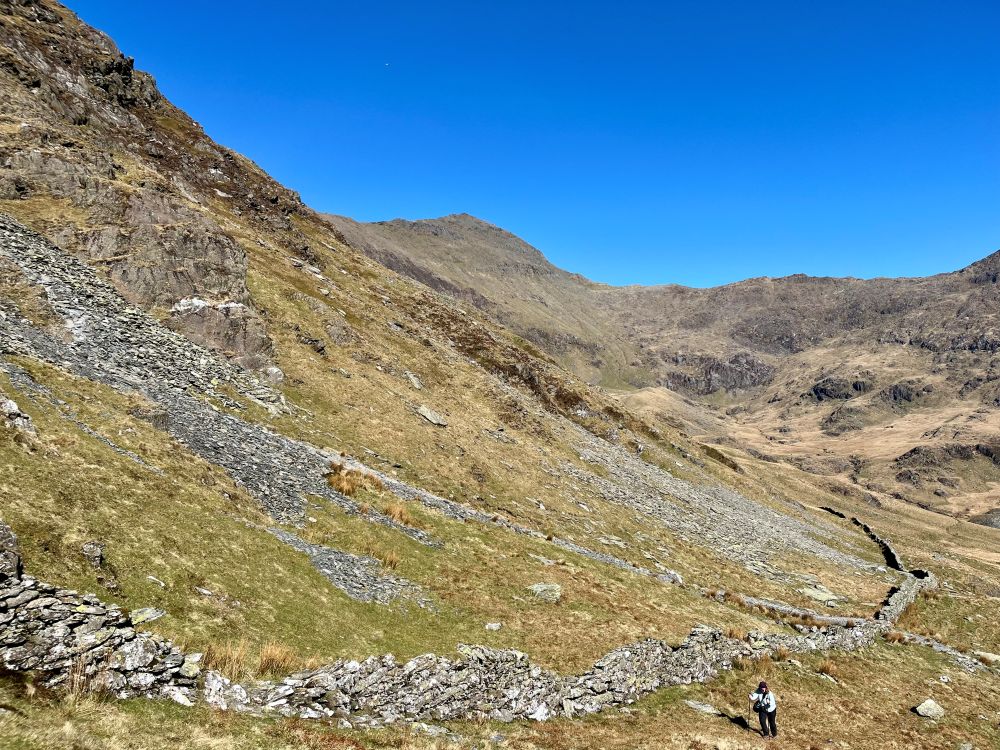
There’s nothing like the mountains for making you remember. We had never climbed Yr Aran before, starting off on Yr Wyddfa’s Watkin Path before striking off beneath the old mines to climb up via Bwlch Cwmllan to the summit. But every day in what we used to call Snowdonia cannot help but be full of memories. Of sausage, egg and chips in Pete’s Eats. Of the smell of the outdoor shops in Capel Curig. Of the racing river in Betws-y-coed. Dire Straits on the radio and putting your socks on in the car park at Ogwen.
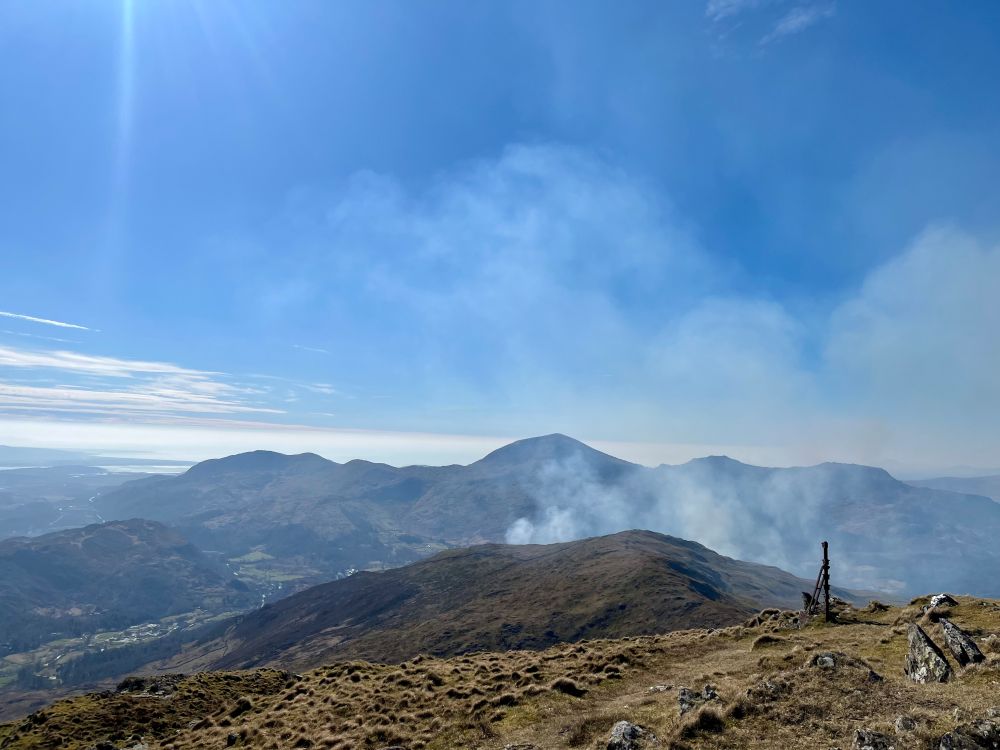
On the summit there were two guys sitting there, sharing their own memories of different walks in these hills. Together we marvelled at the weather. At having this particular mountain pretty much to ourselves. Looking across Cwm Llan through our binoculars we spied the steady stream of people tackling the steepest section of the Watkin Path on their way to Yr Wydffa. Some memories are incredibly vivid. Others, like the time we reached the top of Snowdon, much more hazy. Sometimes, the stories that remain are not always of the highest peaks, or even of the summit at all.
***
What is it we go looking for?
There is a valley in Austria that we return to every couple of years. Friendships born in school and university have been maintained across countries, in the gardens of West Yorkshire and the Biergarten of Berlin, and here in what we have come to think of as “our” valley.
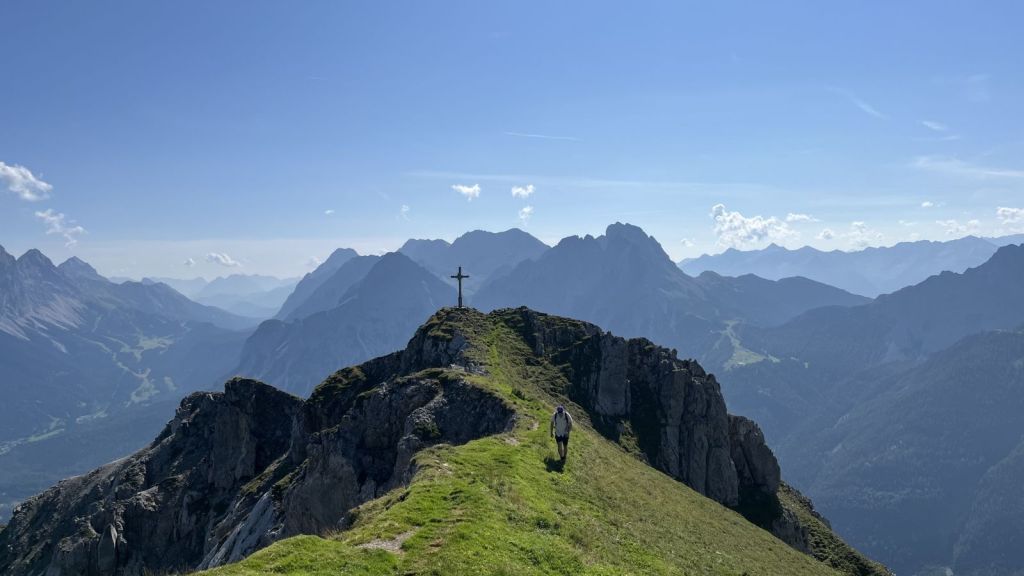
We had made a plan as we ate our tea on the balcony in Ehrwald, looking out across the moss to the mountain rising up from the twinkling lights of the village at its foot. Daniel. It’s summit cross stands at 2,340m and it was our goal for the following morning.
Why did we care about getting to the top? Why not plot a walk, like we did on a previous visit, from mountain hut to mountain hut? Why not simply enjoy the beers and the views? What did the summit mean anyway, and who would even care?
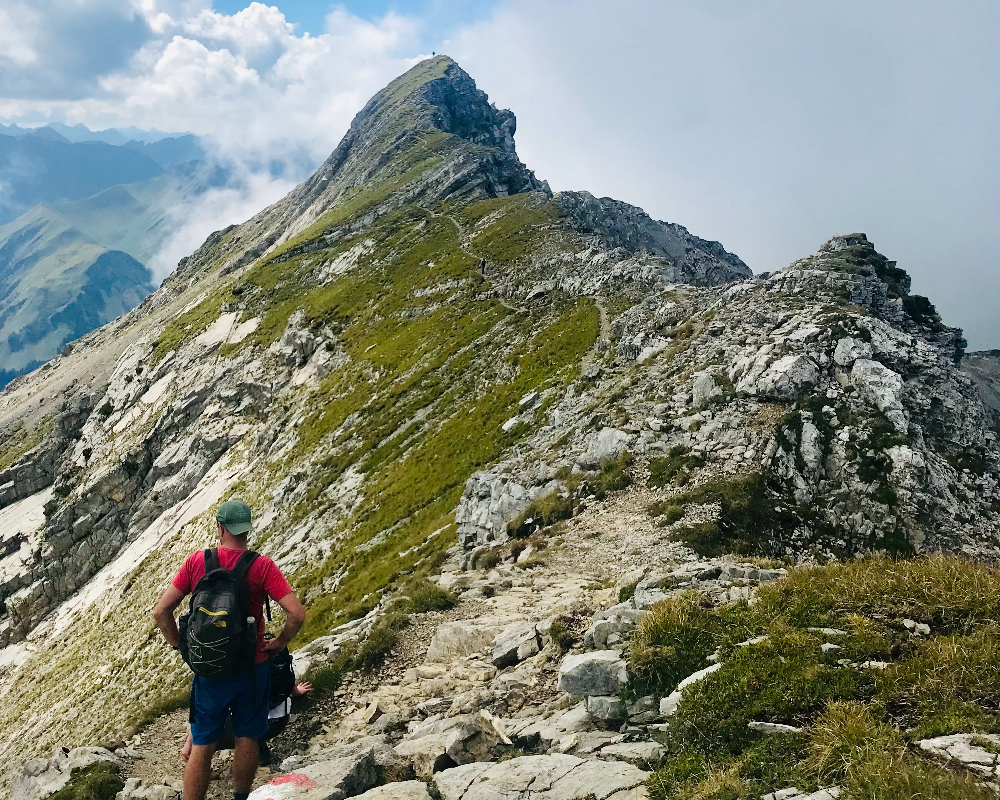
In his book about his (our?) fascination with high places Mountains of the Mind, Robert Macfarlane describes where the desire to reach the top comes from, and how the summit of a mountain is a symbol both of the effort required but also the reward:
‘What simpler allegory of success could there be than the ascent of a mountain. The summit provides the visible goal, the slopes leading up to it the challenge…’
The next day, as morning broke and the sun rose over the shoulder of the Zugspitze to begin to cast away the mist that clung to the moss at dawn, we walked out from the apartment across the dirt track between the drained fields. With each step Daniel loomed ever larger, until its peak was hidden by our proximity. We would only see it again when we emerged from the forest above the treeline.
Daniel is not the most difficult mountain. Aside from a few moments requiring an undignified scramble along the rocky path, you can simply walk to the top. It’s steep, and hurts perhaps more coming down than going up, but there were plenty of us capable of reaching the top on that sunny summer day. Still, the mountain was big enough to share, and aside from when we came together at the summit to share the views, we had most of the walk pretty much to ourselves.
The mountain and the view. With each step we climbed from the valley our perspective shifted, with our apartment building in Ehrwald visible but shrinking almost the entire way. As we moved above the trees, the path wound its way up the side of a huge scree basin beneath the summit and we were able to see beyond our valley and the mountains that had enclosed our view for the previous few days. And then came the moment, the shift that comes with a mountain pass or saddle, a ridge or sometimes even the summit itself, when a whole new world is made available to you on the other side.
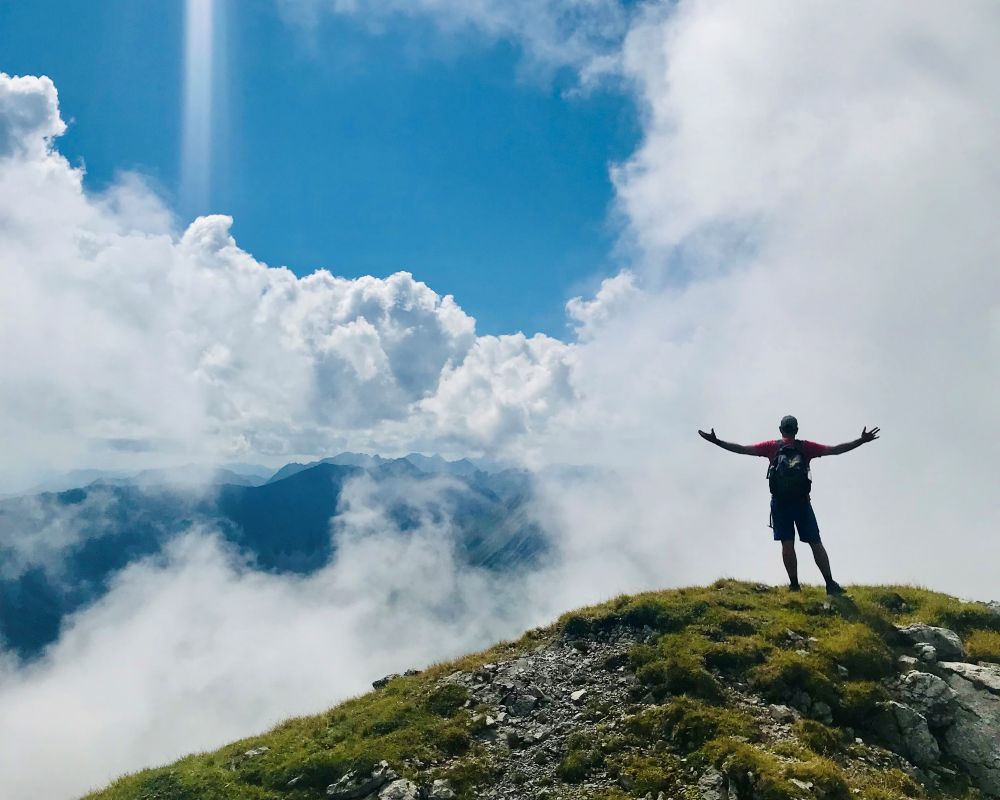
Is this what we had come looking for? At the top we hung off the cross and took photographs, ate our sandwiches and basked a little in the glow of achieving this ultimately unimportant objective. But more than anything, it was important that we had done it together. I’m not sure I’ve ever climbed a mountain alone. For some people, solitude is the aim. It’s what they are looking for. For me, the mountains are best when they are shared. Perhaps this is the goal. And then it really doesn’t matter if you reach the top or not.
***
For Reinhold Messner it certainly mattered whether he reached the top, and also how he did it. His relationship with the mountains compared to my own is so wildly different, that it reminds me of the distinction made in Cognetti’s The Eight Mountains about how each person has a favourite altitude in the mountains, from the valleys to the high pastures to the ominous and eerie landscape of ice and rocks beyond.
But still, whether we feel at home in the villages on the valley floor or skirting the edge of a glacier high above, whether our mountains push above eight thousand metres into what is known as “the death zone” or barely reach four figures, there is something that many of us feel that Messner articulated when he wrote:
‘I’m primarily concerned with what happens inside a person when they encounter the mountains. When you climb a mountain, you come back down as a different person. We don’t change the mountain by climbing it; we ourselves change.’
***
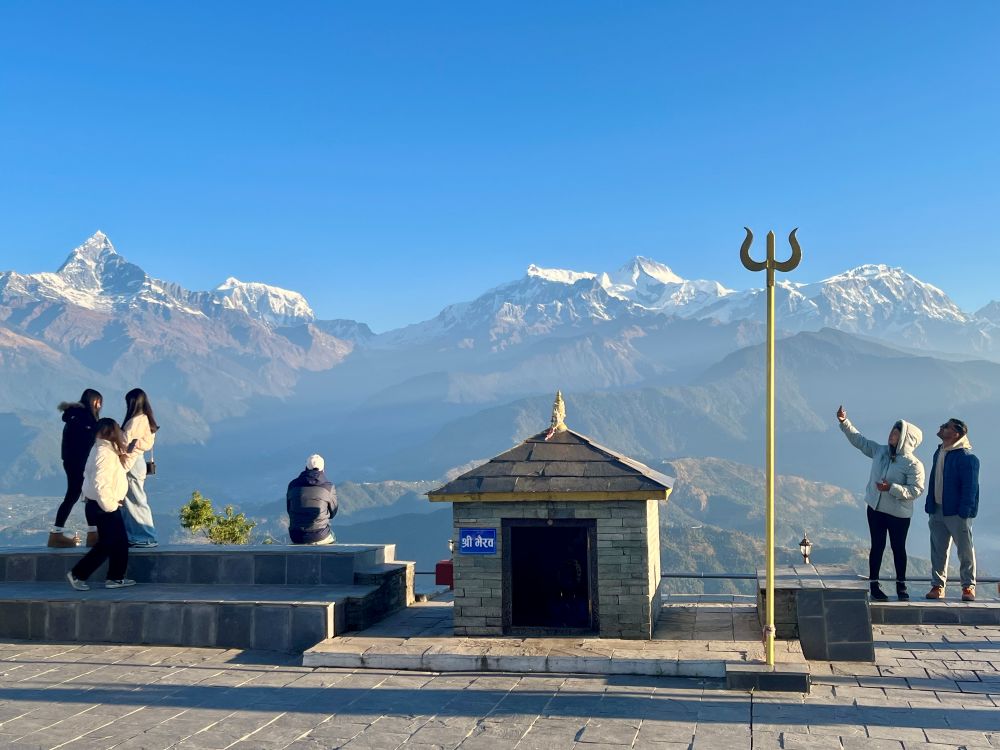
Above Pokhara there is a hill called Sarangkot. Hiking trails leave from the shore of Lake Phewa but there is a road up there and plenty of taxi drivers willing to take you, as well as a new cable car that lifts you from the lake to just beneath the top. However you get there, the view that opens out is breathtaking. Annapurna and Dhaulagiri. Machhapuchhre, the sacred mountain known as ‘Fishtail’. Manaslu, away in the distance.
When I had dreamed of mountains, whether in West Lancashire or eastern Germany, the dreams would eventually take me to Nepal and the Himalaya. Stories of Everest and the Khumbu valley. Sherpa climbers carrying loads along stone trails between monasteries and high villages. Peter Matthiessen in search of the snow leopard. Michael Palin meeting Maoist insurgents. Reinhold Messner. Tenzing Norgay. Wanda Rutkiewicz. Conrad Anker. And now we were here, and the mountains of my imagination were laid out in front of us. It felt like it had been a long time coming.
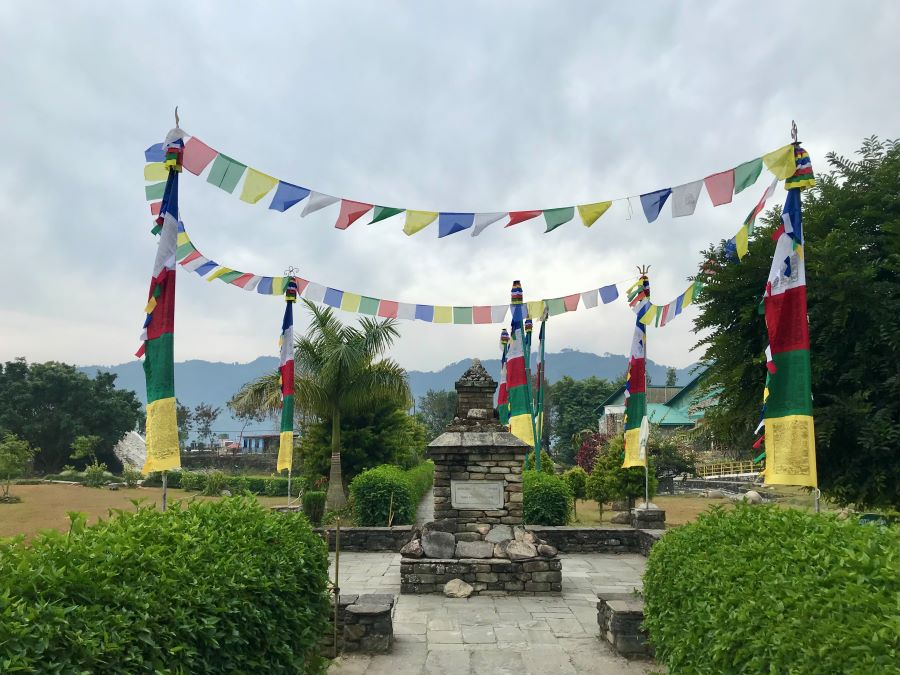
Back down in Pokhara, the International Mountain Museum stands not far from the edge of the city and the old domestic airport. In the time it took to head down from Sarangkot, cloud had descended, obscuring the mountains and filling the valley above us, and a light rain had begun to fall. But we stopped, nevertheless, at the memorial that welcomes everyone to this place, a stone structure with prayer flags fanning out, dedicated to those that had been lost to the mountains, whether in the Himalaya or beyond.
In my time in Nepal, I had already begun to shift my thinking about the stories of the high places. It might have been the tales of the climbers, of the mountaineers and the explorers, that first drew me to this place. But it was the people of the mountain communities and the hill villages that we had been visiting in our travels with Pahar Trust Nepal, to the places where they were building schools and health posts, that had captured something in me and that had made it clear, even before I had said goodbye for the first time, that I would be back.
It was fitting, then, that the first exhibition we came to in the museum was the one about the mountain people, about the Sherpa and the Gurung, the Tamrang and the other ethnic groups of the hills and the high places. The artefacts on display, including tools, clothing and other everyday objects, spoke to the lives of my friends in Tangting and Sikles, those Gurung villages on either side of the Madi river that had welcomed us as guests and made us feel at home in the shadow of the mountains.
The exhibition told stories of how villages had adapted to life on the steep hillsides, and the ongoing challenges of maintaining traditions as roads, internet connections and other tools of communication changed the relationships of peoples and place. These were stories we had heard first hand, complex stories that ranger from the hyper-local discussion about the land use of fallow fields and the need for a new classroom, to the border-crossing impact of the climate crisis, of family members working in Japan or the Arab peninsula, and how it is not just a motorable road that brings the outside world to a village street.
Elsewhere in the hall, a young Swedish woman traced a trekking route with her fingers across a relief map of the Annapurna Massif. She had returned to Pokhara only a few days before, and was struggling to process everything she had experienced and learned on the hillside. The village. The teahouse. The high pass. The road. Another mountain story, written between and beneath some of the world’s highest places.
***
What connects the Himalaya to the Alps? Nepal to Austria? Tangting to Ehrwald or St Anton am Arlberg? In Europe, campaigners lobby to save our winters, urging that there will be nowhere left to ski unless we make real and effective change. Meanwhile snow machines, and the energy and the water they need to keep the industry going, fill in the gaps. A warming world brings instability. Rogue weather patterns that make already unsafe ground even more deadline. Unseasonal monsoon rains in Nepal wash away roads, schools and villages. Rivers run dry in some parts of the year and break their banks in others.
Changes in snowmelt threaten previously predictable water supplies. Traditional knowledge is not forgotten but made obsolete, as old wisdoms of life and the cycles of the seasons no longer hold true. This could be Nepal but it could also be Austria. The major difference is that it is Nepal, which contributes minimally to global carbon emissions, that is bearing a disproportionate burden when it comes to the impact of climate change. And then the mountains themselves are being reshaped, altered by forces set in motion far from these lofty peaks.
***
Arguably the nearest proper mountain to our apartment in Berlin is the Brocken, which stands in the Harz mountains in the centre of Germany. More stories cling to the forested slopes of the Brocken than to nearly any other mountain. This is the place where the witches come to dance on Walpurgis night. This is where Goethe, and Heine, and Coleridge and more found poetry above the treeline. This is where a Cold War border divided the mountain, while Soviet spies and East German border guards occupied the summit. And this is another place where the shadow on the mountains is not the shadow of the mountains, but of a warming world and its shifting weather patterns.
Catch a train early from Berlin and you can be approaching the Brocken summit by lunchtime. On a clear day, the German countryside stretches out in all directions. Most days are not clear. But perhaps this is the reason that the mountain also gives its name to the Brocken Spectre, that ghostly vision of oneself that can often be spied from its slopes. On our most recent climb it was clear, and we were happy for the shade that the forest gave us as we ascended the mountain’s lower slopes.
Despite the old East German border road along which we were hiking, this might have felt like something of a timeless scene, a walk in the eternal German forest, had we not known better. The Harz mountains, as you might experience today, is fundamentally one big forest plantation. These spruce trees replaced the ancient mixed forests because spruce grows quickly and was used extensively in the mining industry that once dominated the economy here.
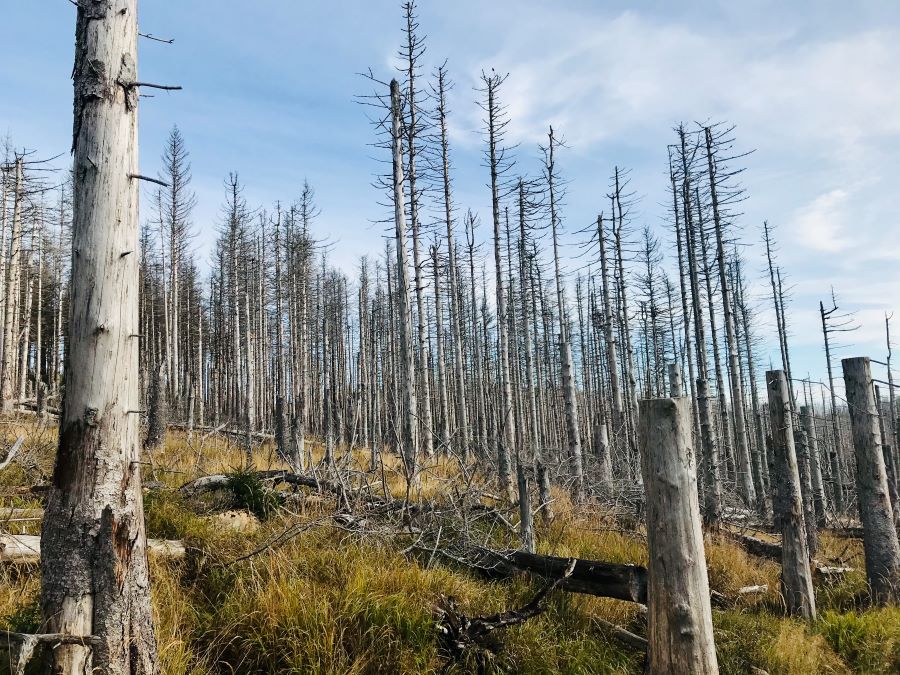
But the forest is dying. Wherever you walk in the Harz you can see it. Bare patches on the hillside. The skeletal remains of trees. The forest is being ravaged by bark beetles, who are thriving in the warming temperatures. The trees are dying because of the drought, because not enough sap is flowing nor resin to trap the beetles when they try to feed. The monoculture of the plantation doesn’t help, for there are no natural barriers to stop the beetles moving from one spruce to the next. The trees can’t protect themselves, and there is nothing else to protect them.
The solution, for some in the Harz and the National Park, is to allow the plantation forest to die and then replace it with a version of the old mixed forest that grew here centuries ago. But what that will do to forestry agriculture in a region where the mines have long closed and there is not much money to be made, not to mention the impact on tourism in the short to medium-term, makes it a contentious strategy. The answers to the warning the mountain is giving us are, as ever, not always easy to agree on.
***
In Austria, we descend from the summit of the Valluga and onto the Galzig, where we sit on a bench that has been brought up from the valley to give weary hikers someplace to rest. The path that brought us here is part of a nature trail, created to give families who have caught the cable car an easy walk around the summit, with information boards and games to keep the kids amused and, hopefully, learn something about the landscape and the environment they are looking at.
When you climb a mountain, you come back down as a different person…
For a long time, I was unsure and uneasy about the trains and cable cars that can carry us to high places. To Yr Wyddfa and the Brocken, the Zugspitze and the Galzig. To places that, perhaps, our bodies alone would be unable to reach. When we were young, it would have been impossible to imagine being allowed to take the train up Snowdon. In the Harz, I couldn’t help but be unimpressed by those carried to the top by steam engine and hadn’t really earned the views.
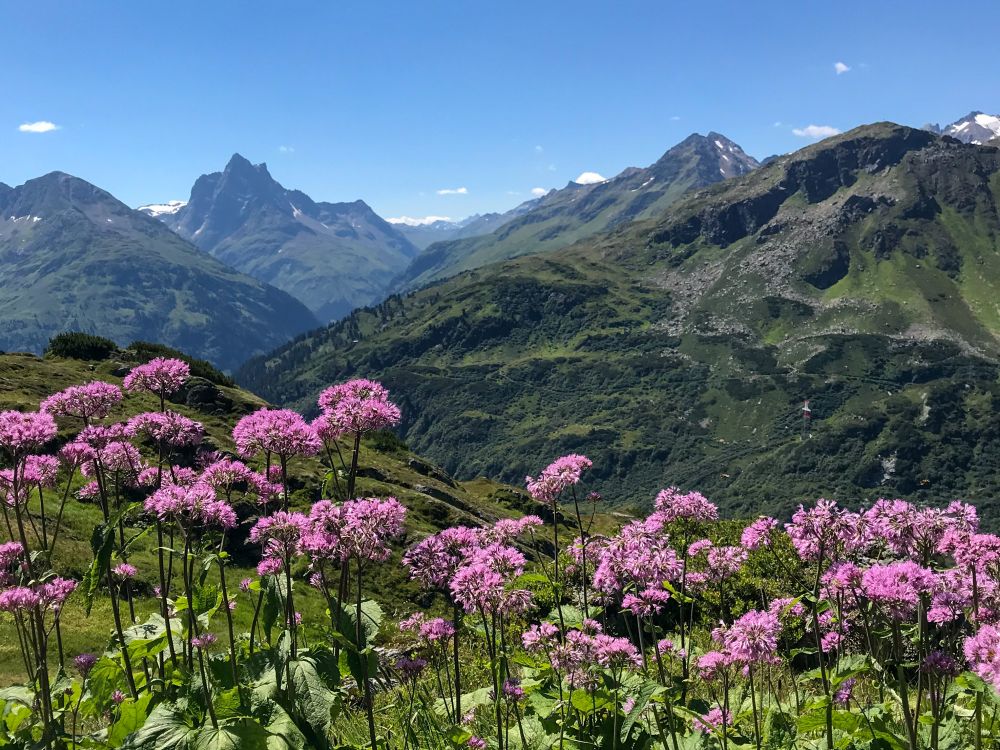
And yet, and yet… Here we were, wandering the easy trails around the Galzig having just been to the top of the Valluga, enjoying the views that had been made possible by the engineers hired by the pioneers of the ski industry in this part of the world.
Accessibility is important. For some, the cable car or the train might offer them a chance at their first mountain experience. For others, they might be the only means of getting up high. Should these places be reserved for only those who can get here under their own steam? Once again, the answers are not easy to agree on. But perhaps it is worth considering that we are more likely to want to protect something if we love it, and we are more likely to love it if we have the chance to experience it ourselves, however many paintings we have on our walls, books on our shelves or maps in our drawers.
Along the path ahead of us, a young girl skips ahead of her family. She is, judging by her accent, from Yorkshire, excitedly reading the translation of the descriptions of flowers on the information boards as her parents approach. She is standing higher than anywhere in the British Isles, and when she looks up from her reading she can see mountains in four different countries. Perhaps this is the start of a love affair. Perhaps today, on the gentle meadowed slopes of the Galzig, a future climber or mountaineer, ecologist or naturalist, has been born of these breathless views and gentle flowers. Born on the stories she has learned and collected, from the panorama of the peak to the embrace of the valley floor.
Words by Paul Scraton
Photographs by Katrin Schönig and Paul Scraton
