
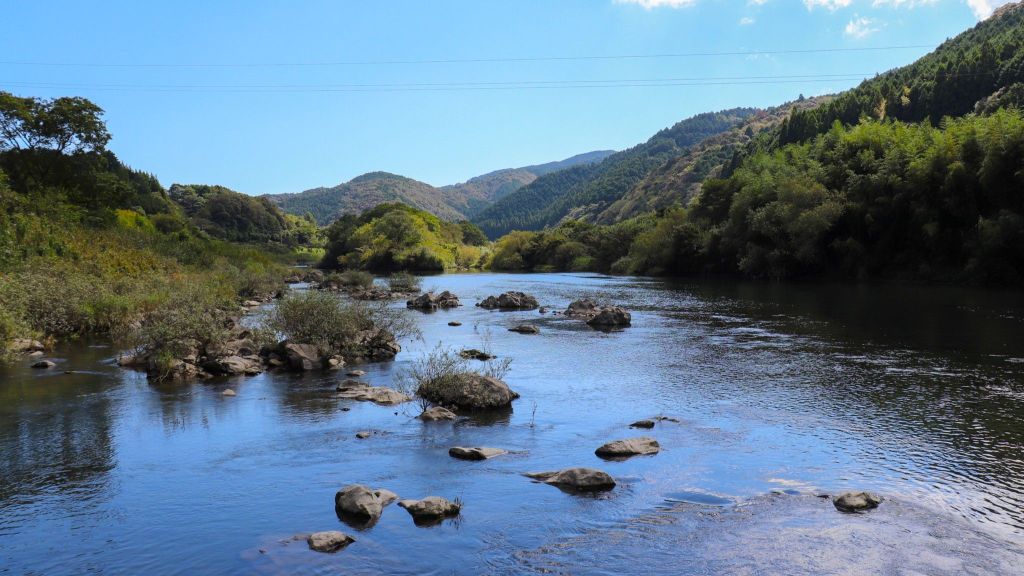
Rain hammers against the car as we drive the narrow road that follows the twists and turns of the river, ever deeper into the island interior. The higher we go the more the forest encroaches on the road. Fallen branches, broken in the wind, are strewn across the tarmac. Colourful tape and cones warn us against mini-landslides that have passed beneath the metal barriers. Trees and bamboo lean out and over, crowding the sky, like a jostling crowd of fantastical figures looming over us as we go.
It all feels quite wonderful and a bit sinister, and a contrast to the cities we have been moving through for the past couple of weeks, and it is not hard to see how these visions seen through a windscreen slick with water inspired Ghibli animations and ancient ghost stories held in these steep valleys and carried through time and the dramatic changes taking place in the world outside. Mountain mist slips in and out of the trees and curls around the hillsides, as if sailing on the wind.
Our aim is a hotel on the road side, after a side trip to a famous vine bridge across the river. The hotel has elevators and a funicular railway that drops to the bottom of the valley where the hot spring waters can be taken beside the flowing river. In the corridors between traditional rooms you can buy beer and cans of coffee from vending machines, and the toilets do the things that Japanese toilets do. And yet, just the drive here into the heart of Shikoku has given us a sense of distance from the world outside. We haven’t travelled that far into the Iya valley, and yet all of the stories we have heard up to now already seem to make total sense.
***
Shikoku is the smallest of the main Japanese islands, the least visited by tourists, and the valleys of the island interior feel even more isolated still. The Iya valley’s historical inaccessibility has long made it a hideaway for defeated warriors looking for a place to disappear. Even the vine bridges that draw the few visitors that come to take a look are said to have been constructed so that they can be cut down quickly should anyone come looking who wasn’t supposed to be there.

When the American-born writer Alex Kerr went in search of the Lost Japan, it was to the Iya valley that he came. In the early 1970s he bought an abandoned thatched farmhouse here, and the story of the house is a central part of the book he wrote about the Japanese culture that was being lost in the midst of the economic boom that followed the Second World War. That book was published in 1993, just as the Japanese bubble was bursting, but three decades on it remains in print and a fascinating guide for those of us interested in this country and the contradictions that any journey here throws up.
Lost Japan. Was that what we had come to Shikoku in search of?
The rain has stopped. A pause in the violent hammering that has been drowning out the radio ever since we turned off the motorway and headed inland. At a lay-by we get out to look down, deep down towards the valley floor and a bend in the river. The bamboo figures on the hillside opposite move as if in agitation. A German cyclist pulls over, sodden wet and breathing heavily. It doesn’t look like much fun, we say, but she shakes her head.
‘All this,’ she says through gulps of breath, ‘The forest. The river. Beautiful… just… beautiful.’
***
We arrived in Shikoku by train. In the bits of Japan that are flat, near to the coast, the landscape unfolds beyond the window in an increasingly familiar way. Boxy buildings of different sizes. Cranes stalking the rice fields on the edge of towns. Waterlogged factory car parks. Line-ups of cars at level crossings. Drainage channels and electricity wires dividing up the land between settlements in neat blocks.
The train crossed onto Shikoku via a series of high bridges above ghostly islands that appeared and disappeared in the mist. Boats on the water far below appeared as apparitions. The moment of arrival on the island was unsure.
Until about forty years ago, Shikoku was linked to the rest of Japan only by ferry. The first bridge opened in 1988. This is the least populated of Japan’s four main islands, and its population of about 3.8 million will have been further reduced in the time between our visit and the writing of these words. Everyone we met before we came was surprised we were coming. Pleasantly surprised, but surprised nevertheless.
‘Shikoku is where I was born!’ a woman on the train in Nagoya said, with delight when she heard about our travel plans. ‘But why are you going there?’
Something had captured our imagination. Far away, in an apartment in Berlin. It was the only thing fixed when we started planning our trip. Shikoku. The four provinces. If we had an ultimate destination for this trip, the island was it.

On the shore of Lake Biwa a few days before we caught the train to Shikoku, I read Kenzaburō Ōe’s The Silent Cry. The Nobel prizewinning author was born in a remote mountain village, like the characters in his novel.
“Born and bred in the depths of this forest, I still couldn’t escape the same stifling sensation whenever I passed through it on the way to our valley. At the core of that sensation lay the emotions inherited from those long-perished ancestors who, driven on endlessly by the mighty Chosokade, had plunged deeper and deeper into the forest until, coming upon a spindle-shaped hollow that had resisted its encroachment, they settled there…”
The Chosokade is a creature of terrifying size that exists everywhere, all at once. Don’t whistle after dark, or you might meet it. It was one bit of advice that we travelled to Shikoku with in our heads. Above the river, the forest shifts again, the wind sounding a thousand voices between the trees. It feels like we can hear Ōe’s ancestors talking. But of course it’s all in our heads. The island of the imagination, fed by books and films, daydreams and the stories of friendly mothers on a train.
***
In Shimanto, the valley is wider. The hills aren’t so steep and there is space for rice fields between the riverbank and the lower slopes. The sky is bigger, the forest more restrained. Our house for the next few days is owned by an Australian woman who has lived here for a while but has now moved in with her partner, a city boy who has decided to take up rice farming. Some people are returning to Shikoku or moving to the country from the city, but the trend is definitely going in the other direction. There are five houses in the hamlet where we are staying, and at least two of them appear to be empty; gently abandoned.
We do not see another soul during our time here, and the only voices other than our own come from the community speaker attached to the lamppost outside our driveway. It broadcasts bulletins to no-one who can understand it about the movements of the mobile library and warnings about email scams targeting the elderly, translated for its only audience by mobile phone.
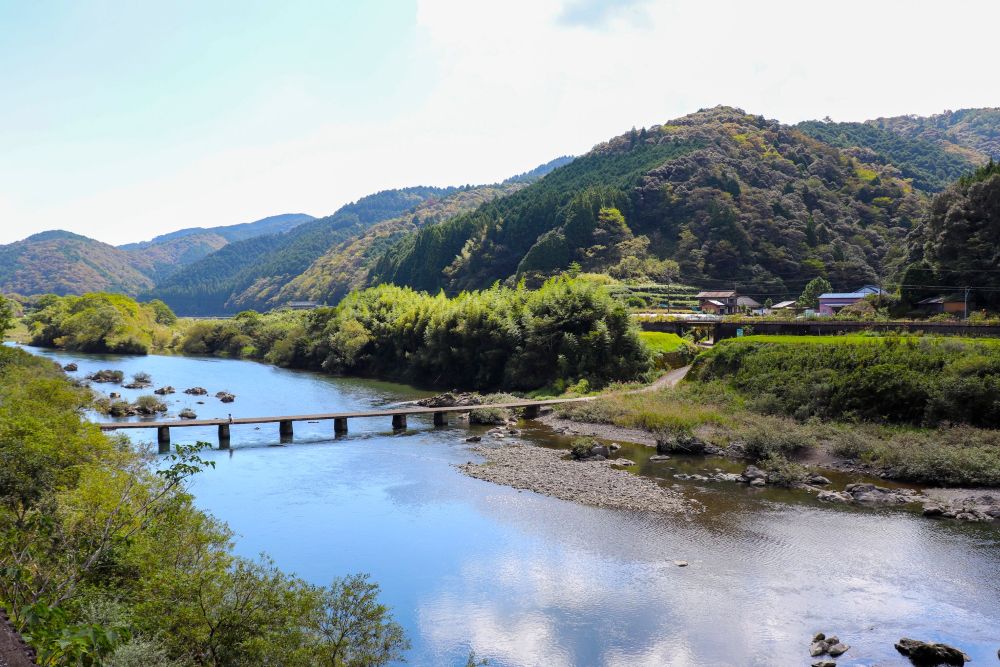
The Shimanto, the river that gives the valley and at least one of its towns its name, was actually a nickname. “Japan’s last clear stream” was once called something else, but it received its new name in the 1980s following an NHK television documentary. Some people believe it is because of the usually clear waters of the river, but in reality it was because this river on Shikoku was the last major dam-free river in Japan. But the phrase appealed to tourist marketing folks and residents alike, and it stuck.
We follow the river in search of the sinking bridges, concrete slab structures that have no railings or walls that might collect debris during the periods of the year when the river is running high. They are quite ugly, and yet have their own kind of brutalist beauty in this otherwise pastoral landscape. And yet island ghosts linger here too. At most places where the bridges have been erected, sloping ramps run down to the river from the road. These are the places where the ferrymen kept a hut. Once the bridges were built, the huts were demolished and the ferries sailed elsewhere, but the ramps remain.
***
And so, to the coast. After almost a week exploring the island’s interior, we travel to the southern tip of the island and the Ashizuri-Uwaki National Park. We have been in Japan for almost three weeks, and this is our first proper view of the Pacific. We drive through coastal towns where surfers brave the swells that roll into long, sweeping beaches. There are signs everywhere, telling us the closest place to flee to should the tsunami warning sound. In the towns where there is no raised land nearby, huge muster towers have been built in the hope that they will never be used.
Everything faces the ocean here. At Cape Ashizuri there is a statue of Nakahama Manjirō, also known as John. He was born here in 1827 and at the age of fourteen was swept off the rocks to be stranded on an island. Rescued by an American whaling ship, Manjirō was educated in Massachusetts before returning to Japan ten years later. His knowledge of English and navigation saved him from the normal punishment for leaving the country, and the Shogun made him a samurai. He would later become a translator for when Commodore Perry’s Black Ships arrived to “open up” Japan to the outside world.

We follow the coastal path at the cape, above the cliffs and through tunnels of camellia trees. Steep steps take us down to the beach to peer into sea caves, wary from the tsunami signs and the stories of swept away fishing boys about the power of the ocean that floods them with each eave. It feels safer at the lookout points, where we can look out into its vastness, trying to imagine a journey from here to the eastern seaboard of the United States, almost two centuries ago.
***
Cape Ashizuri is also home to Kongōfuku-ji, Temple 38 of the pilgrimage for which Shikoku is perhaps best known. We have seen the pilgrims all day, walking by the roadside with their long hiking sticks and conical hats against the sunshine. Most appear to be Japanese, but there is the occasional foreigner to be spotted too. The pilgrimage is rooted in the legacy of Kūkai, the founder of Shingon Buddhism who lived in the 8th and 9th centuries. His training sites were spread out across the island, and became the 88 temples that are now ticked off, one by one, on the Shikoku Pilgrimage.
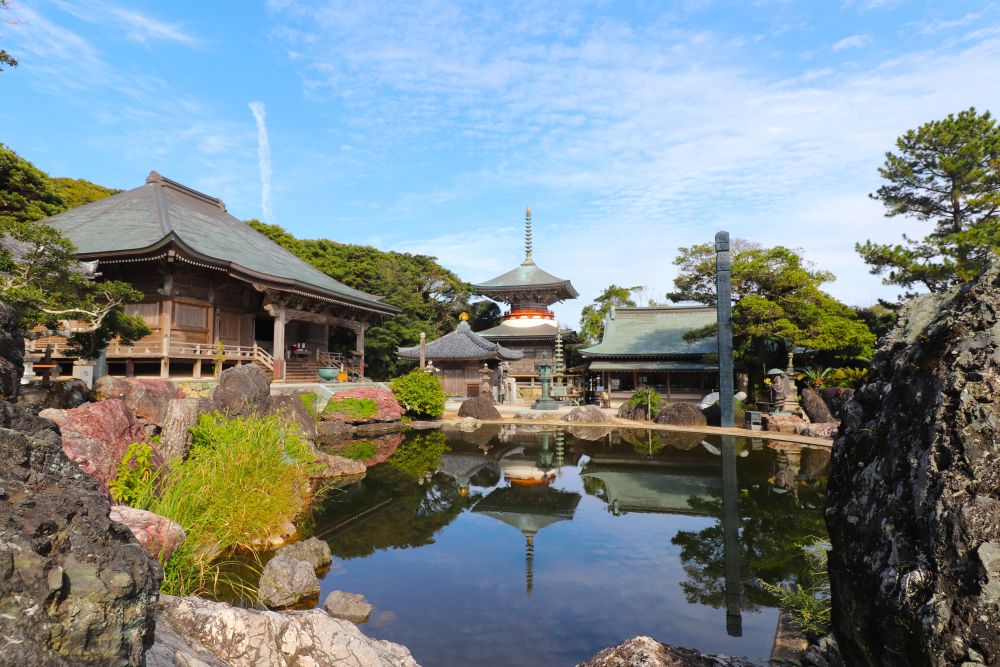
It was in the Edo period that the long walk was formalised, with guidebooks and stamps for walkers to track their progress. The wooden hiking sticks carry the phrase “two walking together” carved upon them, referring to the pilgrim and the unseen companion they are hiking with, namely Kūkai himself. Local people give food and shelter to the pilgrims, for whom each temple is a step towards purification. Some do it in one go. Some do it over a series of visits. Some do it by coach and car, which feels a little like missing the point.
***
On the way back to the house by the Shimanto river we stop at a convenience store in a small town for some supplies and go for a walk to stretch our legs. It is a neat and tidy place, but there are signs of neglect around the edges. Empty shop fronts. Abandoned buildings. Bike paths where tree roots have pushed up through cracks in the tarmac.
Kenzaburō Ōe wrote The Silent Cry in 1967, when the fragility of these rural settlements was already being explored in fiction. Ōe tells stories of hermits escaping into the forest to avoid the draft, and others, like his character, moving far from the island to cities elsewhere in search of a future that they could no longer see in the valleys of their ancestors.
“Now that I have come back to the valley,” his narrator says, “in an attempt to make sure of my own roots, I find they’ve all been pulled up.”
Shikoku’s population peaked in 1950, a few decades before Ōe wrote those words, and has been shrinking ever since. The rate of depopulation on the island has been higher than the country’s overall decline since 2011, and there are haikyo (ruins or abandoned buildings) to be found in towns and settlements beyond the island’s main cities.
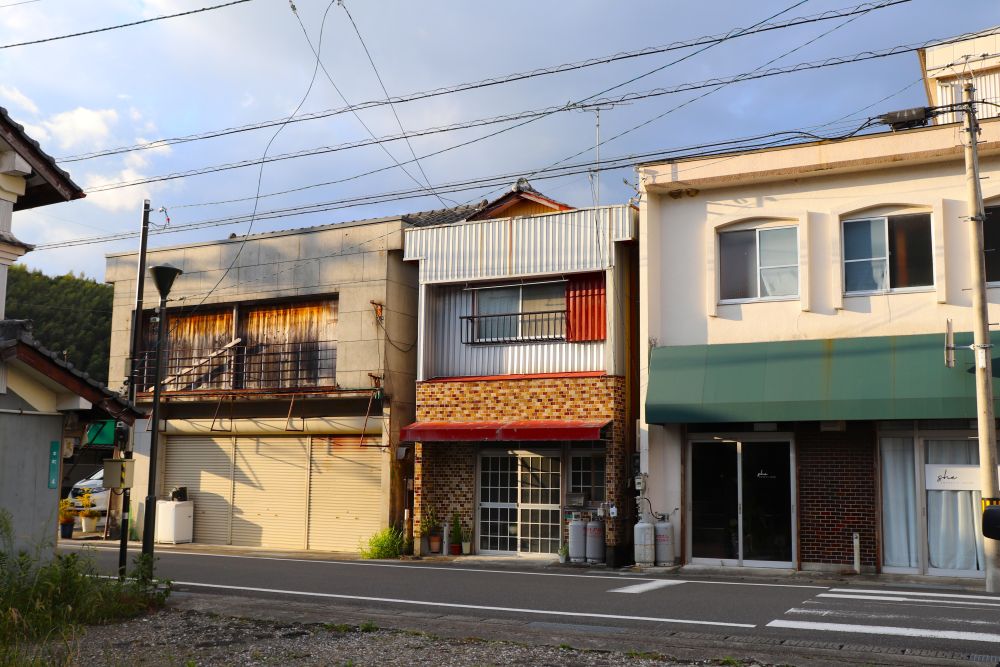
As we walk back to the car, the atmosphere is overwhelmingly one of melancholy. But it is not only here, in places where half the houses are empty, schools echo to the footsteps of the few children still around to attend classes, and highways link shutter towns that have schemes to try and tempt newcomers to build a future on the island. We felt it in Tokyo too. The vision of an imagined future, at its peak when Alex Kerr wrote about the Lost Japan, that has been overtaken and, ever-so-gently and with no little grace and elegance, slowed or even stalled.
Japan’s population peaked in 2008 and has been falling ever since. Four in ten people who live in the countryside are over 65. As we travel through the country, there are an estimated nine million vacant homes, double the number when the real estate bubble burst at the beginning of the 1990s. Young people are leaving the countryside, and are, for the most part, not coming back. As they leave, local economies shrink and infrastructure declines. This cycle reinforces itself, as services are reduced and cultural institutions fade. There is less reason to stay. And on it goes.
***
But there is beauty here, and in certain corners, there is also hope. In Yusuhara, a small town tucked away in the hills to the south of Matsuyama, we stop to visit the library. It is a spectacular wooden structure, designed by the architect Kengo Kuma, the visionary behind Japan’s National Stadium and a number of wooden buildings throughout this town. Establishing itself as a centre for eco-tourism and sustainable living, the library in Yusuhara is bustling on this weekday. The town is preparing for a trail marathon, and the kids in the schoolyard are making a raucous noise as they welcome back their baseball team from a road match.
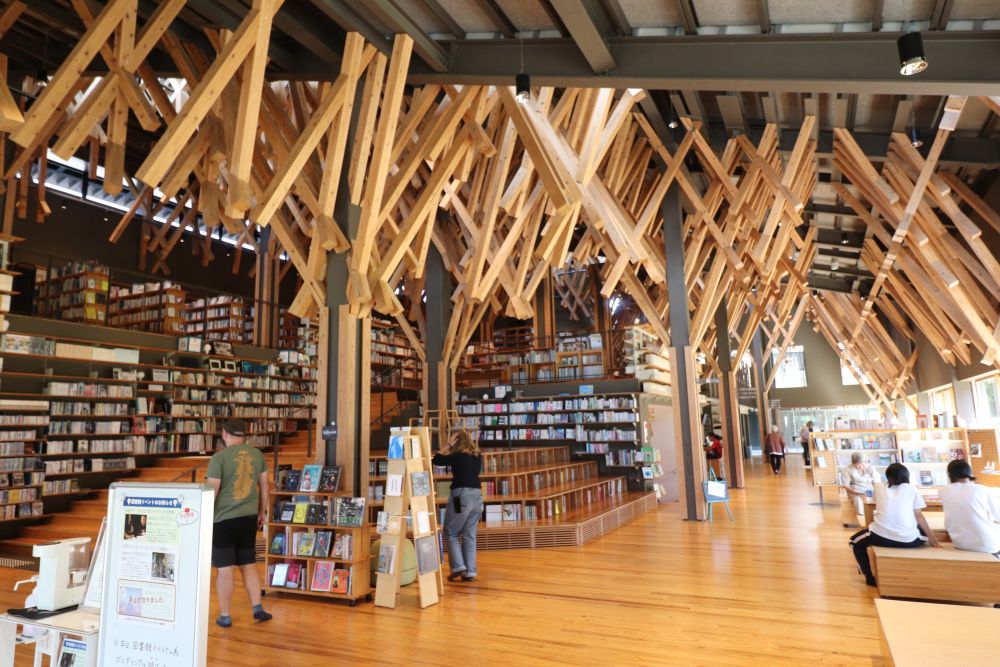
So the decline is not everywhere, and it is not always the same. In Yusuhara, we see a different island of the imagination. Of what it might be.
In Matsuyama we take the gondola up to the castle, where we drink orange juice and beer and look out across the city and to the sea beyond. Tomorrow we will catch the ferry to Hiroshima, and our time in Shikoku will be over. There is more we could have seen. Fabled bathhouses that inspired Studio Ghibli films. More hidden valleys. More sacred temples. Abandoned villages populated only by scarecrows. But our time on this island has given us a sense of a different Japan. Not better or worse, sometimes in stark contrast with the mega-cities and sometimes telling similar stories in very different ways.
Below the castle, a pub hums with scores of student conversations, and we find a corner where we can grab a bite to eat and let the journeys of the last week sink in at little. Where does the imagination go next, once the place you have dreamed about has been felt underfoot and seen with your own eyes? It brings questions to the fore, ones which would apply as much to Brandenburg, North Wales or even Nepal’s hill villages. How do we want to live? How do we maintain connection to the past in our modern world? What happens when everyone leaves? When we arrived it all seemed so foreign, fantastical and strange. But we realise now that these are stories we have heard before. Perhaps it is only the costumes and the stage sets that are different.

Words by Paul Scraton
Photographs by Katrin Schönig
