
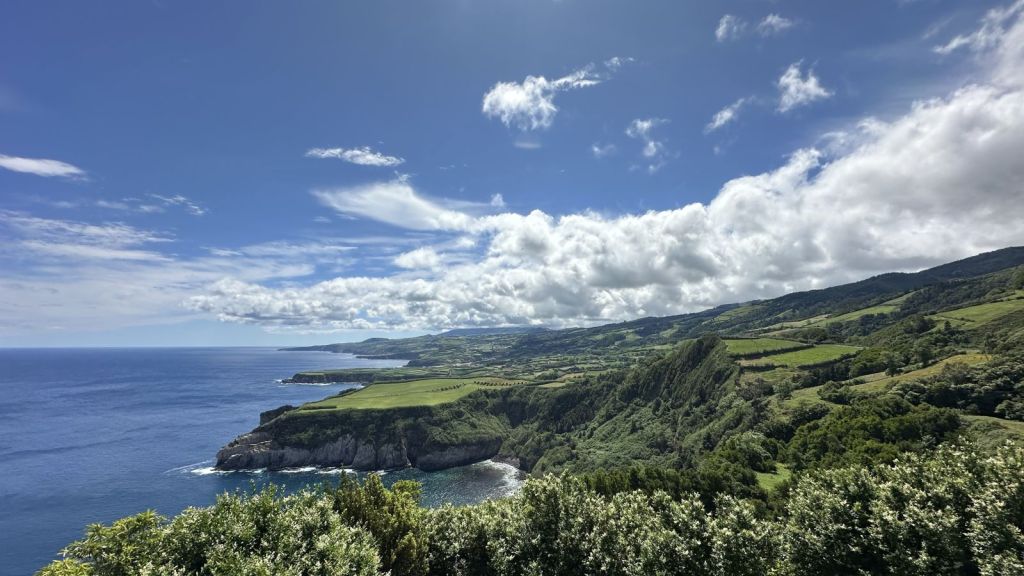
The road climbs up the hillside and into the mist. A few moments ago we stopped to look back down the island, a patchwork of green fields separated by dark stone walls, the blue of the ocean out in the distance. It could be Ireland, we say, except for the conical hills and the fact that you can see that the stone walls, when you get up close, are built from volcanic rock. And the dirt tracks that lead off from the road are a rusty deep red.
But that has all gone now, visibility down to just a handful of metres as we approach one of the high points of the western end of the island. We’ve already been here before. Already arrived in the mix of mist and cloud. Walked through the forest and out to the lookout point. Stood on the edge of the abyss and seen… Nothing. We are here to try again.
The dusty car park is empty as we climb out and make our way along the track through a plantation of tall trees. The forest floor is mossy and damp, the mist swirls and twists, to create shadows and sudden movements that catch the eye. It starts to rain. Surely there is no point. Surely we are going to be disappointed again.
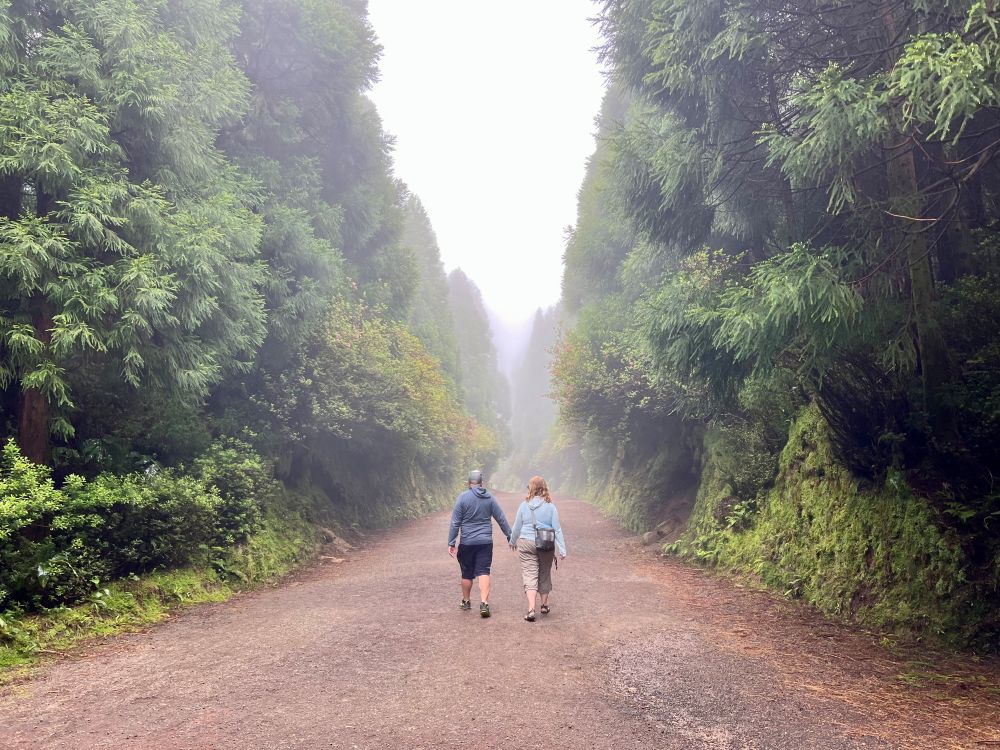
We press on. A young couple are standing by a stone picnic table at the bottom of the short climb that leads to the lookout point. Have they already been? They have, and like us yesterday, they have seen nothing. They are debating whether they should wait any longer or give up the ghost. But they are leaving the island tomorrow. This might be their only chance.
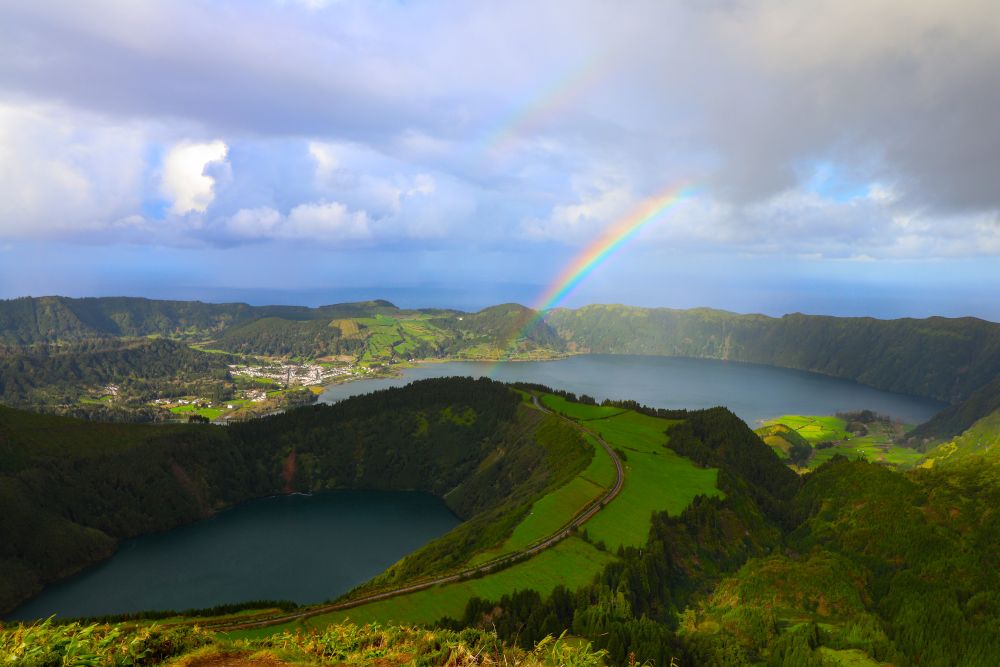
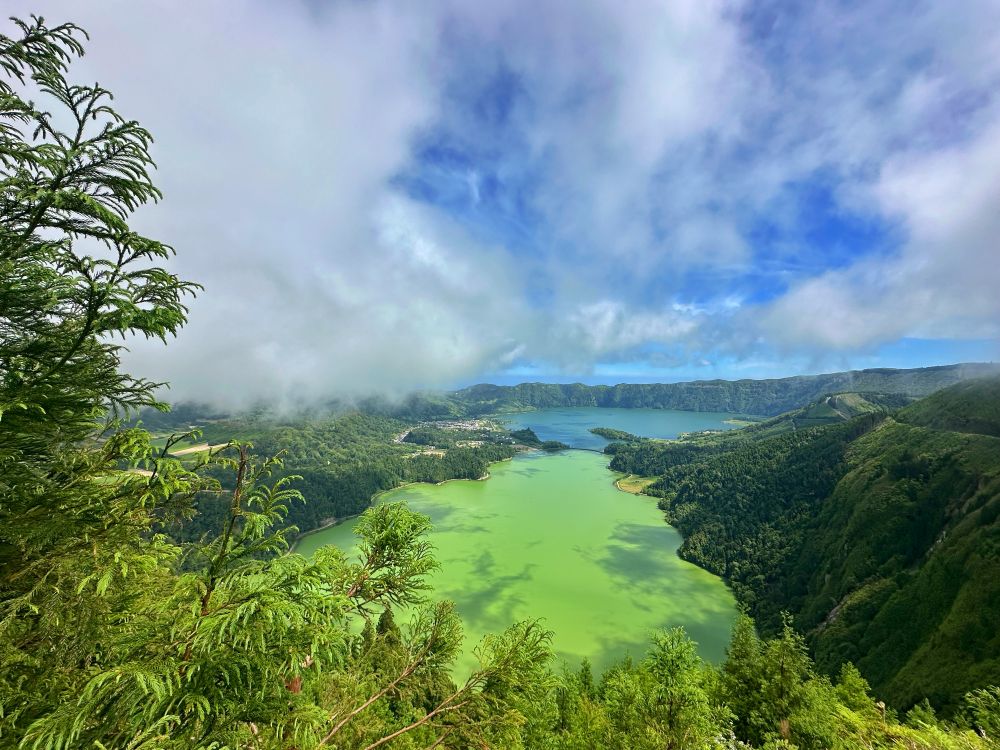
It seems like our arrival, and our blind faith that persistence shall be rewarded, that makes up their mind for them. They follow us up the sandy trail. At the top the path is closed off between wooden hand rails. The Grota do Inferno lookout point is on a rocky outcrop and low cloud and mist is not uncommon. The wooden railings are here to keep us safe. We follow the path along. We know what we should be able to see. It is probably the most famous viewpoint in all of the Azores. It is on the front cover of guide books and tourist brochures, websites and Instagram feeds. The curve of the caldera. The small lake, a volcano inside a volcano, in the foreground. The larger lake behind. The Atlantic away to the west, beyond the caldera rim.
At the lookout point a family is waiting. Daughter swings on the hand rail. Son checks his phone for reception. Mum has her cagoule pulled tight around here, while Dad looks for a break in the weather. How long have they been here? How long will they wait? Will they still be talking to each other this evening? We are all now in this together. And then, a slight break, away to the north. Is that sunshine? Is that the blue of the sky or the sea? More. A little bit more. And, in a piece of natural theatre that had to be experienced to be believed, the mist and the cloud retreats. Sometimes, but only sometimes, patience is rewarded.
Why travel to São Miguel?
All nine islands that make up the Azores are well worth a visit, but if time is short then the largest island is a good bet as it offers a range of activities as well as being your most likely arrival point via the airport in Ponta Delgada. The island capital is a pleasant town whose narrow streets can be explored in a day or so. and has a nice collection of restaurants and bars, lots of accommodation options, and makes for a great base for exploring.
The appeal of the island begins with the landscape. The Azores have been formed by volcanoes that have erupted out of the Atlantic Ocean at the point where three tectonic plates meet… the intersection between Europe, North America and Africa. São Miguel is an island of craters and calderas. At Sete Cidades the twin lakes of green and blue lie in the base of the old volcano. In Furnas, you can eat stew that has been cooked in the bubbling pools of the caldieras before soaking in the thermal baths of the mineral-rich waters. You can hike the rim of a volcano, follow a coastal path above black cliffs or a red-dirt track through some of Europe’s only tea plantations, explore the hydrangea-lined back lanes of the island interior or follow a steep trail through the forest to swim beneath waterfalls in hidden pools.
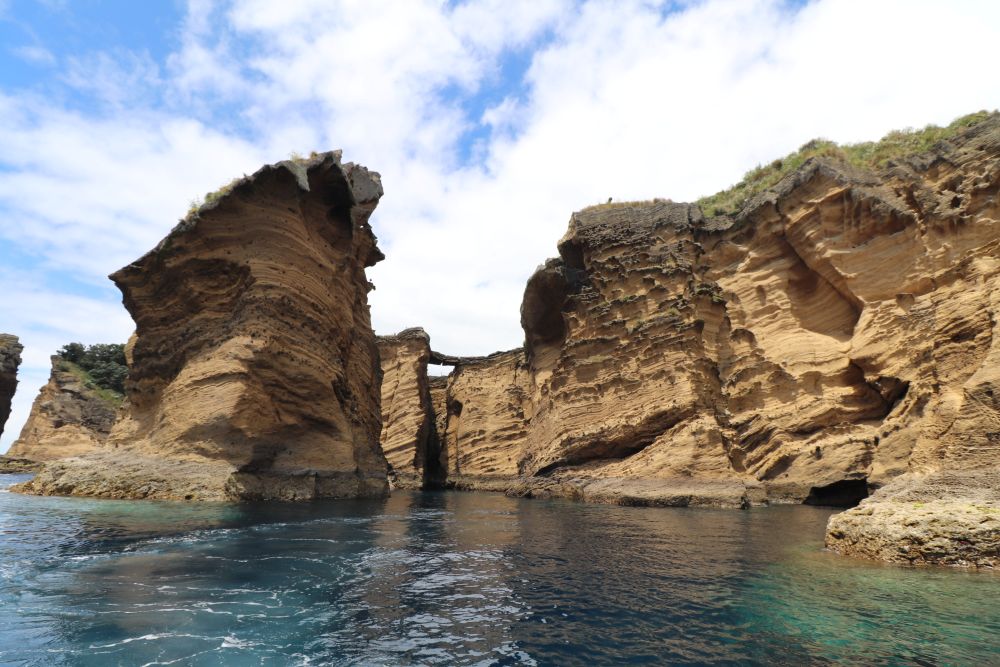
The waters offshore speak to the island’s history as a centre for fishing and whaling. Thankfully today the old watchtowers that were used to hunt whales are now used instead by spotters who tell the captains of the whale- and dolphin-watching boats where to go. Kayakers paddle out from Vila Franca do Campo to explore the semi-submerged volcano that lies off the south of the main island, while to the north in Ribeira Grande, surfers catch waves that have rolled in across the Atlantic for thousands of miles with no land to get in the way.
Beyond these many and varied natural attractions, the joy of São Miguel is something that is shared by most islands in that you really have the opportunity, even in a week or so, to get a feel for the whole place, from its most popular hotspots to its hidden corners. And despite the increase in flights in recent years and the photogenic nature of the place, even in high season it never feels too busy, perhaps because it is pretty much in the middle of the Atlantic ocean and the weather, shall we say, can be mixed.
That said, it never gets too hot in the summer, nor too cold in the winter (and we have experienced São Miguel in both seasons), and although the lush greenery of the island speaks to the amount of rain that falls, you can always be pretty sure that if you just wait an hour or so the sun will be shining once more. Another thing worth noting is that São Miguel, along with the rest of the Azores, is the first island archipelago to achieve international certification as a sustainable tourism destination.
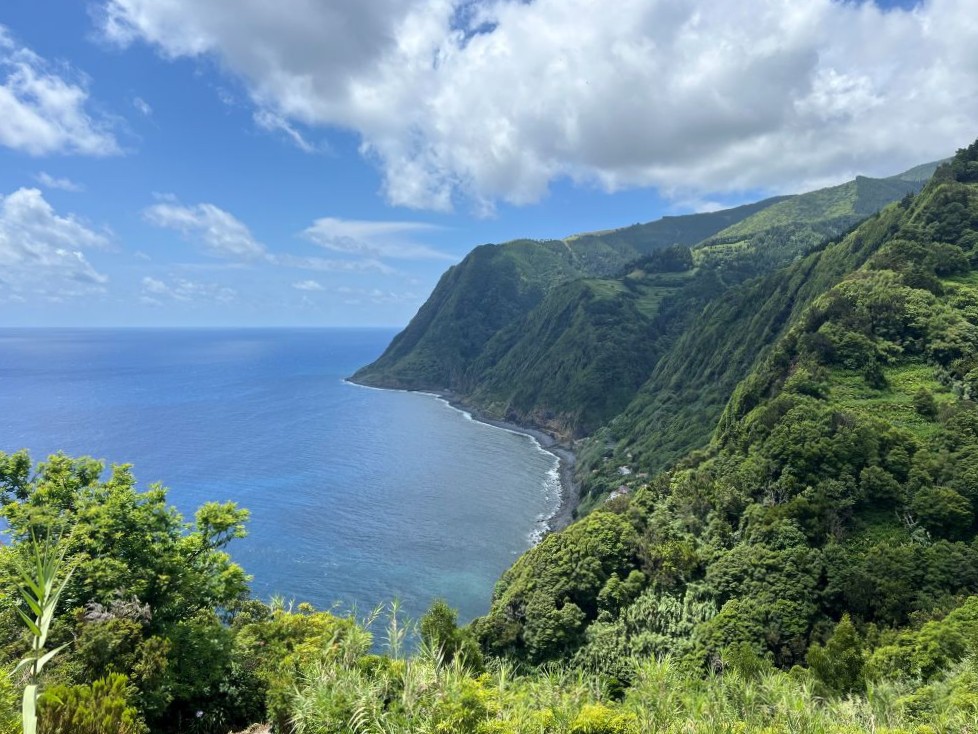
All of the above not only speaks to why you should travel to São Miguel, but also to the fact that even now, after a number of visits and with much of the world still out there to explore, we feel pretty sure that it won’t be too long before we return to this island in the middle of the ocean. There’s just something special about it, from the landscape to the distinctive architecture, the quality and variety of the outdoor activities, the seafood in the restaurants and the friendly people we’ve met on each visit. Go see for yourself.
Favourite walk in São Miguel
Any walk that takes in the lookout point Vista do Rei above the twin lakes of Sete Cidades is well worth your time. This route on All Trails takes you from the lookout point along the rim of the volcano before dropping down to the lakes and climbing back up again.
On our most recent visit we found a slightly less well known route that starts from a trailhead on the main orbital road in the east of the island. This end of São Miguel is often less visited than the west and has a much wilder feel, as well as the highest mountain on the island. The high point of our chosen walk, however, is actually the car park at the trail head.
From here you follow an old track until you reach the ruins of a water mill, and then you descend into the forest, following a river as it makes its way towards the ocean, with some quite steep sections that bring you down to the base of a series of different waterfalls tucked away beneath the canopy. These are great places to swim and wash off the dirt from the trek, whether you stop on the way down, the way back up, or both! You also pass by some small farms and orchards, and the bottom end of the trail, as you approach the village of Faial da Terra, gives you a real feel for life in this remote corner of an island that is, in itself, pretty remote.
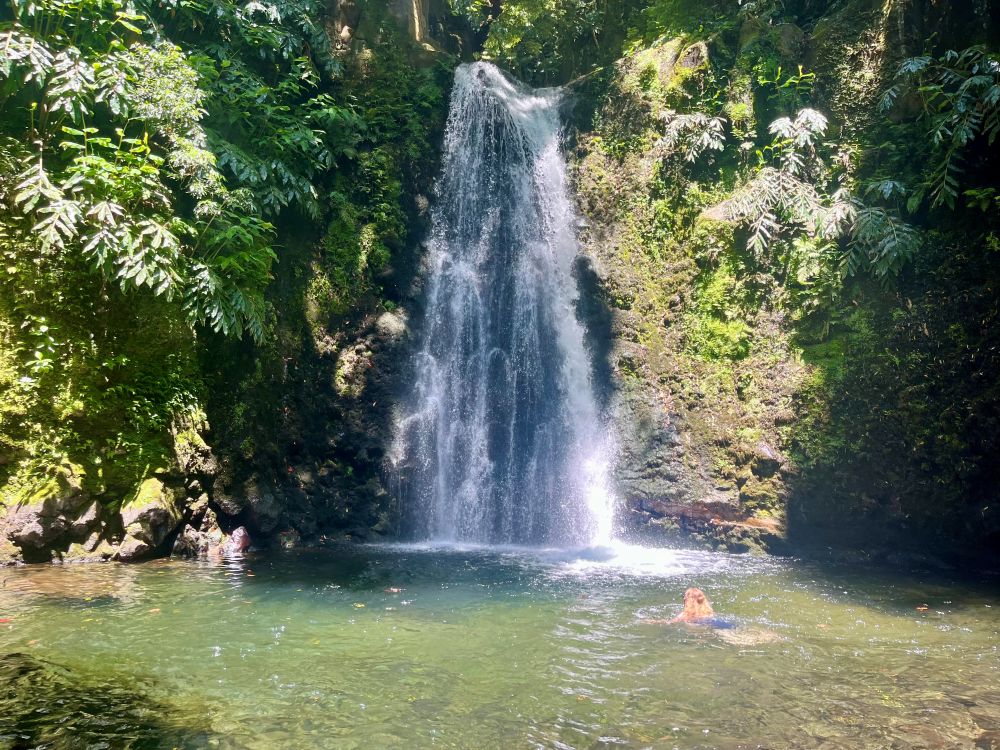
Today, the quality of the roads means that travellers can get from the eastern end of the island to Ponta Delgada in little more than an hour. On one of our visits, our host told us that during his grandparents lifetime, the journey from somewhere like Faial da Terra to the capital would have taken a couple of days. On the day we did the hike, we encountered a number of people picking their way through the forest from one waterfall pool to the next, but there were periods when we had the path and the sound of the birds, the insects and the trees moving in the Atlantic breeze, all to ourselves.
Travel tips for São Miguel
During our visits we have stayed in Ponta Delgada as well as Lagoa, just along the southern coast from the capital, and Nordeste on the opposite side of the island in the north east. Nowhere is really that far from anywhere else, although making the most of your time on the island does probably require renting a car. The benefit is that you can choose the place to stay based on the accommodation, in the knowledge that everything you might want to see is within driving distance. There is a wide range of accommodation options available on AirBnB and we’ve always found lovely places at a reasonable price. The Hotel do Colegio in Ponta Delgadao is a nice boutique hotel right in the heart of the old town centre.
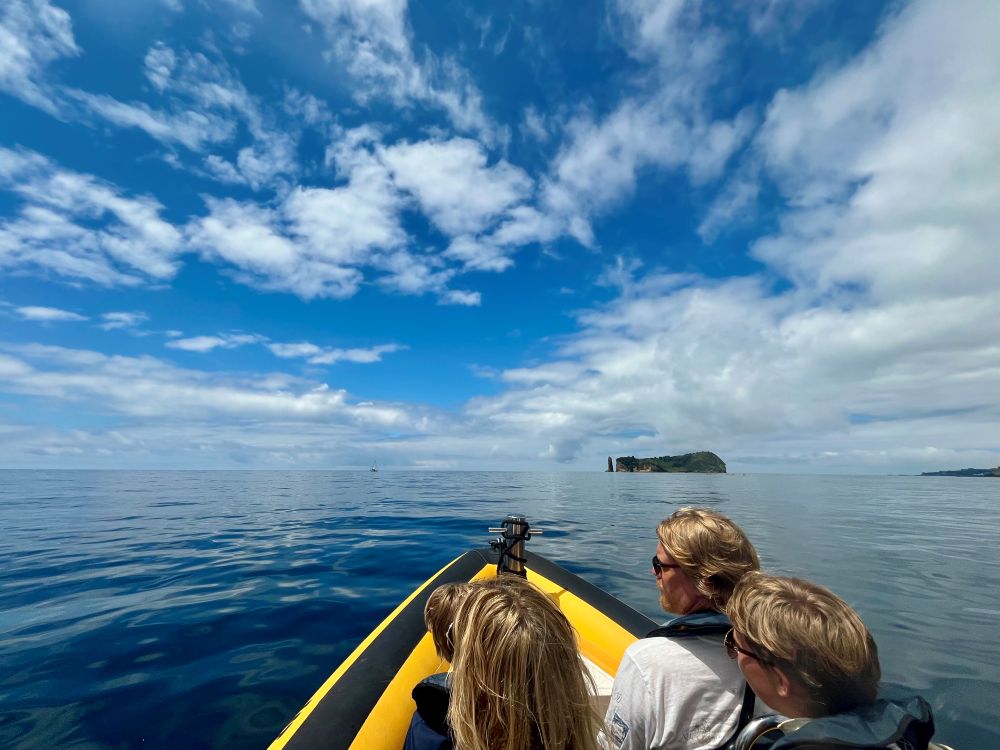
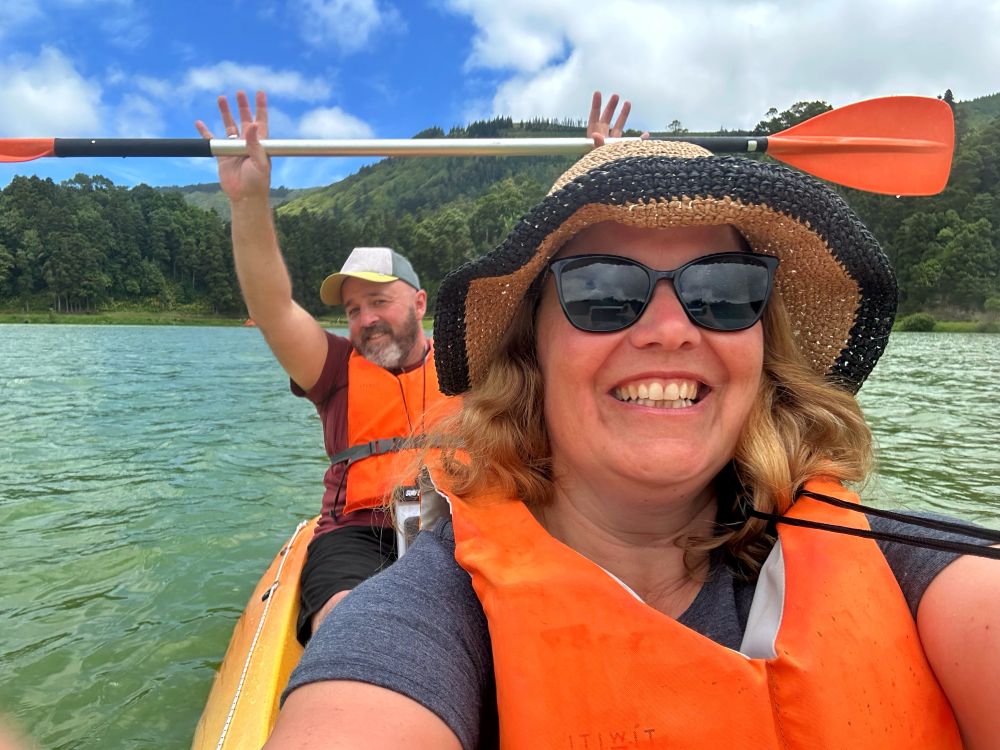
For organising your outdoor activities beyond hiking the lovely island trails, the company Futurismo – Azores Adventures is certified for ethical tourism practices and offers a wide range of options, including whale and dolphin watching with their team of marine biologists. We had such a good experience with them on the tour from Ponta Delgada that we also used them to rent kayaks to explore the green and blue lakes of Sete Citades. For boat and kayak tours from Vila Franca do Campo, we can also recommend Terra Azul and Epic Volcano Azores Kayak and Boat Tours.
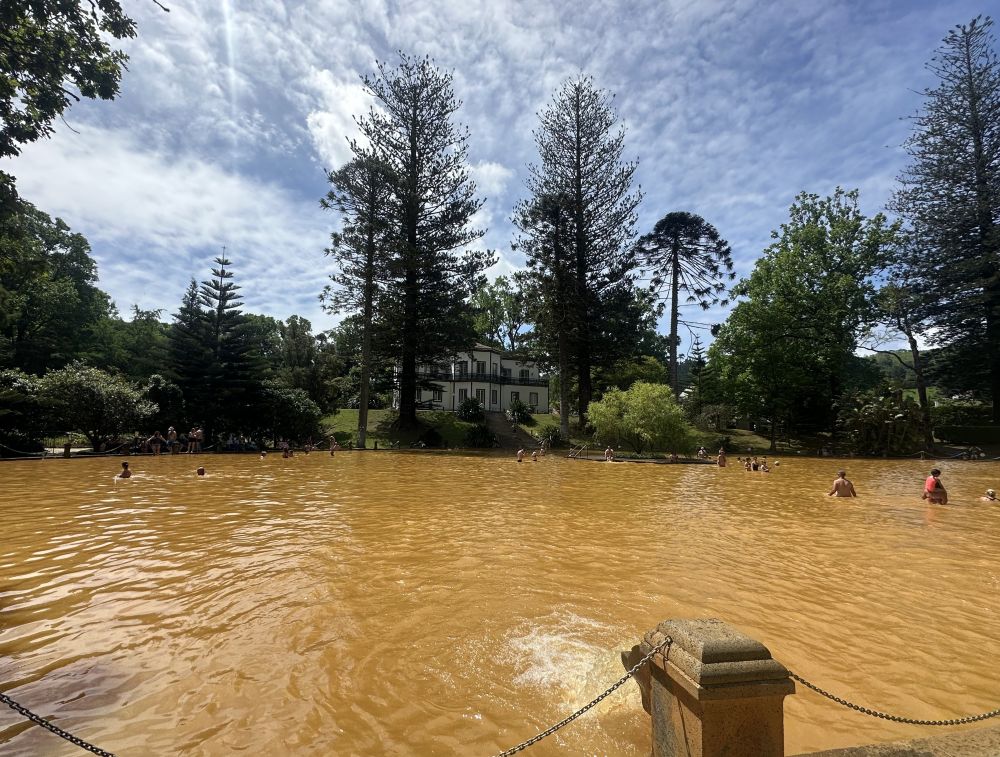
We love the thermal pools that are part of the botanic gardens of the Parque Terra Nostra in Furnas, and there are a number of other thermal bathing options in this part of the island. One unique bathing spot is in the far west at the Ponta da Ferraria bathing spot. This is an ocean swimming spot, with free changing rooms and toilets, but what makes it different from the others you’ll find dotted around the island (including in Ponta Delgada harbour itself) is the fact that this is the only place where the thermal volcanic waters meet the sea.
Other attractions you shouldn’t miss include the Gorreana tea plantation in the north of the island (which we have written about here) and the Azores Brewing Company in Ribeira Grande, whose fine selection of craft beers can also be found in selected supermarkets around São Miguel, so look out for them. Our favourite restaurant on the island is the Louvre Michaelense, close to the harbour in Ponta Delgada. As for local specialities: the Azores is rightly famous for its organic beef and dairy products (especially the cheese), its tinned fish and the volcanic wines from the island of Pico.
Words by Paul Scraton
Photographs by Katrin Schönig
