
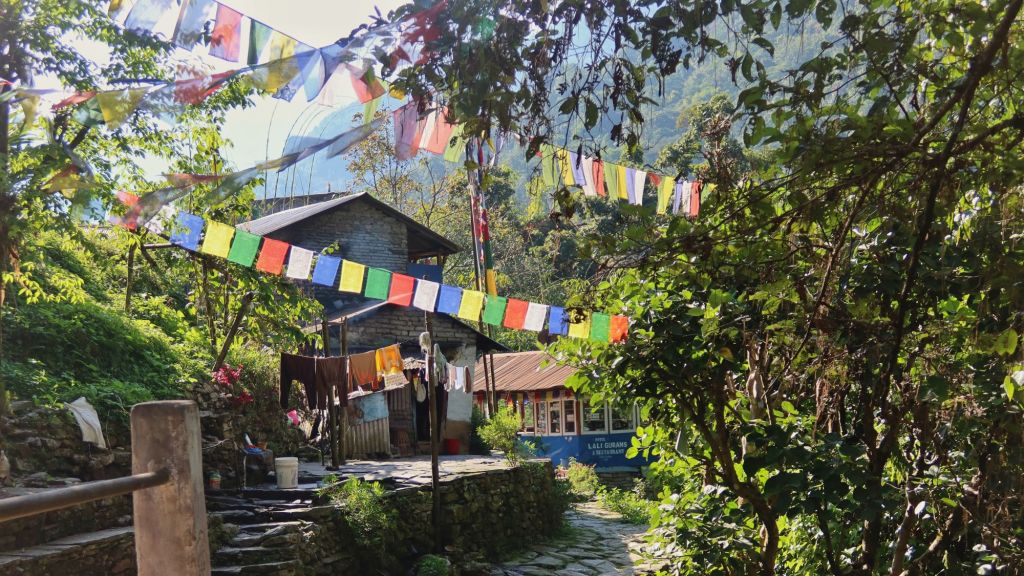
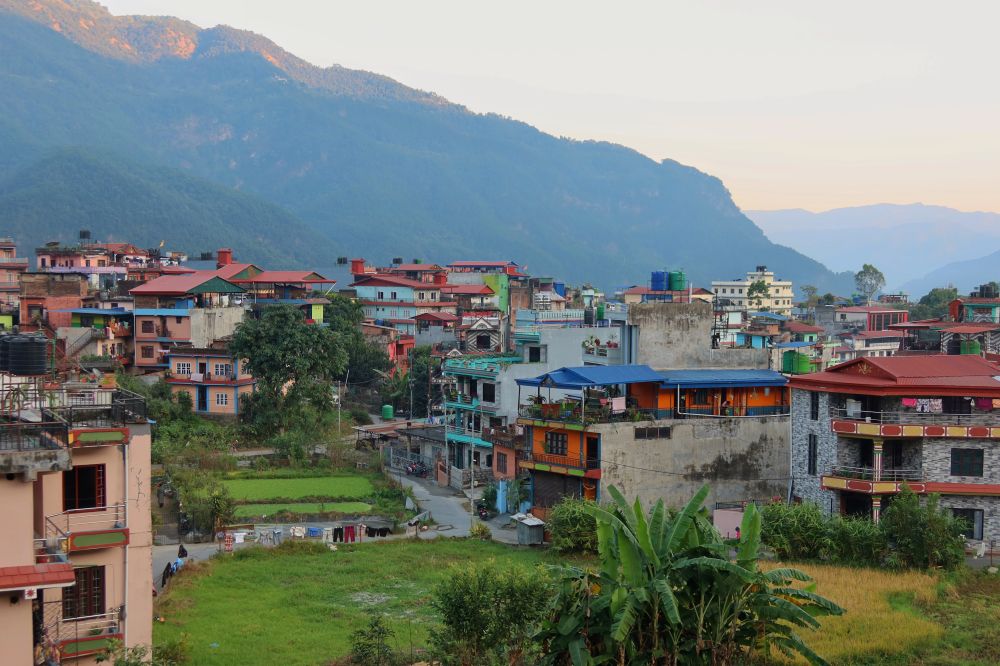
The hotel was built on a series of terraces leading down from the main street in Besisahar. Once they were farmed, but now they hold a car park, a dining room, a restaurant and bar and two buildings containing the hotel rooms. The neighbouring terrace was still cultivated, and from the balcony of our room we watched as a woman tended to her crops while a kite circled above the town’s houses and the last of the afternoon sun hit the highest of the Himalayan peaks on the horizon.
Before dinner we wandered the streets. Construction projects were ongoing. A group of women shovelled gravel while a man in flip flops used an angle grinder, sending sparks flying across the road. Outside a small cafe with a dusty Tuborg sign (they all seem to have dusty Tuborg signs) a group of men played a game that involves flicking small disks across a sawdust covered board. Chickens pecked at the gutters. A dog looked down on us from a rooftop. Every so often the houses that have been built up on the slopes on either side gave way to a small field. The countryside and the town, merged together in this hilltop settlement.
For a long time, Besisahar was the classic starting point for the Annapurna Circuit trek, and the main drag still had a few shops aimed at tourists. But the jeep roads now extend far up the valley, and trekkers often bypass the place. After all, who wants to walk for hours along a dusty track? What will this mean for the town, if the trek begins elsewhere? It is yet another story from our travels in Nepal that spoke to the precarious nature of things in this country. A new road improved communications in remote villages, making key parts of everyday life easier, but has a knock-on effect on the hotels, guesthouses and restaurants further down the valley.
The conversation in the dining room that evening was about the future of the town if tourism passes it by, and also the election. It would happen in the following March, and we were only a few weeks from the Gen Z uprising that had led to the collapse of the government. ‘We need hope,’ someone says. ‘We need to believe that there is a future. Otherwise anyone who can will continue to leave. But we don’t want to leave. We want to build something here. But you know, it’s hard…’
*
Almost a year on, these words echo as we watch the images of the devastating flash floods that wiped out whole communities close to the Nepal-Tibet border. Other images from elsewhere in the country show a road that we travelled down from Ghandruk to Birenthanti washed away by a landslide during the monsoon rains. Very few countries have a lower per capita carbon footprint than Nepal, and yet there are very few countries who are being hit harder by the impacts of the climate crisis. It all adds up to challenges that seem impossible to imagine from Berlin or Liverpool.
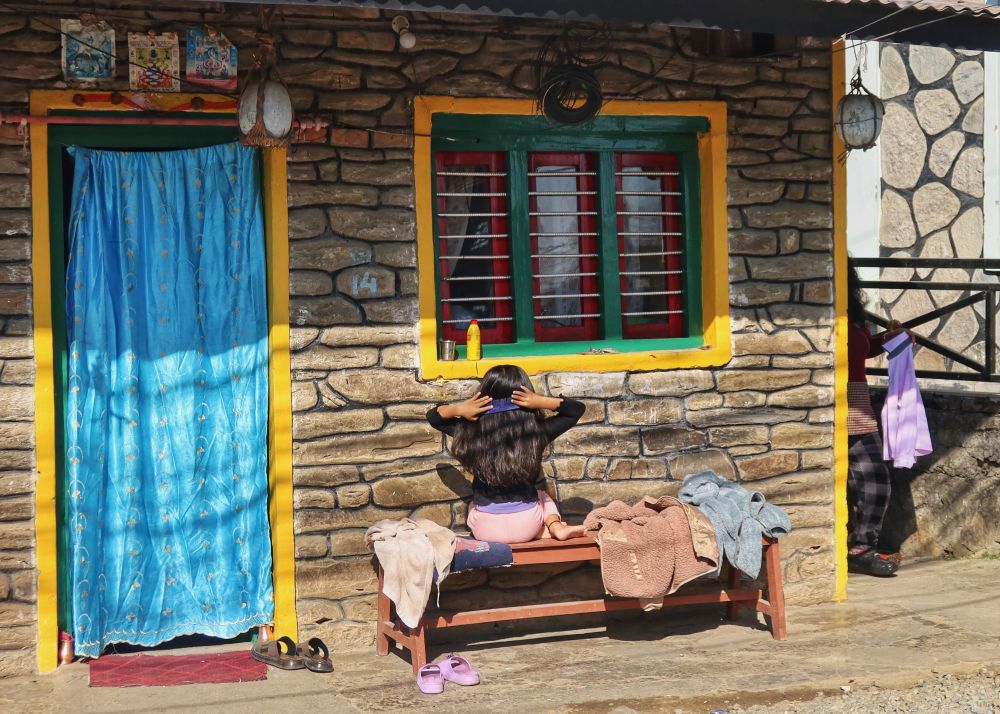
What inspired us in Nepal were the people we met, whether through our journeys with colleagues from Pahar Trust Nepal or in roadside conversations with strangers, and the determination that something better was possible. We saw it in the schools we visited and the health posts that had been built. We also experienced it in the social enterprises that kept money and resources in communities. And we heard about Nepali companies that were trying to encourage sustainable travel and tourism, that would have a positive impact on places that outsiders would visit.
On our trek from Birenthanti up to Ghourepani, our guide Kushum told us about the company she worked for. 3 Sisters Adventure Trekking was founded more than twenty-five years ago, and remains a women-owned company that not only provides guided tours for tourists and work for women guides, but also a training problem for young women from rural communities to become guides themselves.
Kushum has been doing this for ten years, including two complete treks on the Annapurna Circuit, while her assistant Mamita was on only her third ever trek. Mamita moved to Pokhara from the far west of the country a few months before, and was not only learning to be a guide in the mountains but also learning to speak English while learning how to live in the big city.
‘It’s hard for the young women,’ Kushum said. ‘It’s a lot to experience at once. But it is also a great chance for them.’
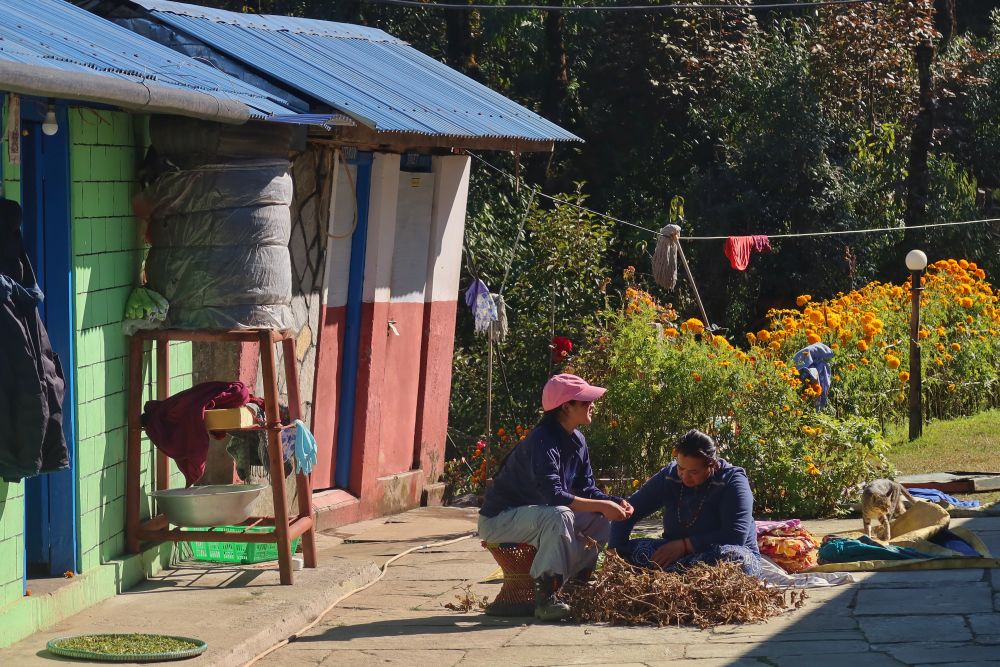
Mamita shadowed us for five days, carrying a greater load than anyone else, and always ready with a smile when the words failed her. By the last days, with Kushum’s gentle encouragement, she began to take over some of the guide’s duties. But we could also see that she was often happy when we reached the guesthouse, and she could escape for a while into the company of the women who sat on the terrace, shelling beans as the birds made their final fuss before the last of the sun’s rays disappeared behind the mountains to the west.
*
What does it mean to make a connection to a place that is far from your home, one that you will surely never live in? For many of us who have lost a piece of their heart to Nepal, the original draw might well be the landscape, and the reality and the mythology of those highest of mountains. But what makes us want to keep coming back, as is so often the case, are the people we have met and the friends we have made.
Just on the edge of Kathmandu, we stopped at a small park on the hillside, the valley with the city at its heart stretched out in front of us, but obscured with a soft haze. Two young men had pulled in on a scooter, and had joined us at the lookout point.
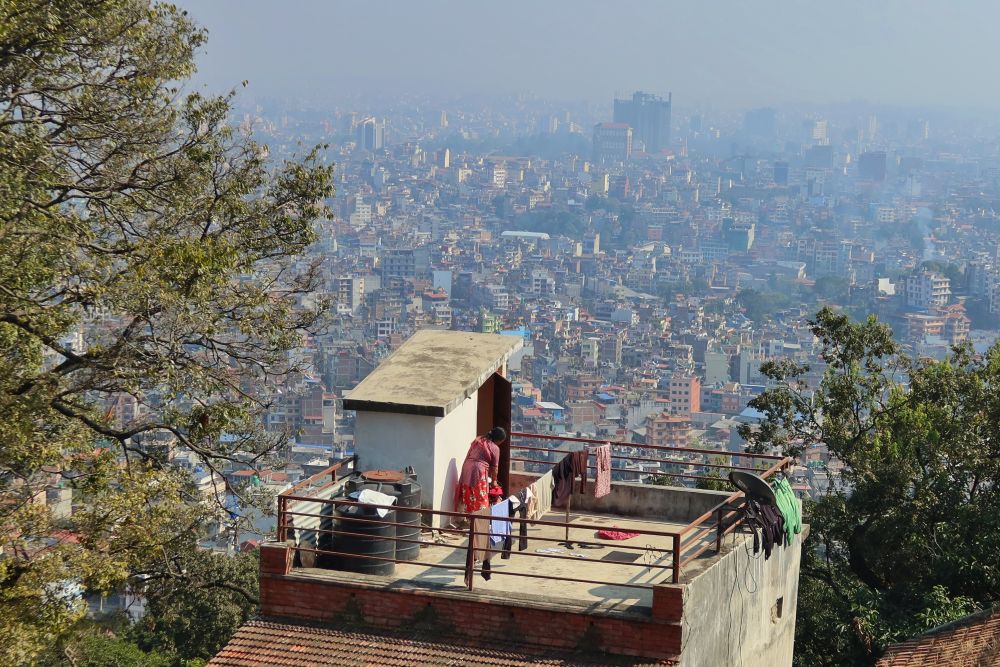
‘Where are you from?’ one of them asked. ‘Ah, Germany. And the UK! I love it. One day I will travel to the UK. Germany, I’m not so sure, but we shall see.’
He giggled.
‘But how do you like it here? Very peaceful, I think? Not so much like at home.’
‘Or Kathmandu.’
‘Yes,’ he laughed. ‘Not like Kathmandu. This is most certainly true. But I like Kathmandu also, because there you feel like something is happening. Or can happen.’
He was training to be a doctor, moving to Kathmandu from a small town not far from Besisahar. But Kathmandu was a stepping stone. A means to an end. Once qualified he would probably go abroad for a while. But eventually he wanted to go back and work closer to home. If it was possible.
*
The school was at the end of a dirt road on an outcrop in the hills above Putalibazar, a little bit further down the slope from the village it served. It was a small school, with only a handful of children, but the restoration and refurbishment work undertaken by Pahar Trust Nepal and funded by Pahar Foundation Nepal in Australia, would mean that it had the potential to educate many more.
We met Hum, who had been to the school as a young boy before leaving the village to complete his education. He told us stories of protecting the harvest from monkey raids and how he joined the Gurkhas fifty years before, eventually becoming a welfare office in the UK. But he never forgot his home.
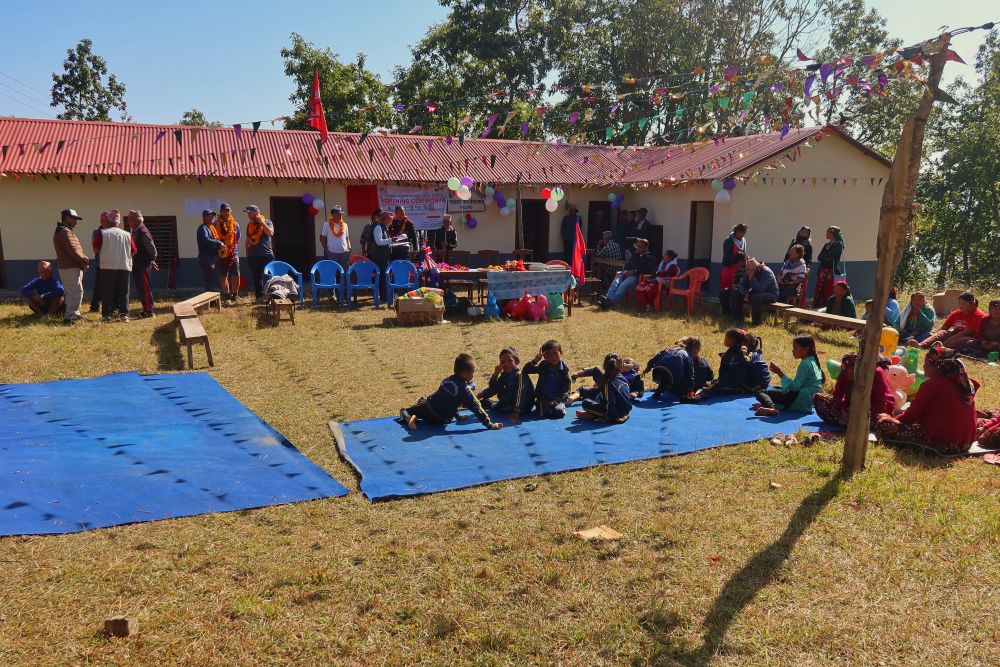
With the children sitting cross legged in the sunshine, surrounded by their parents and grandparents, Hum made a speech to mark the opening of the school, with some of it in English for our benefit. He spoke about the people who had come from the village and gone out into the world, and how he wanted to paint their names on the classroom doors to inspire the young people that followed in their footsteps.
‘The more languages you can speak,’ he said to the children directly, ‘the better it is for our brains. And for your future.’
Hum’s speech and the stories he told us afterwards, all spoke to a deep belief in the power of education to transform individual lives but also communities. He was someone who had left, who had made his way in the world far beyond the borders of his home country, let alone this tiny village on a hillside, but his sense of home and belonging was strong.
*
The power of social media means that we are still in contact with many of the people we met during our travels, and we hear their stories as they speak about what has been happening in the country since we left, from the cautious optimism of the election results in March to the absolutely devastating scenes from the Rasuwa, Nuwakot, Dhading, Gorkha and Tanahun districts that bore the brunt of the flooding in recent weeks. And yet, incredibly, the word that seems to come most often is hope despite the almost overwhelming challenges the country faces.
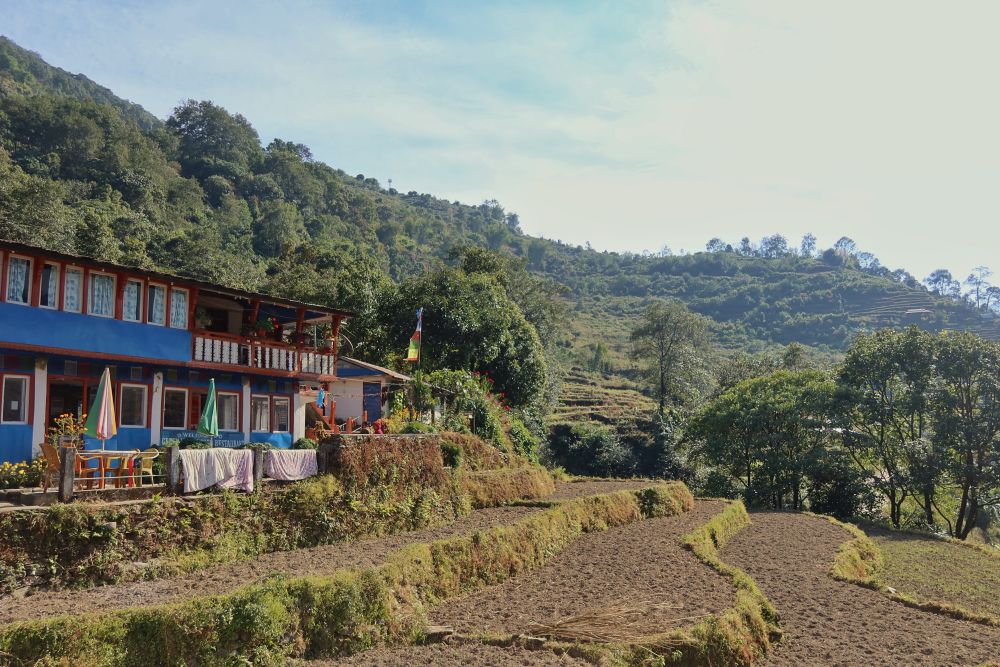
It is the hope that something better is possible, if we work towards that goal. It’s what we brought home with us when we left Kathmandu almost a year ago, and it is threaded through all of our correspondence with friends since. It is quite remarkable, and it is why we remain committed to supporting our friends meet those challenges, in any way we can.
Words by Paul Scraton
Photographs by Katrin Schönig
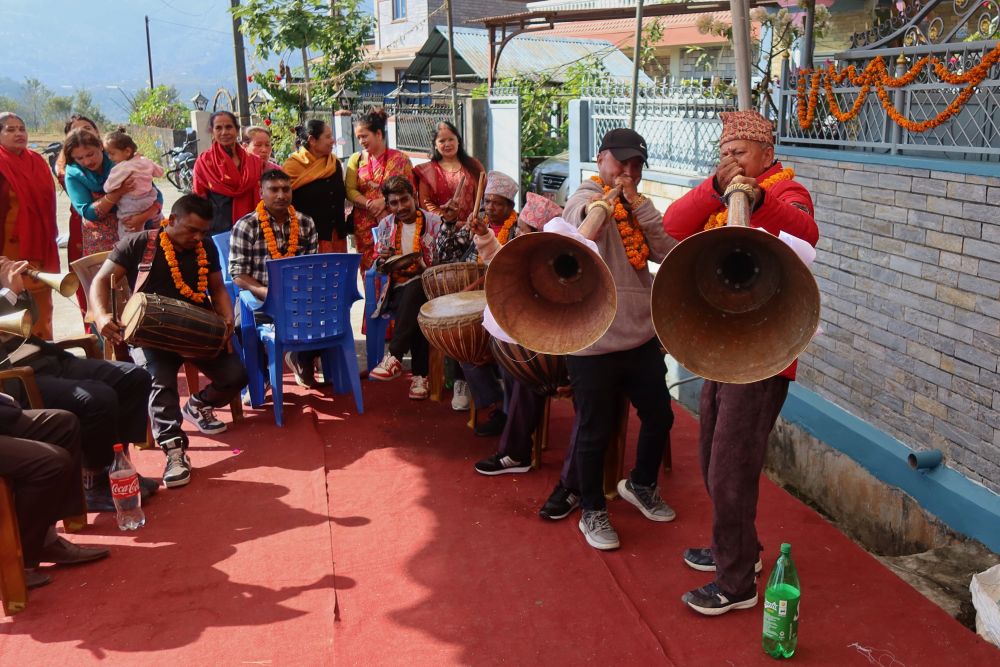
If you would like to support the emergency relief for those communities devastated by the recent floods, Pahar Trust Nepal has created a fundraiser and the team in Pokhara will make sure that the money goes to the places it can be of best use. Beyond this, Pahar Trust Nepal’s core work remains to build earthquake-resilient schools and healthcare facilities in rural Nepal to improve opportunities for young people and their families. You can find out more on their website.
The other important message coming out of the country is that it remains open for travel and tourism, and that people cancelling their trips this autumn could have an absolutely devastating impact on people’s livelihoods far beyond the areas hit by the flooding. Of course, as with all travel, it is important to check the most up-to-date information about the places you want to go to.
If you are looking for a trekking company, we can wholeheartedly recommend 3 Sisters Adventure Trekking, who offer tours with female guides, and run a training programme to bring through the next generation of guides, breaking down barriers for Nepalese women and promoting sustainable adventure tourism.
