
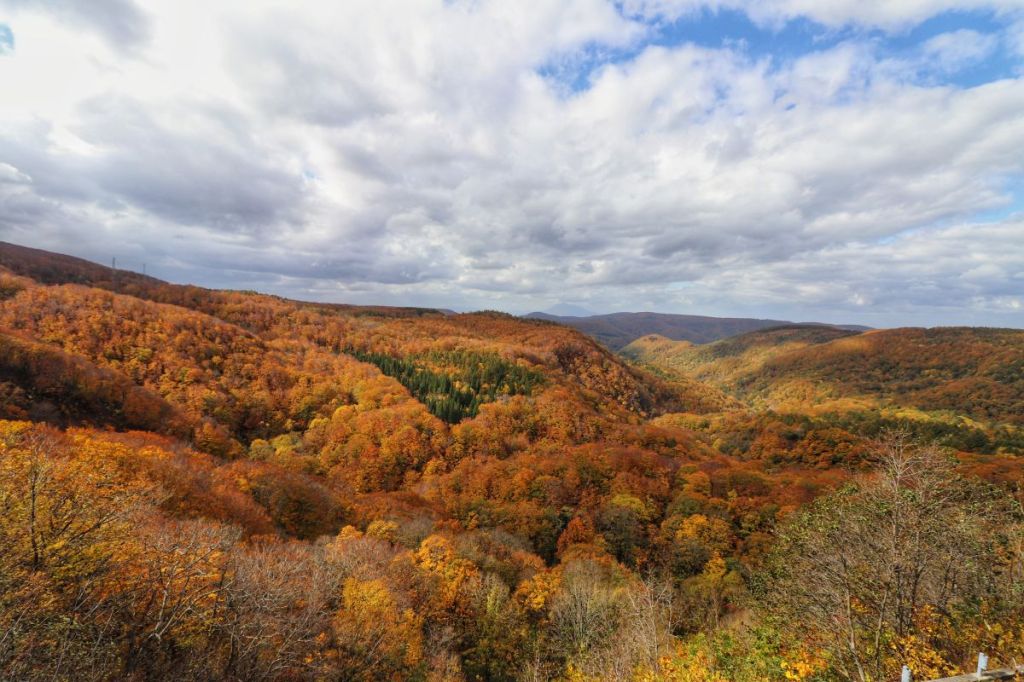
Yamagata sits in a basin, surrounded by hills. We arrive in the city at dusk having left the big city bustle of Sendai behind us only a few hours ago. There we discovered tiny bars in post-War market halls lined with shops, some of which have been in operation since those early days of reconstruction, between strolling wide, tree-lined boulevards beneath towers of glass and steel. But even though the drive into Yamagata has taken us past the usual parade of shops and showrooms, and most of all billboards and car parks, we feel we have left the true urban Japan behind us, at least for a little while. To the west, the sky grows red with the falling sun.
To the east, the mountains are illuminated and feel so close that, should there be a hiker on the ridge, we would be able to wave to them from our eleventh-floor hotel room.
*
Pilgrims of one sort or another, including our old friend Matsuo Bashō, have been coming to Yamadera for centuries. There are more than a thousand steps to be climbed before you reach the top of the temple complex, but the hike up through the dark and mystical woods is more than worth it. When Bashō came he had the place to himself, except for a handful of monks. We have more company, but the words that he wrote on his visit to these hills still resonate for all of us on the mountain today.
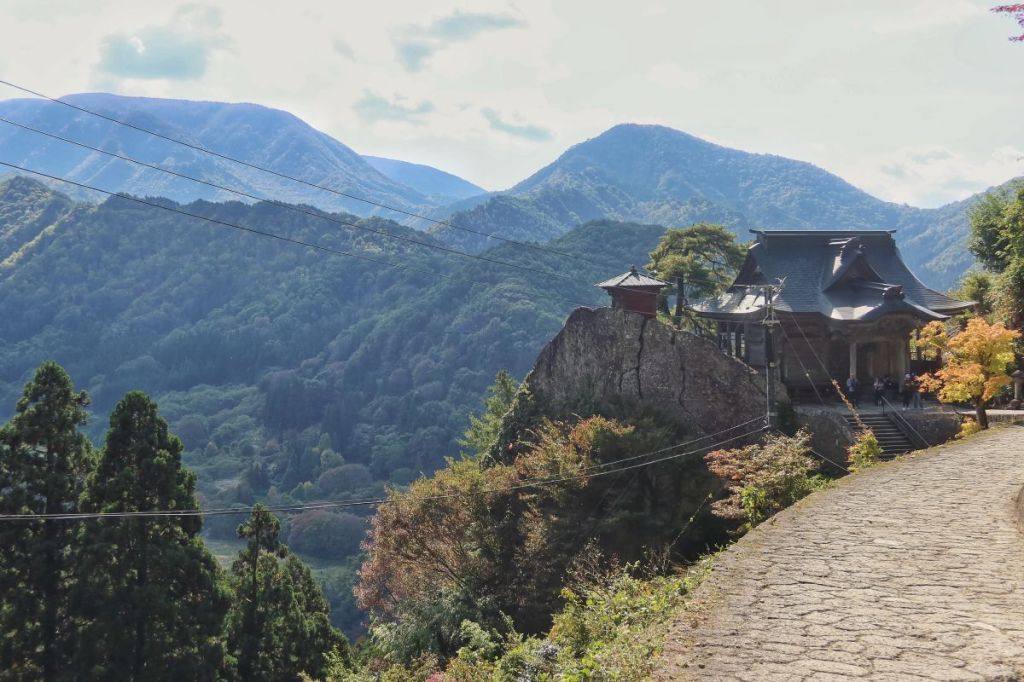
As I moved on all fours from rock to rock, bowing reverently at each shrine, I felt the purifying power of this holy environment pervading my whole being.
Bashō’s statue is at the bottom of the climb and his museum is on the other side of the valley. We pause to let him know that we’ve enjoyed travelling with him so far, although soon we shall be heading even further north than even this great wanderer ventured.
*
At Zao the road keeps climbing through the ski resort, getting narrower and steeper until we reach the point where we can drive no further. We follow a bamboo tunnel walkway into the woods where there is a small wooden cabin. One goes through the red curtain, the other through the blue. We strip off and step out beneath the forest canopy. There are a handful of other bathers in the onsen, and most are enjoying the warm water and the onsen colours. In the men’s section, one man is curious about the foreigner in the midst, and although his English is as limited as my Japanese, we manage to hold a conversation of sorts, about whether Europeans have hot springs, where I have travelled to in his country, and the films of Michael J. Fox.
*
In Naruko, having strolled the forest path through the early autumn colours above the famous gorge, we came to the Kokeshi Doll Museum. Each of the onsen towns of the north, like Zao or Naruko, have their own version of these dolls. They were first invented as souvenirs for the visitors to the hot spring resorts of Tohoku, and over the years certain features became synonymous with one town or another, such as a certain type of nose or the hair tied in a topnot.
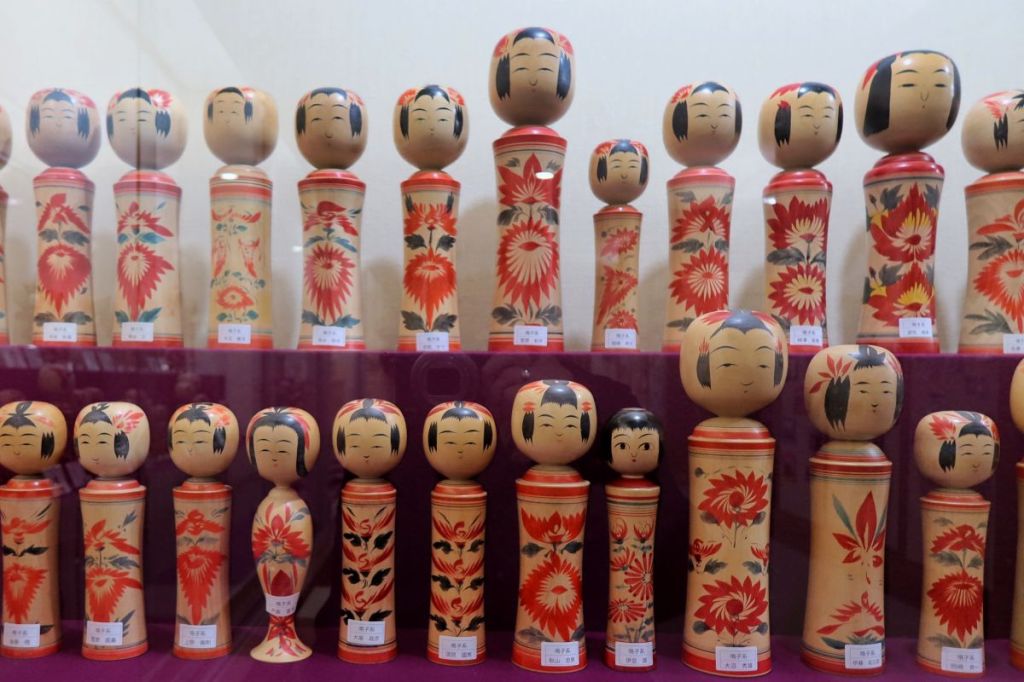
So all Naruko Kokeshi dolls will have similar features, but of course each individual craftsperson is able to add their own stylistic touches and flourishes within the limitations of their location tradition. When you are faced with a collection as big as the one housed in the museum, you can really see how each individual doll is rooted both in its place of birth but also its creator.
*
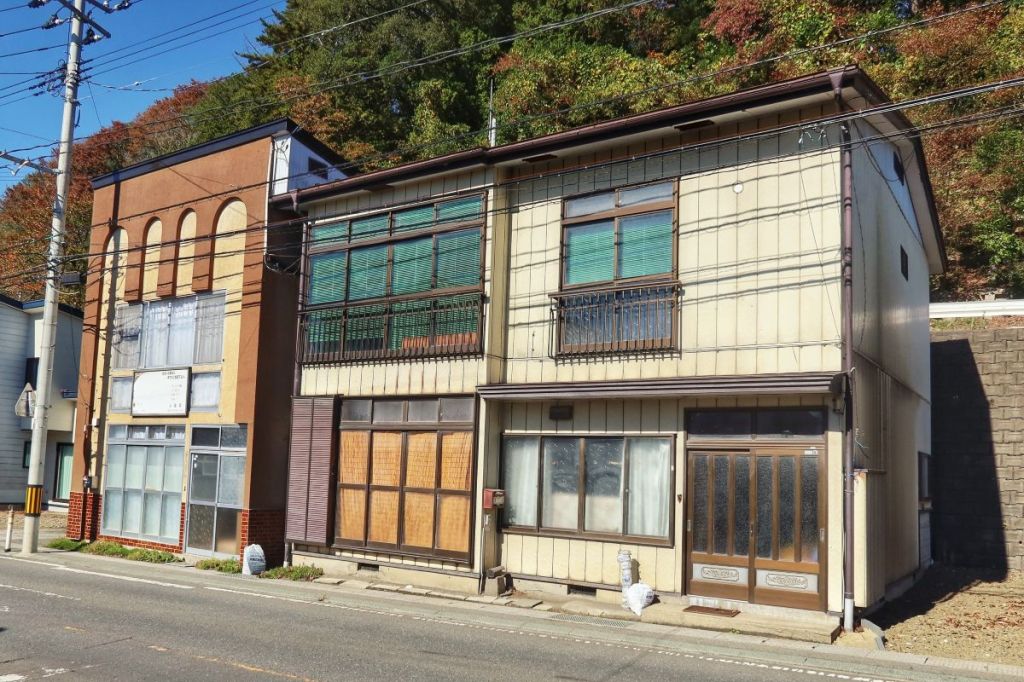
The journey overland through the Tohuku interior brings us through many smaller communities. Some seem to be thriving. Others look half-abandoned. These are places with some of the highest levels of rural depopulation, as well as an ever-aging community among those who have remained. You can see it in the empty shopfronts and overgrown yards of shuttered houses. Cracked pavements and plantlife creating natural barriers along bicycle paths that have not been used for years.
This region that makes up the north of Honshu, the biggest of Japan’s islands, has long had a reputation as being a little bit ‘out there’. A place beyond the boundaries of civilization. The writer Richard Lloyd Parry:
In ancient times, the region known as Tohoku was a notorious frontier realm of barbarians, goblins and bitter cold. Even today, it remains a remote, marginal, faintly melancholy place, the symbol of a rural tradition that, for city dwellers, is no more than a folk memory.
Tohoku accounts for about a third of the total area of Honshu but only about 10% of its people, and that proportion is falling. But for many of the Japanese that we meet or know, it is a place that is thought of somewhat fondly. For the wildness of its mountains and coastlines. For the quality of its food. For its hot spring towns, its autumn colours and winter snow, and for the fact that it offers them a glimpse at another, older version of Japan. It helps connect them to something that instinctively they know they have lost or are losing.
*
In contrast to the decline of parts of the countryside, Morioka feels like a vibrant, youthful place. We walk along a bustling Shōwa-era shopping street until we cross the river and find, on the corner facing the bridge, a lively, smokey and friendly Izakaya where we are squeezed into a table between a raucous family and cheerful group of students out for drinks on a Saturday night. Everyone is knocking back the highballs and beers, picking at small dishes that are delivered from a kitchen hatch in the corner, and we are all, including the team of young servers, having a grand old time. Sometimes you make a decision about a place in those first hours, and the first people you meet can decide a place’s reputation forever. Morioka has made a good start.
*
Mount Iwate looms over the city like a northern Mount Fuji, and we skirt its lower slopes until we reach the Hachimantai Aspite Line, famous for its snow corridors in springtime, but today more a riot of autumnal colours as we drive up through the trees on the winding road that leads to Mikaeri-tōge Pass. From there we hike up to the summit plateau where a boardwalk crosses high marshes between ponds, surrounded by stunted forest.
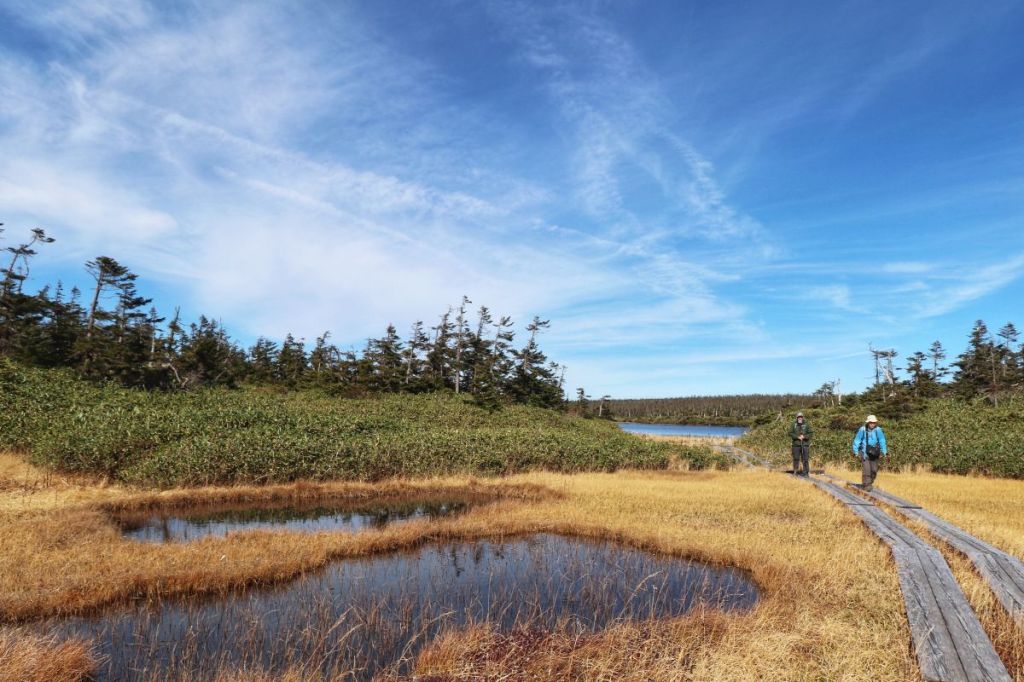
We can see the plain where Morioka sits by the river away to the south, and Iwate as our constant companion, as if carefully monitoring our progress. The only sound up here, when we pause listen, is the wind rustling the shrubs and bushes, and the jingle-jangle of the bear bells attached to the backpacks of our fellow hikers.
*
How do you like them apples? In Hirosaki, the answer is: an awful lot. This is apple country, and any drive through this corner of Aomori Prefecture is a journey through orchards that are, at this time of the year, laden with apples the size of which we have never seen before. Everywhere is busy with the harvest, and we can see workers in the fields, sorting yards filled with boxes and small open-bed trucks taking them off to wherever they will fetch the best price.
The story behind the fruit industry in this part of the world is linked to the Meiji restoration, when thousands of Hirosaki samurai were left unemployed and unable to find work. They were encouraged to grow apples, with the first saplings imported from the United States in the 1870s. Aomori has a cool climate with low average rainfall, which apparently makes it a great place to grow the fruit, and today over half of all the apples grown in Japan come from here. Two of them were picked by our own hands at the Hirosaki Apple Park.
*
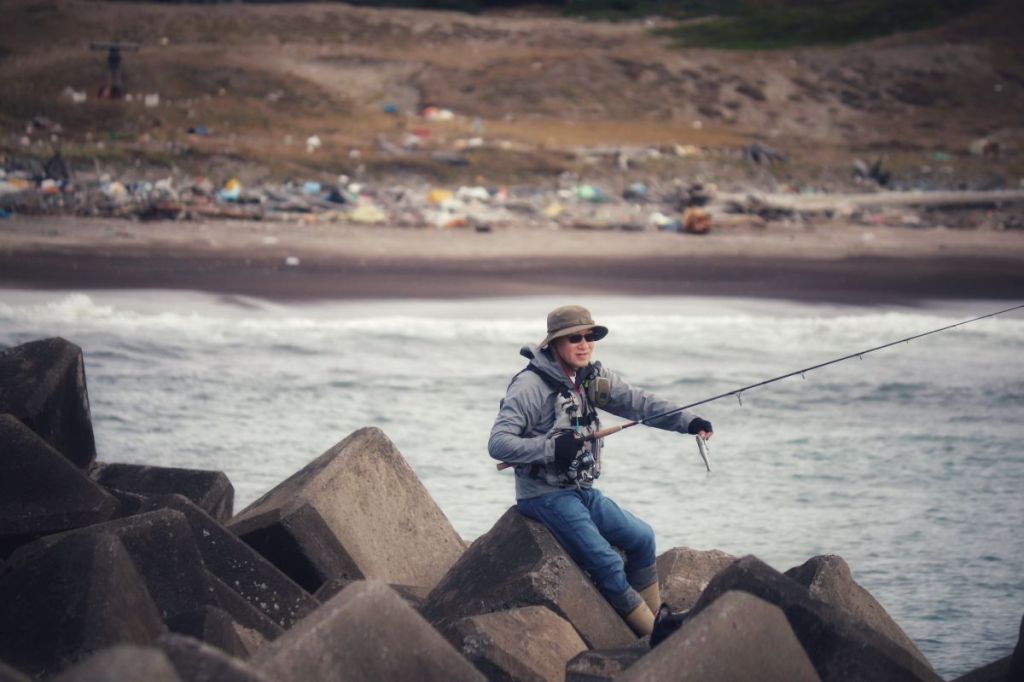
At Shariki and the nearby Takayama Inari Shrine, we reach the northernmost point of our journey. The Sea of Japan is moody and restless as we watch the fishermen work the shallows while behind them, at the foot of the sandy cliffs, is the flotsam and jetsam of global trade.
There are a thousand torii gates at Takayama, winding their way through a mix of forest and sculptured gardens beneath the main shrine. This is also the memorial site for the Cheseborough shipwreck, when an American vessel ran aground in 1889. The villagers of Shariki bravely roped themselves to each other and headed out into the waves, managing to save four of the crew, although another nineteen sadly perished. Two of the villagers ran 64 kilometres to Aomori city to bring news of the disaster, fuelled only by rice balls.
Today, on a peaceful hilltop, there is a lookout point and a memorial, dedicated to:
The people who disappeared into the rough seas
The people who survived
The people who rescued by doing their best
Now there is no one left
Only the bleat of the gulls and the sound of the sea are the same as the past
*
And perhaps the stars. Takko is the southernmost town in Aomori, famous for its garlic and attempting to forge a more positive path than many of its fellow small towns in rural Tohoku. Above the town, with a fabulous view that stretches all the way to the Pacific and unpolluted dark skies above, the Lodge Cowbell is run by Taka-san. He came to Tohoku with his wife in search of a different way of living, and has developed the lodge in what was built as a hotel thirty years ago, just as the Japanese bubble was in the process of bursting.
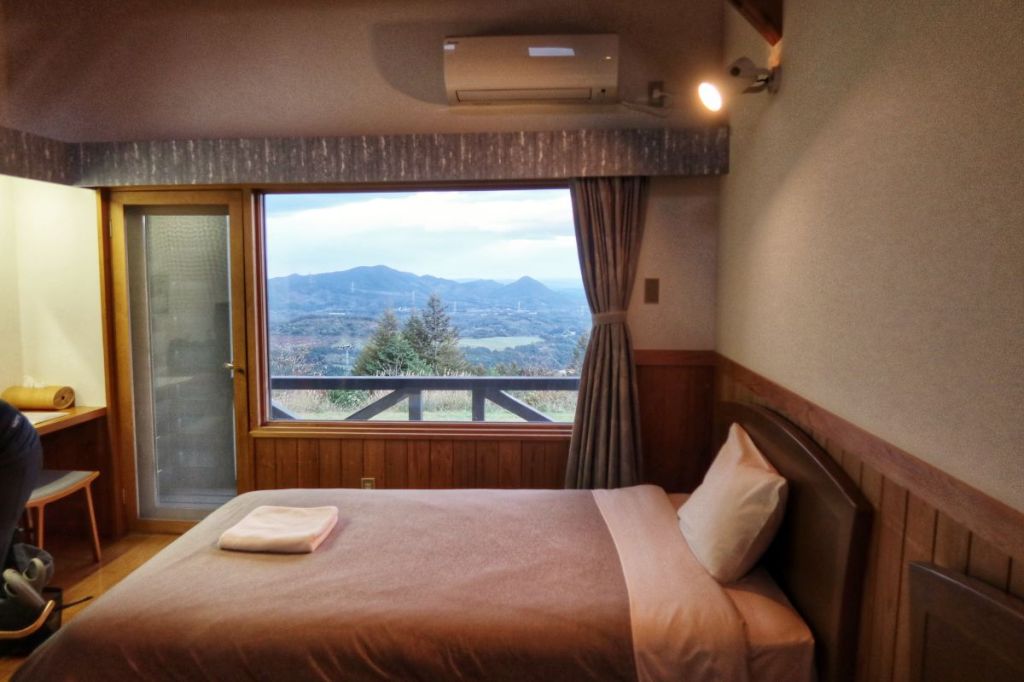
The hotel never really worked, and having been abandoned for a while, Taka and his team arrived with a new concept and have been running the six-room lodge for four years. It seems to be working out for them. A place for late nights looking at the stars, and early mornings for the sunrise across the hills.
*
It was a long and lonely road to the Lodge Cowbell, with only a couple of farmers passing in the other direction, but we got there via the drive from Hirosaki to Tsuta, down the Oirase gorge and along the shores of Lake Towada. We were not the only ones out in search of the autumn colours, and on a drive that took us from 300m above sea level up to about 1600m and then down again, we were treated to what felt like every moment in the fall journey, from the green leaves starting to turn, the bare trees just below the mountain pass, and an absolute explosion of colours in between.
*
And then: the Sanriku coast. We reached the Pacific at Kuji and then began the three day drive that would eventually take us via Matsushima back to Sendai. This is a beautiful and rugged place where, almost immediately, you are confronted with the legacy of the 2011 Great East Japan Earthquake and the devastating tsunami that hit the coastline not long after. Signs on the road tell you when you are in the ‘Past Tsunami Immersion Zone’ and lines on the buildings mark the high-water mark. Evacuation notices are everywhere, so you can always be sure where to run to should a wave like the last one ever return.
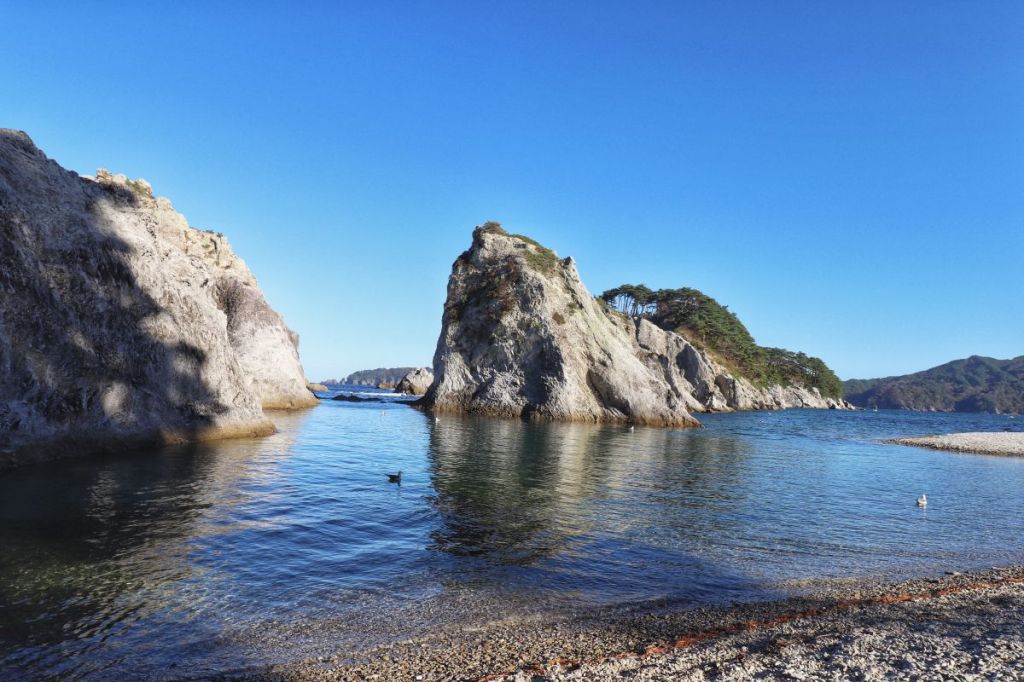
The Sanriku Fukko National Park and the 1000-kilometre Michinoku Coastal Trail were both developed in the aftermath of the earthquake and tsunami, one of the many inspiring initiatives designed to bring hope to a place that had suffered such devastation. We could also feel this in Kamaishi, an old steel town,home to one of Japan’s greatest rugby teams, and a place that lost more than a thousand of its inhabitants to the tsunami. Mostly rebuilt, it is still an industrial town, but the spirit in which its community has attempted to recover from both the tsunami but also the closure of the steel mills in the late 1980s cannot help but be inspiring.
*
There is too much sadness in the stories of Minamisanriku, where nearly 10% of its residents were killed in the tsunami, or Okawa Elementary School where 74 of the 78 children and ten of the eleven teachers present that day were lost to the wave. This coastline is a place I want to write more about in the future, but there needs to be some more time to process the stories of what happened here. For now, it is the words of the parents and community who survived the tsunami, enshrined in the ruins of the school that now stands as a memorial to what was lost, that echo now that we have left this shore behind.
There was a town here.
There were daily routines here.
There was life here.
Here, children used to run around.
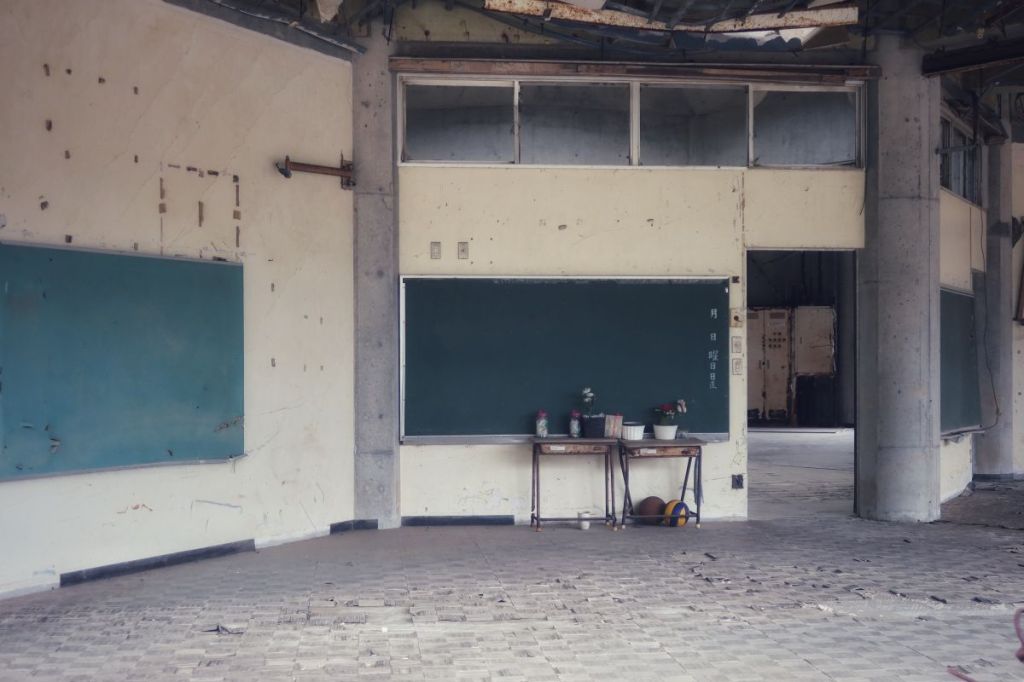
What ‘we’ who live to remember want to pass down to future generations is important. We want you to think about what it means to live with nature. We want you to think about the significance of knowing the sanctity of life. We want you to think about the importance of being prepared. We want you to think about these things with us.
*
The story of Okawa Elementary School is not only one of tragedy, but a tragedy compounded by negligence of planning and catastrophic decision-making on the day itself. There were 51 minutes in which the schoolchildren were gathered in the yard before the tsunami struck.
About a hundred metres away, a path leads up the hillside into the woods. You can see the white sign that marks the high water mark. You stand and look at it, and as black kites circle overhead, you cannot help but think that all of them would have survived if they had just been taken up the hill. All of them would have survived. All of them should have survived. The thought of it is just unbearable.
*
Our journey to the north ends at Matsushima, the bay of the pine islands and one of the iconic ‘Three Views of Japan’ that are supposedly the most beautiful places the country has to offer. And it is beautiful here, in this place where even Bashō was lost for words on his journey along the narrow road to the deep north.
Who else could have created such beauty but the great god of nature himself? My pen strove in vain to equal this superb creation of divine artifice.
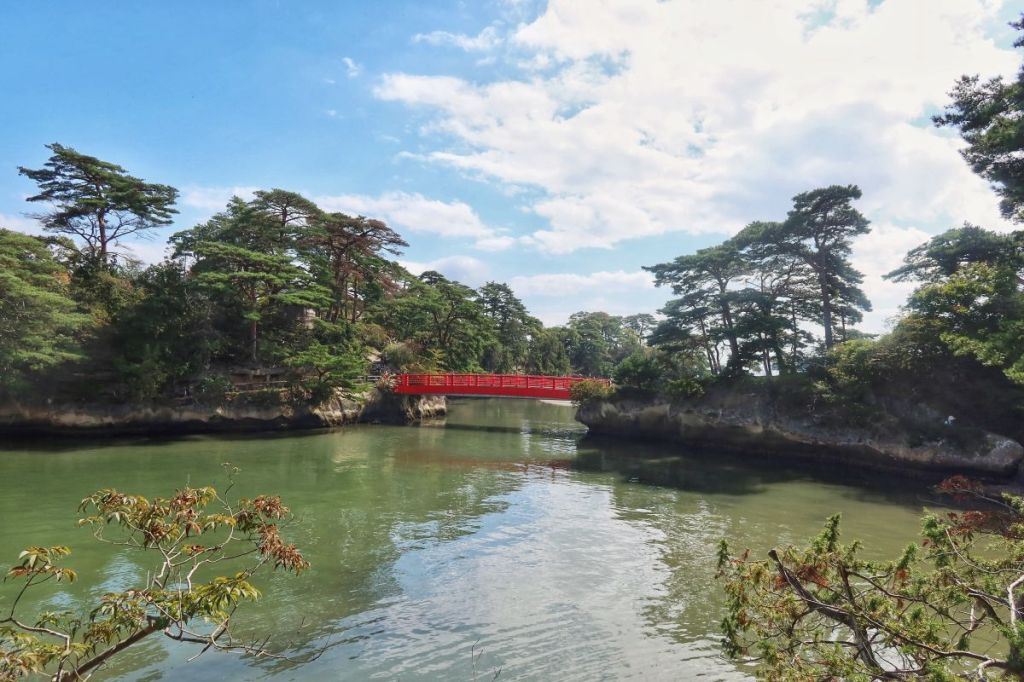
On Oshima Island you understand what he meant. You reflect on the beauty of this bay, of these islands, and as you cross the red bridge that was rebuilt having been washed away in the tsunami, you have to reckon with the coastline and all the stories of the shore, from the divine to the devastating, and the fact that is is often possible to find both in exactly the same place.
Thanks for reading,
Paul & Katrin,
Tokyo, October 2026
Over the next few months we are travelling through Japan and New Zealand, and will be sending out these newsletters from the road to everyone subscribed to The Winding Trail. We hope you enjoy these sketches from our travels.
