
A message from the little yellow house tells us that the cherry tree in the garden is about to blossom. This is both wonderful news and a bit sad, because we left only the day before and it means that we might have missed it by the time we return in a couple of weeks.
But it is the fleeting nature of these annual displays that make them so special, and it is these distinctive moments in time that can still be observed, whether it is the asparagus stand by the supermarket, the huge strawberry stalls on the streets of Berlin, the rhododendrons in the Schlosspark or the magnolia in our neighbour’s front yard, that remind us that our lives are still, just about, shaped by the seasons.
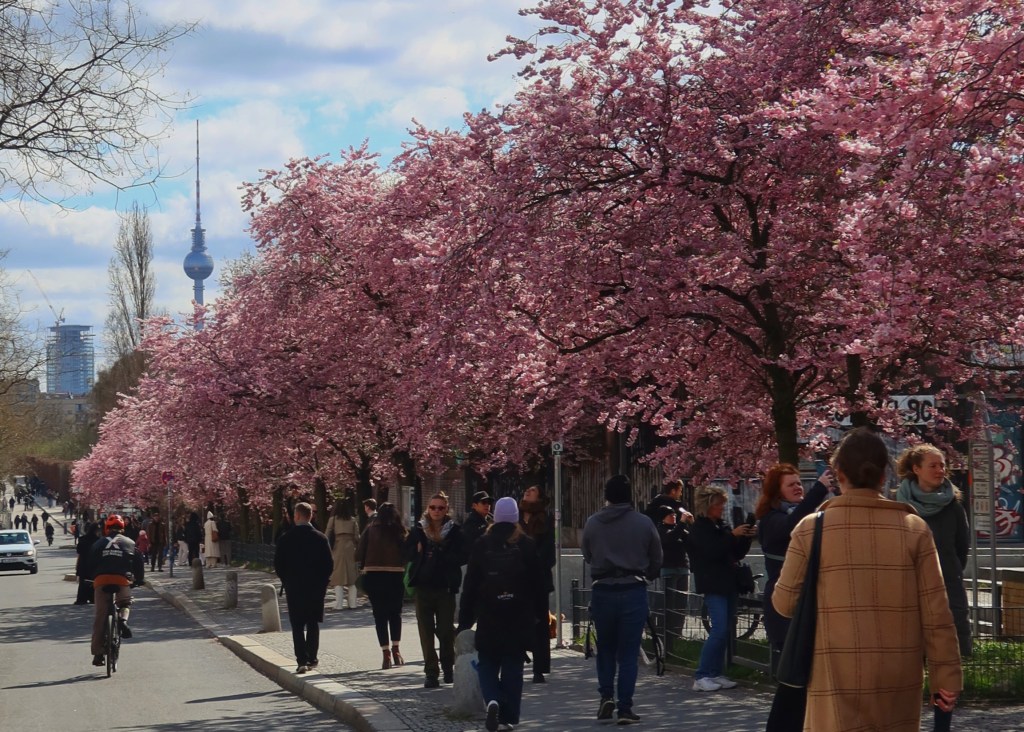
Back in Berlin, we walk from our flat to where the Berlin Wall once divided our home city in two. On Schwedter Straße, at the north end of the Mauerpark, the cherry trees are in full bloom. A little further along the Mauerweg – the trail that follows the route of the Berlin Wall for a hundred miles through and around the city – the trees at Bornholmer Straße are still holding their beauty close. We will have to wait a little longer. But if we are not careful, we might miss this display too.
There are hundreds of memorials where the Berlin Wall once stood. At the bridge on the end of our street, there is a photo display from the 9th November 1989 when this checkpoint was the first to open on the night the Wall came down. Elsewhere there are short stretches of the Wall still standing, a memorial site for longer than it was a fortified border. Walk its length through the city and around the edge you will find information boards and sound installations, plaques in the ground and on nearby walls, museums in former watchtowers and checkpoints, artworks and urban gardens, parks where people sing karaoke and grill sausages, and an old patrol road used for running, cycling and walking the dog.
But of all the sites of memory along the old border, the cherry trees are something different. After the Wall came down, the people of Japan gifted more than nine thousand trees to be planted at different places along what would become the Berlin Wall Trail and at other sites in the city. Perhaps it is because they are living things, rooted now in what was once known as “the death strip”. Perhaps it is the contrast of their colour, in comparison to a city that is often described, a little unfairly, as being grey. Perhaps it is the fact that the blossom only comes for a few days a year.
And perhaps it is because, like the footpaths and the parks, the urban gardens and the other public spaces that now occupy this former restricted zone, they bring people together at this place that once symbolised the division not only of a city and a country, but of a continent and significant parts of the rest of the world.
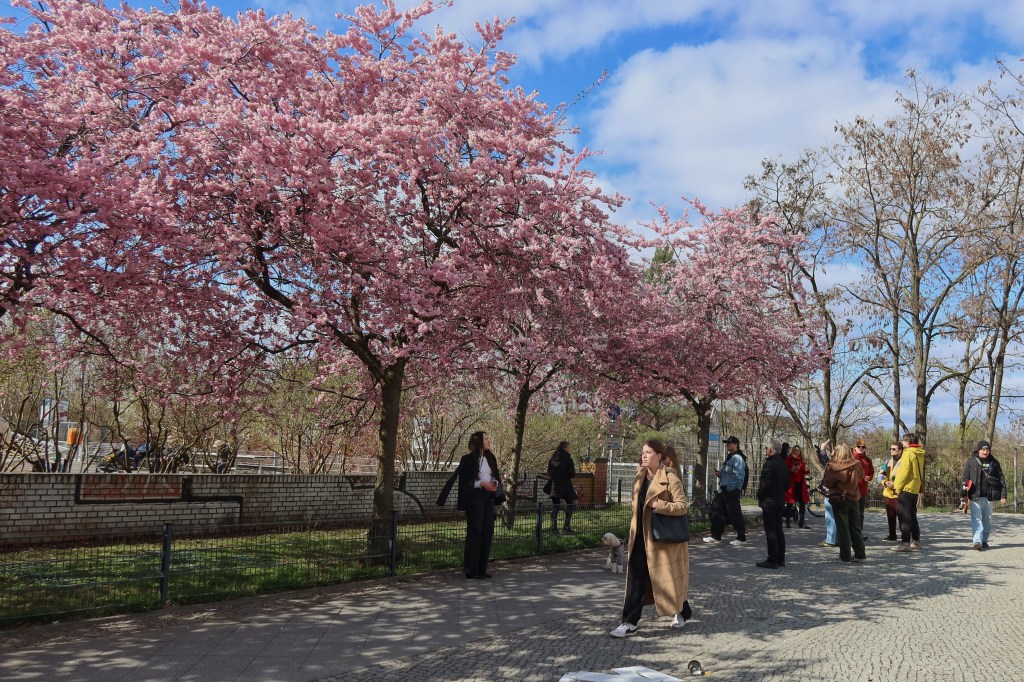
This year, the arrival of the blossom on Schwedter Straße provoked a re-reading of Jessica J. Lee’s book Dispersals: On plants, borders and belonging. Jessica is a friend of ours, a fellow Berliner, and in chapter two she tells the story of the cherry trees.
Six springtimes passed with me living there; my life in that time became more joyous than I could have imagined. Walking among the cherries was a particular pleasure. Each year, I wanted to drink in their colour and beauty, as if I could carry it through the year. Unimaginably light, they seemed frivolous even, in a city where so much once felt too heavy to hold.
Jessica’s book is a wonderfully written and thoughtful series of connected essays that tells of the linkages between the plant world and the human one, exploring the language around migration of plants and people, and her own story of movement and search of belonging. And in the chapter on the cherry trees, she also explores how the symbolism of the cherry blossom is not exactly a simple one. Japan has gifted cherry trees. But it has also planted them in occupied territories too.
The legacy of colonisation remains symbolically and intimately linked with the cherries, even as they continue to be celebrated for their beauty…
Nothing is straightforward. And nor should it be. The magic of the world, and how writers like Jessica approach it, is to understand that it is complex, that the stories it offers up are always nuanced, and all the more special for it. In Berlin, on a springtime Sunday, standing in a place where people died attempting to cross from one side of the street to another, in a crowd of happy Sunday strollers taking pictures of the beautiful cherry blossom, is a moment that both weighs heavy and yet is somehow full of hope.
Perhaps that is why this moment of every year is so special. It causes us to look both forward and back. It causes us to remember what has gone before and imagine what might be possible in the future. So maybe it is time to stop writing. To send out this newsletter, close the laptop and then leave the house. Because the blossom at Bornholmer Straße might just be out. And we wouldn’t want to miss it.
Thanks for reading,
Paul & Katrin
Berlin, April 2026
New on The Winding Trail:
“Old men loiter by the traders who have laid out their wares in the heart of a square. Holy men attempt to bless those of us with the orange scraps of paper around our necks in exchange for payment. A group of lads stroll through the scene, Adidas trainers against time-worn paving stones, Linkin Park hoodies and a confidence as thick as their baggy jeans. Hawkers hawk. Pilgrims pray. Tourists gawp.”
The restless city – Kathmandu, Nepal
Our latest guide:
“Whether you take on the full 116-km, eight stage challenge of completing the Malerweg in one go or decide to split it up into more manageable chunks, there is little question that this trail, tucked away in the sandstone mountains along the Elbe river close to the Czech border, is one of Germany’s most beautiful hiking routes. You’ll be following tracks through the forest between picturesque villages and towering rock formations, with the river itself a constant (although not always visible) companion.”
On the trail – the Malerweg, Saxon Switzerland
From the archive:
Today, the forest in much of the Kiso Valley is fast-growing cedar. But there remain patches of the five sacred trees that are still revered in this part of the world: the sawara, the asuhi, the nezuko, the koya maki and the hinoki. These trees were traditionally so important that they were protected, and could only be used for special buildings such as temples and shrines. For those who ignored their protected status, the price for unlawful felling was severe. One tree, one head. One branch, one limb.
