
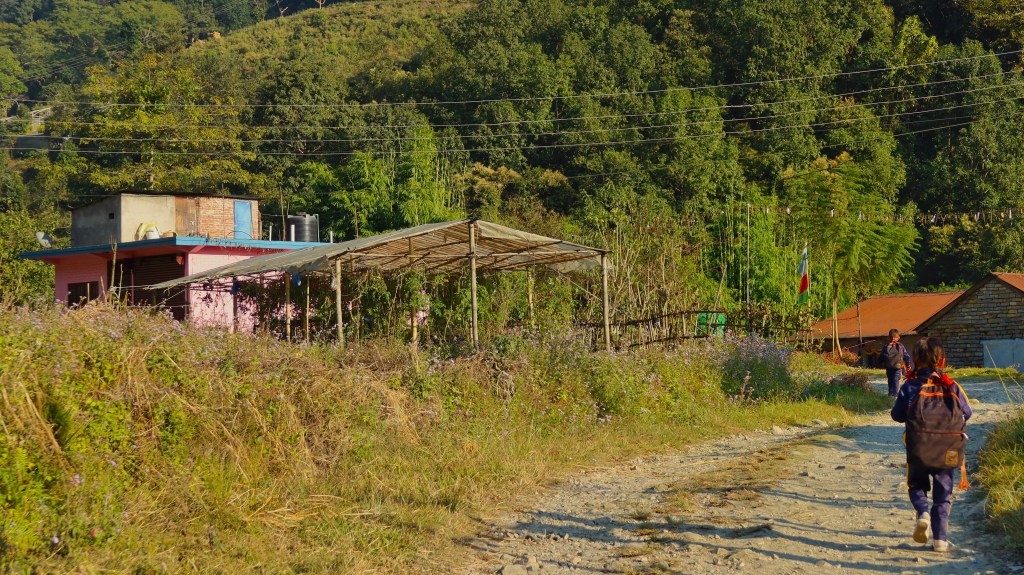
What did your walk to school look like? How about your kids? Grandkids? Katrin and I grew up on either side of the Iron Curtain, but the walk along School Lane in Burscough in northern England or across Sonnenhof in Stralsund in East Germany don’t sound all that different. A low winter sun to the east. Chestnut trees. Stone-washed denim on the adults passing by on the pavement. About ten minutes, from the front door to the school gate.
Last November we were in a small village just up the valley from Besisahar in Nepal. The village was surrounded by steep hills with dense jungle covering their slopes. In the gaps between them we could see the snowy peaks of the Himalaya. To reach the village and the school, where 174 children learn, we needed a jeep ride along a rutted, dirt road that is often damaged during the monsoon season when the river overwhelms its banks.
As we were being shown around by the English teacher from the school, he pointed up beyond the school buildings to settlements clinging to ridgelines high above in the hills. Some of the children from the school came from up there, a two-hour walk each morning and afternoon. During the monsoon, when the paths are treacherous and there is a danger of landslides, some of the kids stay in the school hostel, a series of would-be classrooms filled with beds. But the school has a number of children who live in the hostel full-time, the teachers supporting them with food and other supplies out of their own pay packets.
One solution to the long and sometimes dangerous walk to school would be to have more space for kids to stay. But with teaching space in the school already at a premium, this would only be an option if a new building could offer the school more classrooms, freeing up more rooms in the hostel building that are currently used for classes.
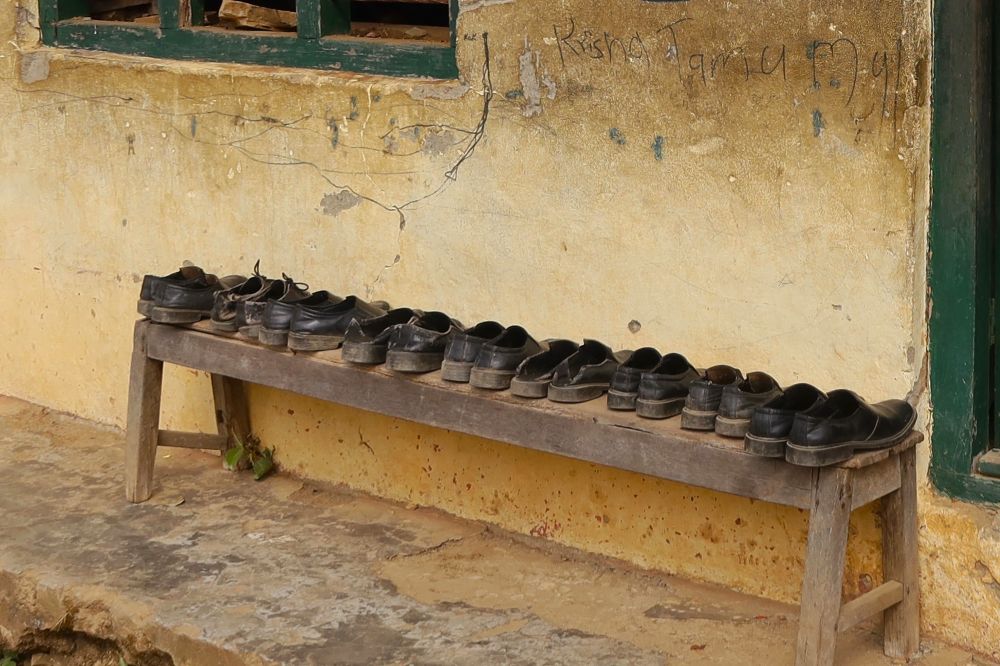
This is just one example of the type of project Pahar Trust Nepal is approached with, as schools and their communities attempt to provide better and safer spaces for their children to learn. These might be schools that want to expand for older children in the village, to reduce the need for long travel times to secondary school and to help prevent high drop-out rates. This might be repairs to buildings damaged in the 2015 earthquake or through the impact of a monsoon that is becoming ever more unpredictable due to the impact of the climate crisis. This might be early childhood development rooms to help the youngest thrive, or computer labs or libraries. New toilet blocks so children and teachers alike have safe and sanitary facilities.
This year, Pahar Trust Nepal is celebrating 35 years of improving lives through education and healthcare projects. They have worked together with local communities to create lasting opportunities and improve access to essential services for tens of thousands of people.
Working together, from Nepal to the Isle of Man, to the UK, Germany, Australia and beyond, Pahar Trust Nepal have achieved:
- 387 projects completed
- 200 new school buildings constructed or refurbished
- 126 Early Childhood Development Centres established or refurbished
- 5 hostels built
- 73 libraries created
- 11 health centres established
- 1 maternity suite built
- 33 small community projects completed
- 4 uniform distribution programmes delivered
It is probably impossible to quantify how many lives this has impacted, but a conservative estimate from the team is that the work has reached 1,470 communities, about 315,000 people including 63,000 students and 4,200 teachers in 31 districts across Nepal.
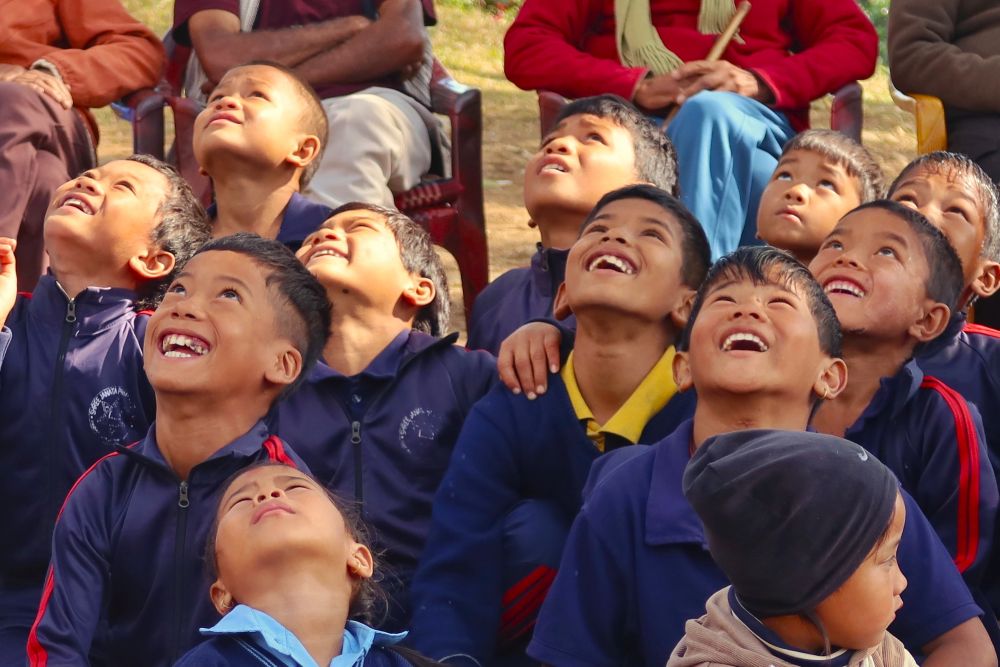
But spend any time in the country and you can see that while this is an incredible achievement, the challenges remain. During our time in Nepal we visited schools where work has been completed and schools where construction is ongoing. We also visited schools who have asked for help, but with resources limited, hard decisions already have to be made.
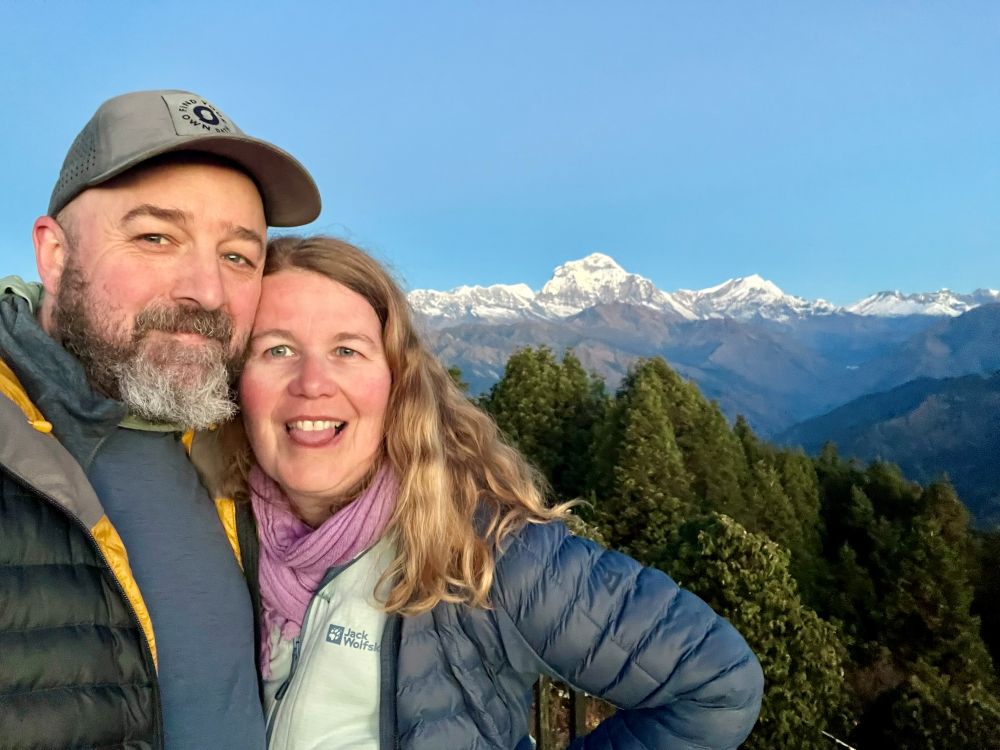
We connected with Pahar Trust Nepal thanks to Chris Hughes, a family friend who has been a tireless ambassador for the important work being done both in Nepal but also beyond, in terms of sharing stories, building awareness and raising money. We decided a few years ago to join him, which is why you are reading this and why, in the end, we ask that if you can spare something to help Pahar Trust Nepal in their work then it would be greatly appreciated.
But perhaps more than this, we have also been thinking a lot as the world seems to turn progressively darker, about purpose and how we can find hope in bleak times. When I look at what Kanta, Tek and all the team in Nepal have achieved and continue to achieve, despite the challenges of doing the work in a country where nothing comes easy, it is a reminder although it is not possible for the vast majority of us to make a difference to every problem we can see around us, whether in our local communities or on the other side of the world, there is hope and a sense of purpose in doing something, whatever feels right and purposeful to you.
Thanks for reading,
Paul & Katrin
Berlin, June 2026
New on The Winding Trail:
Our latest guide is to Wustrow on Germany’s Baltic coast, about as different a landscape to Nepal as is possible to imagine:
“We decided on Wustrow for our first Baltic guide because it is a place we return to every year, but also because it is one of the places where you can best experience the duality of this coastline: the Baltic sea on the one side, and the Bodden or the lagoon on the other. Whether it is between a peninsula such as Fischland-Darß-Zingst or an island like Usedom, the Bodden of the Baltic shore have long had both social and economic importance for the communities that live alongside them, but they also give the landscape in this part of the world a very specific identity…”
Where to go in Germany: Wustrow
More from Nepal:
A long read from Nepal where the uneven gravel roads are slowly but surely connecting the hill villages. Journeys from Pokhara with Pahar Trust Nepal:
“The road makes it easier of course. To bring equipment and supplies. As we walk the village the same topics come up in conversation. The abandoned fields. The people who have left. The possibilities of tourism. The importance of the road. About how it brings people in but also makes it easier to leave…”
Between the mountains and the river
Field notes from Kathmandu:
An exploration on foot through a city of temples and tempos, where new buildings rise alongside ancient streets, a place of new arrivals and those making plans to depart:
“These streets we are walking have been here for a long time, since before there were mopeds and water trucks, taxis and three-wheeled tempos. These are old ways. That one will take you out of the valley towards India. The one we are following now has been the trading route to Tibet for centuries. These merchant’s trails meet at the Asan crossing, site of one of Kathmandu’s oldest markets, where the temple facing the police post belongs to Annapurna, goddess of food and feeding…”
